
Commonwealth of Nations
A voluntary association of diverse states linked by diplomacy, development cooperation, and post-colonial networks
The Commonwealth of Nations is a voluntary association of mostly former British Empire territories and other member states linked by diplomacy, development cooperation, legal traditions, soft power, and shared summits.
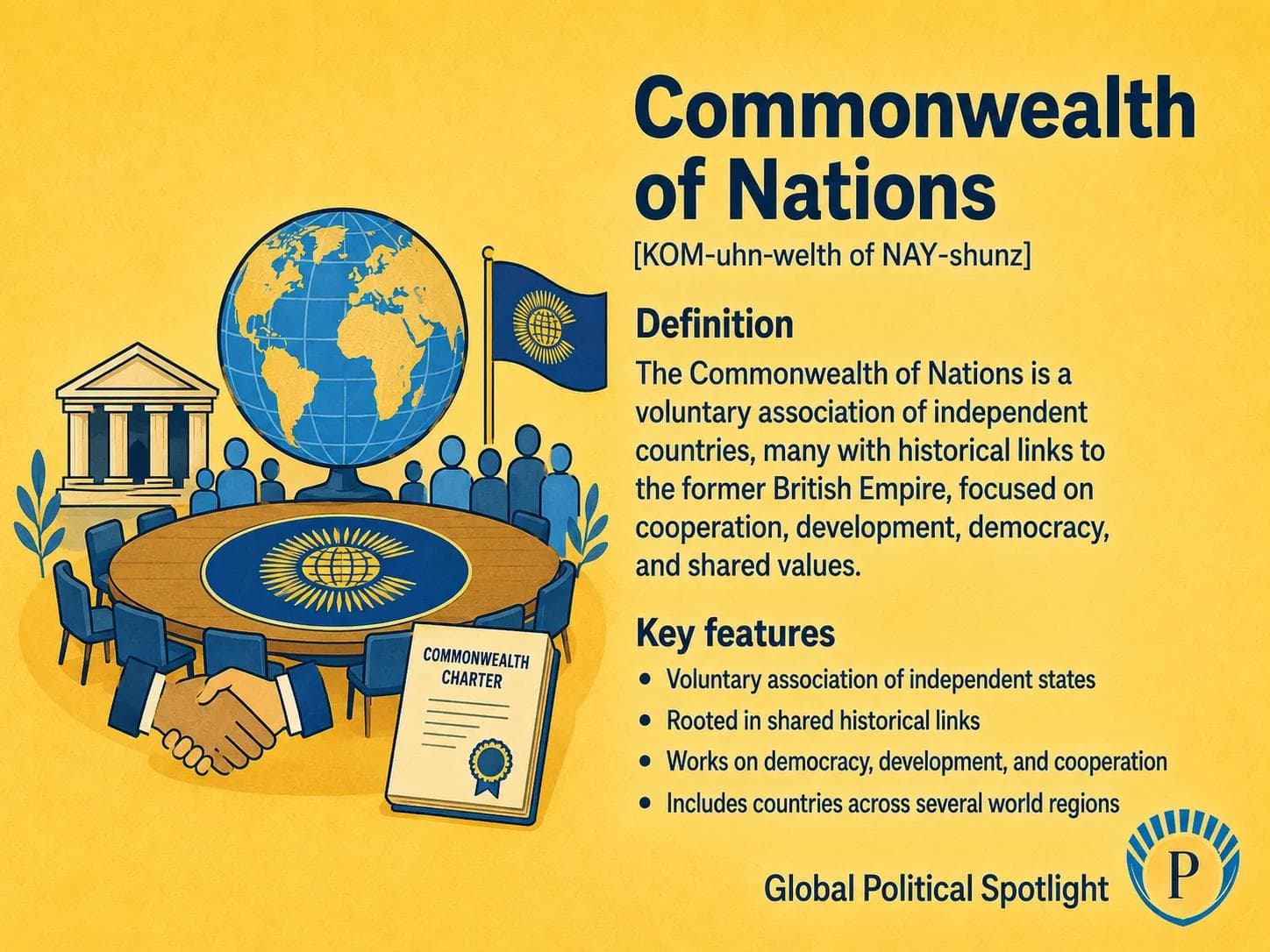
Definition
The Commonwealth of Nations is a voluntary association of independent states, most of which have historical links to the former British Empire. Its members span large and small states across Africa, Asia, the Caribbean, the Pacific, Europe, and the Americas, making it a geographically broad diplomatic network rather than a military alliance or supranational union.
The British monarch is the symbolic Head of the Commonwealth, but this role does not give the United Kingdom authority over member states. Commonwealth members cooperate through summits, ministerial meetings, technical assistance, election observation, legal and parliamentary networks, youth programs, and development initiatives.
Why It Matters
The Commonwealth matters because it is a post-colonial diplomatic network that gives many small and medium-sized states a recurring forum for visibility, development cooperation, legal exchange, and collective advocacy. It is especially relevant for small island states, climate-vulnerable countries, and governments seeking technical support rather than binding integration.
Its influence is mostly soft power. Commonwealth summits and declarations can shape norms on democracy, rule of law, development, trade, youth, climate resilience, and human rights, but implementation depends on member-state consent and political will.
GPS should track the Commonwealth of Nations as a soft-power and post-colonial diplomatic network where development cooperation, small-state advocacy, climate diplomacy, rule-of-law norms, legal traditions, migration ties, education networks, and the United Kingdom's symbolic role intersect. Key watchpoints include Commonwealth Heads of Government Meetings, membership changes, democracy or suspension decisions, climate finance advocacy by small island states, and debates over colonial legacy, monarchy, and reparations.
Key Facts
- Type
- Voluntary association of sovereign states
- Main institution
- Commonwealth Secretariat
- Headquarters
- London, United Kingdom
- Symbolic head
- The British monarch serves as Head of the Commonwealth, a symbolic role separate from the government of any member state
- Membership pattern
- Most members have historical links to the British Empire, but membership has expanded to include some states without direct British colonial ties
- Major summit
- The Commonwealth Heads of Government Meeting, known as CHOGM, is the main leaders' summit
- Core areas
- Development cooperation, democracy, rule of law, education, youth, climate resilience, small-state support, and diplomatic networking
- Strategic relevance
- Soft power, post-colonial networks, small-state diplomacy, legal traditions, and climate and development advocacy
FAQ
What is the Commonwealth of Nations?
The Commonwealth of Nations is a voluntary association of sovereign states. Most members have historical links to the former British Empire, but the organization is now a diplomatic and development network rather than an imperial structure.
Is the Commonwealth controlled by the United Kingdom?
No. Commonwealth members are sovereign states. The United Kingdom is one member, and the British monarch's role as Head of the Commonwealth is symbolic rather than a source of governing authority over members.
What does the Commonwealth do?
The Commonwealth supports cooperation on development, democracy, rule of law, youth, education, climate resilience, small-state advocacy, election observation, and technical assistance. It also provides a regular diplomatic forum for member governments.
What is CHOGM?
CHOGM stands for Commonwealth Heads of Government Meeting. It is the main summit where leaders from Commonwealth member states meet to discuss shared priorities, issue declarations, and set the association's agenda.
Why does the Commonwealth matter geopolitically?
It matters because it connects states across many regions through post-colonial ties, legal and educational networks, development cooperation, and soft-power diplomacy. It is especially relevant for small states seeking visibility on climate, finance, and development issues.
Are all Commonwealth countries monarchies?
No. Some Commonwealth members are realms that share the British monarch as head of state, but many are republics or have their own monarchs. Membership in the Commonwealth does not require having the British monarch as national head of state.
Recent Developments
The Commonwealth admitted Gabon and Togo
Commonwealth leaders admitted Gabon and Togo as new members at the 2022 Commonwealth Heads of Government Meeting in Rwanda, illustrating the association's ability to expand beyond states with direct British colonial ties.
Commonwealth SecretariatCommonwealth leaders met in Samoa for CHOGM
The 2024 Commonwealth Heads of Government Meeting in Samoa highlighted small-state priorities, climate vulnerability, development cooperation, and the continuing diplomatic role of the Commonwealth across diverse regions.
Commonwealth SecretariatSources6 references
- Commonwealth Secretariat
Official Commonwealth website with information on membership, institutions, priorities, and programmes.
- Commonwealth Secretariat Membership
Official source for Commonwealth member countries and membership information.
- Commonwealth Charter
Official Charter setting out Commonwealth values and principles.
- Commonwealth Heads of Government Meeting
Official Commonwealth source on CHOGM, the main summit of Commonwealth leaders.
- The Royal Family
Official explanation of the British monarch's symbolic role as Head of the Commonwealth.
- Encyclopaedia Britannica
Reference overview of the Commonwealth's history, membership, and institutional development.

GPSNews App
Read GPSNews on iPhone
Daily geopolitical briefings, government updates, and prediction signals in one focused app.
Newsletter
Stay Ahead Of The Next Signal
Get briefings in your inbox when new analysis and reports are published.