
Tsar Bomba
The Soviet thermonuclear test that became the largest nuclear explosion in history
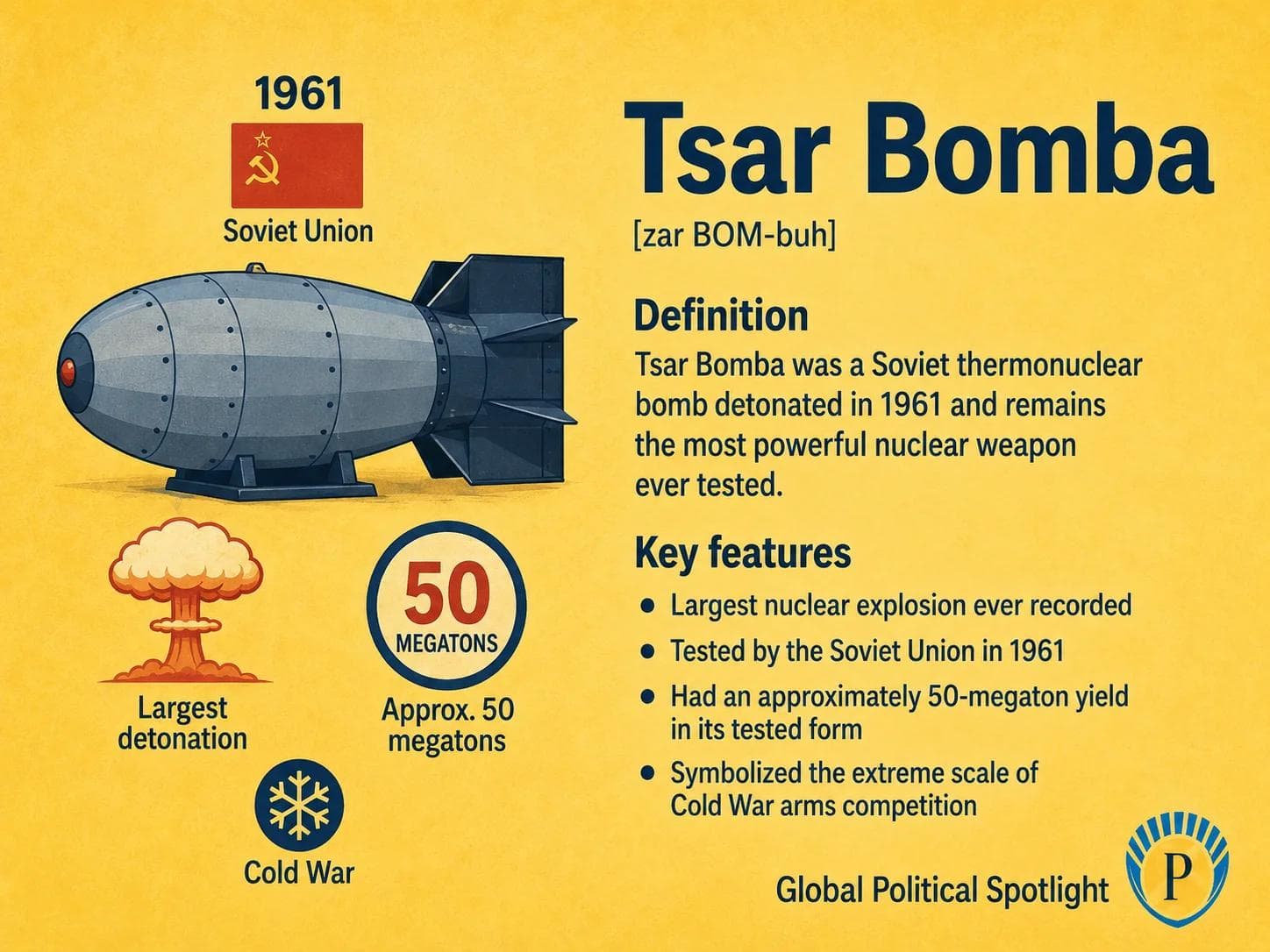
Tsar Bomba was a Soviet thermonuclear bomb detonated over Novaya Zemlya on October 30, 1961, with an approximate yield of 50 megatons, making it the most powerful nuclear weapon ever tested.
Definition
Tsar Bomba was the nickname given to the Soviet RDS-220 thermonuclear bomb tested on October 30, 1961, over Novaya Zemlya in the Arctic. With an approximate yield of 50 megatons, it is widely recognized as the most powerful nuclear weapon ever detonated.
The test took place during a tense phase of the Cold War, when the Soviet Union and the United States were competing over nuclear capability, strategic reach, and political credibility. Although Tsar Bomba demonstrated extraordinary explosive power, its size and delivery requirements made it more important as a political and symbolic demonstration than as a practical deployed weapon.
Why It Matters
Tsar Bomba matters because it became the clearest symbol of how far Cold War nuclear competition could go when states treated destructive capacity as a measure of power. Its scale helped shape public understanding of nuclear danger and reinforced the political urgency of nuclear test limitations.
The test remains geopolitically relevant because it illustrates the relationship between weapons technology, prestige, deterrence signaling, and arms-control pressure. It is often used as a reference point in discussions of nuclear escalation, nuclear taboo, atmospheric testing, and the risks of arms racing.
GPS should treat Tsar Bomba as a historical reference point for nuclear symbolism, Cold War arms competition, and the politics of deterrence signaling. It is useful for explaining why nuclear capability is not only a technical matter but also a tool of prestige, coercive messaging, domestic political theater, and arms-control mobilization.
Key Facts
- Type
- Thermonuclear weapons test
- State actor
- Soviet Union
- Test date
- October 30, 1961
- Test location
- Novaya Zemlya, an Arctic archipelago used by the Soviet Union for nuclear testing
- Approximate yield
- About 50 megatons of TNT equivalent
- Historical status
- Widely known as the most powerful nuclear weapon ever tested
- Delivery method
- Dropped from a modified Soviet Tu-95 bomber during the test
- Strategic meaning
- Served primarily as a Cold War demonstration of nuclear capability and political signaling
FAQ
What was Tsar Bomba?
Tsar Bomba was a Soviet thermonuclear bomb tested on October 30, 1961. It produced an approximate yield of 50 megatons and remains the most powerful nuclear weapon ever detonated.
Where was Tsar Bomba tested?
Tsar Bomba was tested over Novaya Zemlya, an Arctic archipelago used by the Soviet Union as a nuclear test site.
Why is Tsar Bomba important?
Tsar Bomba is important because it symbolized the extreme scale of Cold War nuclear competition. It showed that nuclear weapons could be used not only for military planning but also for political signaling and prestige.
Was Tsar Bomba ever used as an operational weapon?
No. Tsar Bomba is best understood as a test and demonstration weapon. Its enormous size and delivery limitations made it impractical compared with smaller, more deployable nuclear weapons.
How powerful was Tsar Bomba?
Tsar Bomba's yield is commonly described as approximately 50 megatons of TNT equivalent. That made it far larger than the nuclear weapons used in 1945 and the largest nuclear detonation in history.
How did Tsar Bomba affect nuclear arms control?
The test did not by itself create arms-control agreements, but it became part of the broader context that increased concern about atmospheric nuclear testing and helped strengthen political pressure for limits on nuclear tests.
Sources5 references
- Comprehensive Nuclear-Test-Ban Treaty Organization
Institutional reference source discussing nuclear testing and yield comparisons, including the 1961 Soviet Tsar Bomba test.
- Nuclear Museum / Atomic Heritage Foundation
Reference history of Tsar Bomba, its yield, Soviet testing context, and Cold War significance.
- The National WWII Museum
Historical explainer on Tsar Bomba as the largest atomic test in world history.
- United Nations Office for Disarmament Affairs
Institutional background on nuclear weapons, disarmament, and international nuclear-risk governance.
- Comprehensive Nuclear-Test-Ban Treaty Organization
Institutional background on the global treaty framework seeking to prohibit nuclear test explosions.

GPSNews App
Read GPSNews on iPhone
Daily geopolitical briefings, government updates, and prediction signals in one focused app.
Newsletter
Stay Ahead Of The Next Signal
Get briefings in your inbox when new analysis and reports are published.