
Stuxnet
A landmark industrial malware case that showed cyber operations could create physical effects
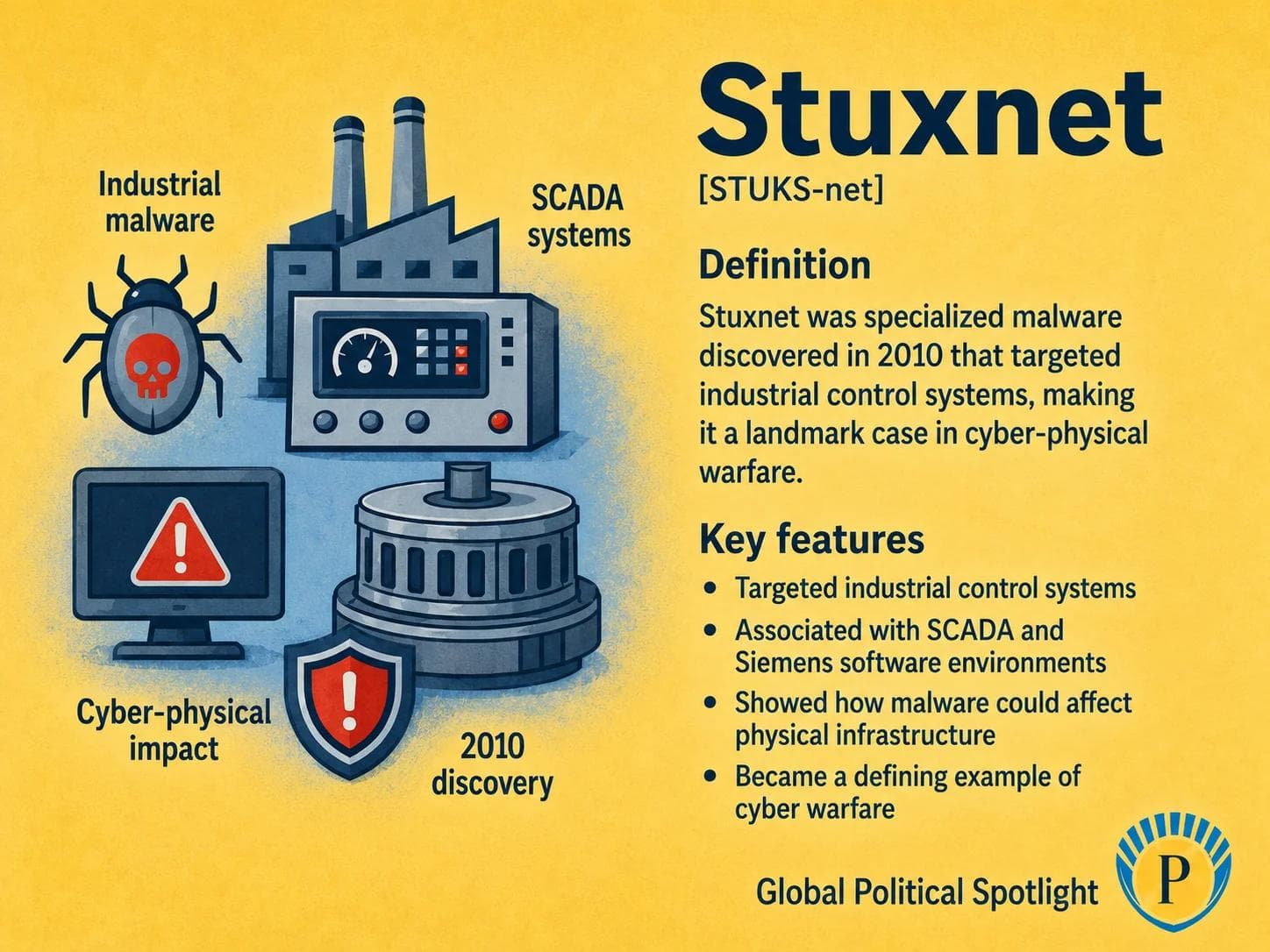
Stuxnet was specialized malware discovered in 2010 that targeted industrial control systems, especially Siemens systems linked to centrifuge operations, and became a landmark example of cyber-physical warfare.
Definition
Stuxnet was a highly specialized computer worm publicly discovered in 2010 that targeted industrial control systems rather than ordinary consumer or business data. It is widely associated with attacks on Siemens control systems connected to centrifuge operations in Iran's nuclear program.
The malware became historically significant because it crossed the boundary between cyberspace and physical infrastructure. Instead of only deleting files or stealing information, Stuxnet was designed to manipulate industrial processes while hiding abnormal behavior from operators.
Although attribution has been widely reported in open sources, governments have not publicly confirmed all operational details. For geopolitical analysis, Stuxnet is best understood as a landmark case showing how cyber tools can affect strategic infrastructure.
Why It Matters
Stuxnet matters because it demonstrated that malware could be engineered to affect physical machinery, not just digital information. This changed how governments, militaries, companies, and critical infrastructure operators think about cyber risk.
It also shaped debates over cyberwarfare, covert action, escalation, and the protection of industrial control systems. Power grids, factories, pipelines, water systems, transport networks, and nuclear facilities all depend on control systems that can become geopolitical targets.
GPS should monitor Stuxnet as a reference case for cyber-physical operations, industrial control system security, covert cyber activity, and escalation risks around critical infrastructure. Its long-term importance lies less in the original malware itself and more in how it normalized strategic thinking about cyber tools that can produce physical effects.
Key Facts
- Type
- Specialized industrial control system malware
- Discovered
- Publicly identified in 2010
- Target environment
- Industrial control systems, including Siemens SCADA and PLC-related environments
- Strategic context
- Widely associated with disruption of centrifuge operations linked to Iran's nuclear program
- Main significance
- Landmark example of malware designed to create physical effects through digital manipulation
- Cyber domain
- Operational technology security, SCADA systems, programmable logic controllers, and cyber-physical infrastructure
- Policy relevance
- Raised questions about cyber norms, state responsibility, covert action, and critical infrastructure protection
- Assessment limit
- Some operational details and attribution claims remain based on public reporting and expert analysis rather than full official disclosure
FAQ
What was Stuxnet?
Stuxnet was specialized malware discovered in 2010 that targeted industrial control systems. It is best known for its association with centrifuge operations in Iran's nuclear program and for showing that cyber operations can have physical effects.
Why is Stuxnet important?
Stuxnet is important because it became a landmark example of cyber-physical warfare. It showed that malware could be designed to manipulate industrial machinery, not only steal information or disrupt ordinary computers.
What are SCADA systems?
SCADA systems are supervisory control and data acquisition systems used to monitor and control industrial processes. They are common in sectors such as energy, manufacturing, water, transport, and other critical infrastructure.
Did Stuxnet target nuclear infrastructure?
Stuxnet is widely associated with Iran's nuclear program, particularly centrifuge-related systems. Public accounts describe it as malware designed to affect industrial equipment used in sensitive nuclear-program infrastructure.
Was Stuxnet a cyber weapon?
Many analysts describe Stuxnet as a cyber weapon because it was highly targeted, technically sophisticated, and designed to influence physical equipment. However, legal and political labels can depend on attribution, intent, and the framework being applied.
What did Stuxnet change about cybersecurity?
Stuxnet made industrial control system security a central issue in national security. It encouraged governments and operators to treat factories, power systems, pipelines, and other operational technology as potential cyber targets.
Sources6 references
- CISA - Stuxnet Malware Mitigation
U.S. government cybersecurity alert on Stuxnet mitigation and industrial control system risk.
- CISA - Industrial Control Systems
Official U.S. government reference on industrial control systems and critical infrastructure cybersecurity.
- NIST - Guide to Operational Technology Security
Official U.S. standards reference for operational technology and industrial control system security.
- IAEA - Nuclear Security Series
Institutional source for nuclear security guidance, including protection of sensitive nuclear-related systems.
- Symantec - W32.Stuxnet Dossier
Detailed technical analysis of Stuxnet by a major cybersecurity research organization.
- Council on Foreign Relations - Cyber Operations Tracker
Reference database for significant cyber operations and state-linked cyber activity.

GPSNews App
Read GPSNews on iPhone
Daily geopolitical briefings, government updates, and prediction signals in one focused app.
Newsletter
Stay Ahead Of The Next Signal
Get briefings in your inbox when new analysis and reports are published.