
SolarWinds Attack
A major software supply-chain compromise that exposed trusted enterprise update channels as strategic cyber targets
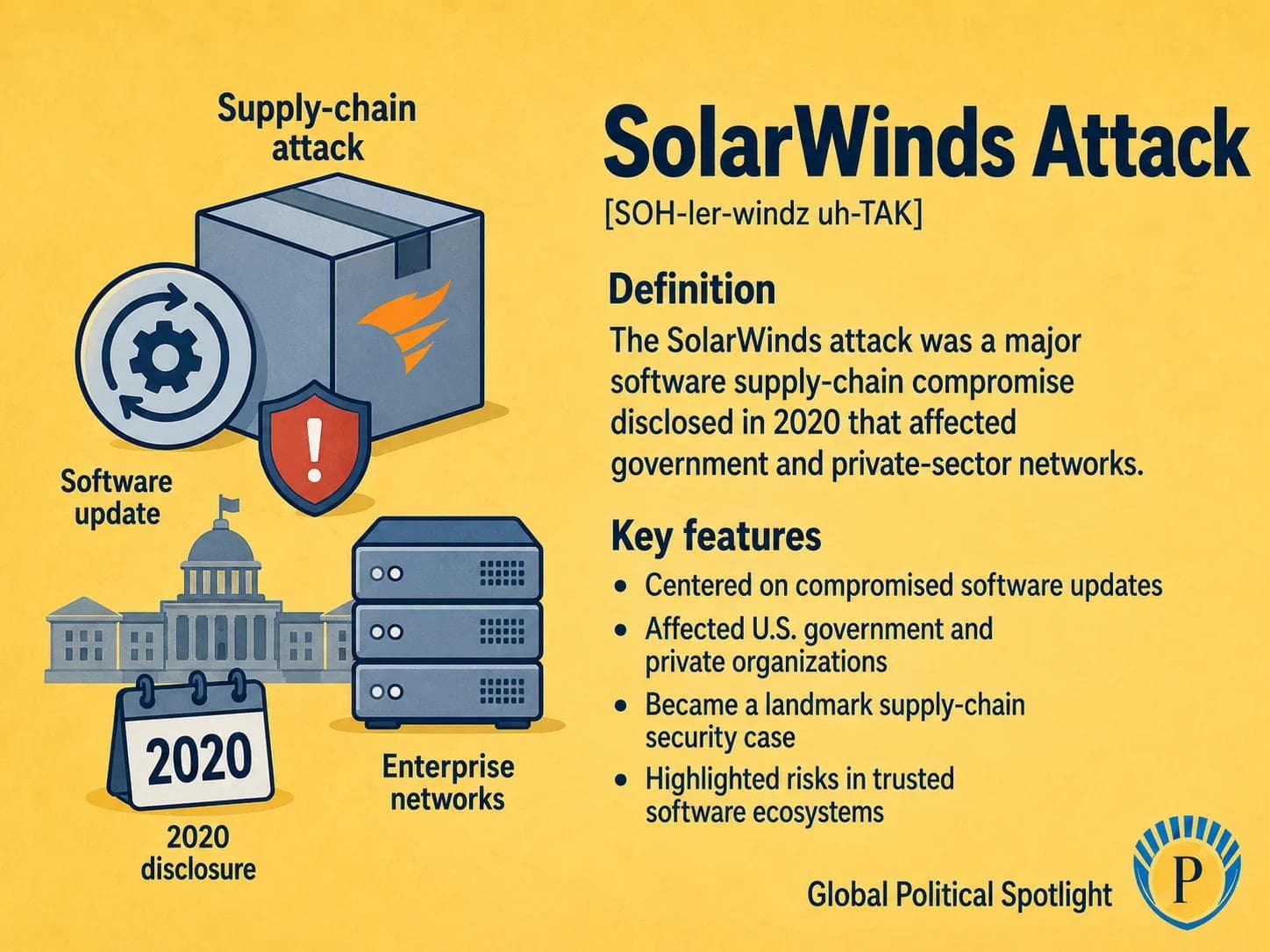
The SolarWinds attack was a major software supply-chain compromise disclosed in 2020, in which malicious code inserted into trusted Orion software updates enabled access to government and private-sector networks.
Definition
The SolarWinds attack was a major software supply-chain compromise disclosed in December 2020. Attackers inserted malicious code into updates for SolarWinds Orion, a widely used network management platform, allowing the compromised updates to reach selected government and private-sector environments.
The incident became a landmark case because it exploited trust in routine software updates rather than relying only on direct intrusion into each victim network. It highlighted how enterprise software vendors, cloud identity systems, and administrative tools can become strategic access points.
U.S. authorities attributed the campaign to Russia's Foreign Intelligence Service, while public technical reporting often refers to the malware component as SUNBURST. The case continues to shape policy debates about supply-chain cybersecurity, vendor risk, zero trust, and federal network defense.
Why It Matters
The SolarWinds attack matters because modern governments and companies depend on complex software ecosystems. If a trusted vendor update channel is compromised, attackers may gain access to many organizations at once, including highly sensitive networks.
The incident pushed cybersecurity policy toward stronger supply-chain scrutiny, software bills of materials, incident reporting, cloud identity hardening, and zero-trust architectures. It also showed how strategic cyber operations can target the invisible connective tissue of digital infrastructure.
GPS should monitor the SolarWinds attack as a reference case for state-linked software supply-chain operations, trusted vendor risk, federal cybersecurity reform, and cyber espionage against high-value networks. Its enduring relevance lies in how it changed assumptions about software trust, cloud identity, and the strategic vulnerability of enterprise technology ecosystems.
Key Facts
- Type
- Software supply-chain compromise
- Disclosed
- December 2020
- Affected product
- SolarWinds Orion network management software
- Attack method
- Malicious code inserted into trusted software updates
- Known malware name
- SUNBURST is the commonly cited name for the backdoor associated with the compromised Orion updates
- Affected sectors
- U.S. government agencies, technology firms, cybersecurity companies, and private-sector enterprise networks
- Strategic significance
- Showed that trusted software vendors and update channels can be used as pathways into many networks
- Policy impact
- Helped accelerate U.S. and allied focus on supply-chain security, zero trust, federal cybersecurity modernization, and vendor risk management
FAQ
What was the SolarWinds attack?
The SolarWinds attack was a major software supply-chain compromise disclosed in 2020. Attackers inserted malicious code into updates for SolarWinds Orion, allowing access to selected government and private-sector networks that installed the compromised updates.
Why is the SolarWinds attack important?
It is important because it showed that trusted software updates can become a strategic attack pathway. Instead of hacking every target directly, attackers can compromise a supplier and use normal update channels to reach many organizations.
What is a software supply-chain attack?
A software supply-chain attack targets the tools, code, vendors, update systems, or dependencies that organizations trust. The goal is often to compromise a supplier or product so the attack reaches downstream customers.
Who was affected by the SolarWinds attack?
The compromised Orion updates reached many customers, but the attackers appear to have selected specific high-value targets for follow-on activity. Reported victims included U.S. government agencies, technology companies, cybersecurity firms, and private enterprises.
Who was responsible for the SolarWinds attack?
The U.S. government attributed the campaign to Russia's Foreign Intelligence Service. As with many cyber operations, some technical and operational details remain based on public attribution, forensic evidence, and government assessments.
What did SolarWinds change about cybersecurity?
SolarWinds accelerated attention to software supply-chain security, vendor risk, cloud identity protection, zero-trust architecture, incident reporting, and stronger monitoring of trusted administrative tools.
Recent Developments
United States attributed the SolarWinds campaign to Russia's Foreign Intelligence Service
The U.S. government formally attributed the SolarWinds cyber campaign to the Russian Foreign Intelligence Service, framing the incident as a major state-linked cyber espionage operation against U.S. government and private-sector networks.
The White HouseU.S. executive order emphasized software supply-chain security
Executive Order 14028 on improving the nation's cybersecurity directed federal action on software supply-chain security, zero trust, incident response, and stronger standards for government technology systems after major cyber incidents including SolarWinds.
The White HouseSources6 references
- CISA - SolarWinds and Active Directory/M365 Compromise Guidance
U.S. government guidance on response to the SolarWinds Orion compromise and associated identity risks.
- CISA - Emergency Directive 21-01
Official emergency directive requiring federal agencies to mitigate the SolarWinds Orion compromise.
- The White House - Attribution and Response
Official U.S. attribution and policy response to Russian government cyber activity, including SolarWinds.
- The White House - Executive Order 14028
Executive order that advanced federal cybersecurity modernization, software supply-chain security, and zero-trust policy.
- Microsoft - Solorigate Resource Center
Technical and operational guidance from Microsoft on the SolarWinds-related campaign and identity-based intrusion activity.
- NIST - Cybersecurity Supply Chain Risk Management
Official U.S. standards reference for cybersecurity supply-chain risk management.

GPSNews App
Read GPSNews on iPhone
Daily geopolitical briefings, government updates, and prediction signals in one focused app.
Newsletter
Stay Ahead Of The Next Signal
Get briefings in your inbox when new analysis and reports are published.