What Moved the Market
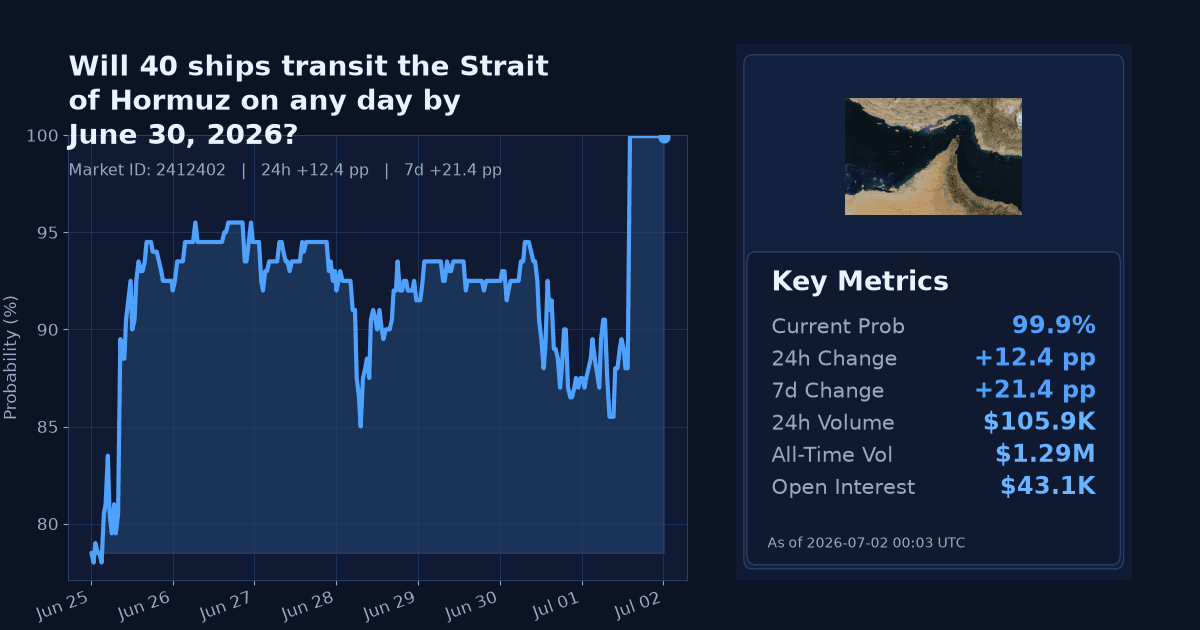
The Polymarket contract “Will 40 ships transit the Strait of Hormuz on any day by June 30, 2026?” repriced sharply higher. Over the past 24 hours, the implied probability rose 12.4 percentage points to 99.9%. Over the past week, it is up 21.4 percentage points.
The contract covers any day from June 1 to June 30, 2026, and resolves on finalized daily “transit calls” (Arrivals of Ships) for the Strait of Hormuz as reported by IMF Portwatch.
Why It Likely Moved
- Repricing appears driven by signals that shipping activity through the Strait resumed under a fragile U.S.–Iran ceasefire, with analysis noting that ships have begun transiting again, albeit amid lingering risks, according to CSIS (July 1, 2026).
- Traders likely interpreted official commentary on the recent closure’s trade impacts—and the outlook for “peace and normalisation in the Gulf”—as consistent with improving throughput conditions, referenced in an Australian government speech via the DFAT ministers’ site (June 30, 2026).
- A grounding incident reported in the strait on July 1 did not immediately indicate a persistent blockage, which markets may have read as a non‑disruptive event relative to the question’s already‑ended window, per AP News (July 1, 2026).
- Macro conditions align with easing supply stress: Brent crude is at $71.14/bbl, down 3.5% over 7 days and 25.1% over 30 days, suggesting improved oil flow sentiment that is directionally consistent with higher Hormuz throughput (source: Yahoo Finance, as of July 1, 2026).
How Strong the Move Is
By the platform’s risk metrics, this is an extreme move. The 24-hour z-score is 49.8 and the 7-day z-score is 81.8, both categorized as “extreme,” indicating a sharp repricing relative to recent trading history.
The magnitude—a 12.4 pp daily jump to near-certainty—reads as a late-window spike rather than incremental drift, consistent with markets reacting to new signals about June-end traffic conditions and/or imminent data finalization.
Cross-Market Confirmation
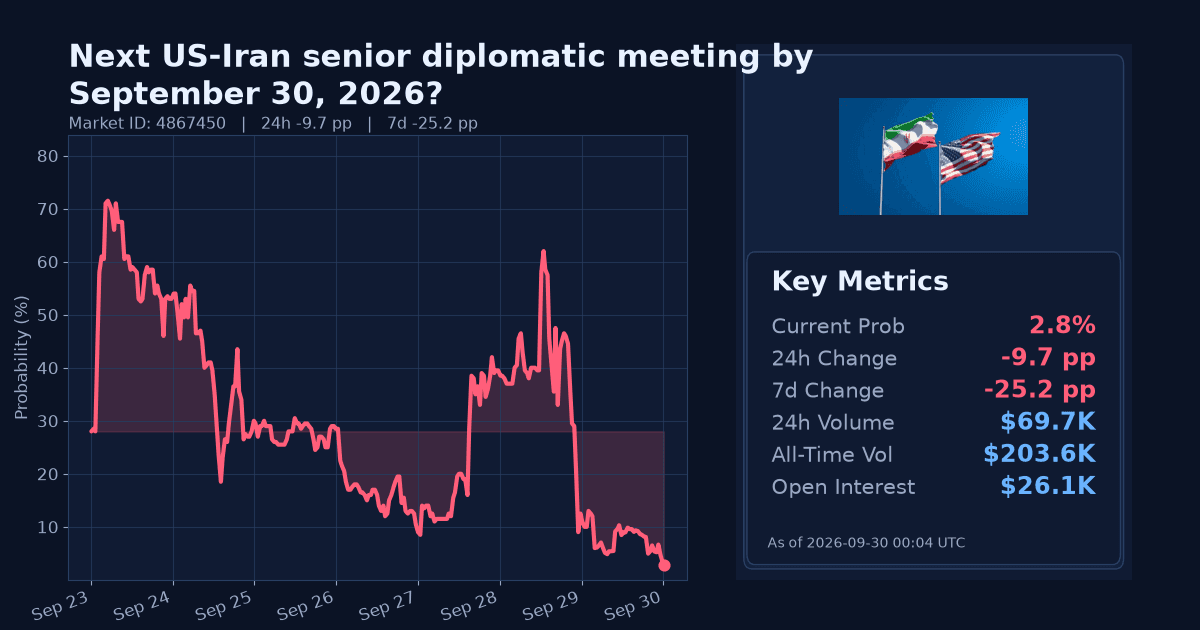
- “US-Iran Final Nuclear Deal by September 30, 2026?” rose to 30.0% (+2.5 pp 24h), a mild directional alignment with improved diplomatic tones supporting transit normalization.
- “US-Iran Final Nuclear Deal by August 31, 2026?” stands at 24.0% (no 24h/7d deltas provided), offering neutral confirmation.
- “Will Trump agree to Iranian transit fees in the Strait of Hormuz by June 30?” is at 1.5% (+0.7 pp 24h, −1.15 pp 7d), a largely divergent/irrelevant signal for immediate traffic conditions.
News & Real-World Context
- A fragile U.S.–Iran ceasefire has “allowed ships to begin transiting the Strait of Hormuz,” even as risks persist and broader energy markets only partially recover, according to CSIS (July 1, 2026).
- Iranian state TV reported a vessel ran aground on July 1 in the Strait; details were limited and no immediate broader disruption was reported by the source, per AP News (July 1, 2026).
- The Australian government highlighted the “trade impact of the closure of the Strait of Hormuz” and expressed hope for “peace and normalisation in the Gulf” to enable trade to ramp back up, in a speech published by the Department of Foreign Affairs and Trade (June 30, 2026). This official statement underscores governments’ focus on restoring flows and supporting exporters affected by the Middle East crisis.
Bottom Line
The market’s jump to 99.9% reflects a broad-based repricing toward near-certainty that at least one day in June met the 40‑transit threshold, supported by signals of resumed passage under a fragile ceasefire and easing macro oil pressures. While individual incidents still occur, current evidence points to normalization sufficient to justify the sharp move.
Market Conditions at Time of Writing
- Current Probability (%): 99.9
- 24h Change (pp): +12.4
- 7d Change (pp): +21.4
- Volume (24h, $): 105,941.57
- Open Interest ($): 43,103.62
- Spread (pp): 0.1
- Z-score (24h): 49.8