What Moved the Market
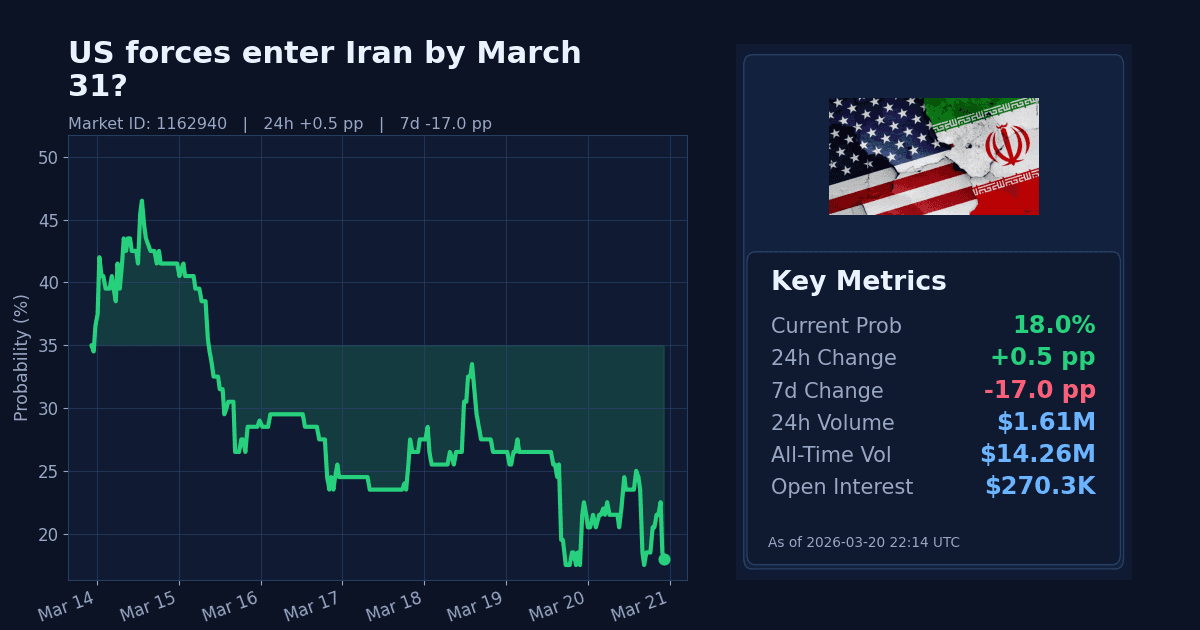
The market “US forces enter Iran by March 31?” prices the chance that active US military personnel physically enter Iran’s terrestrial territory by the end of March 31, 2026 (ET). As of March 20, the probability stands at 18%.
Over the past seven days, pricing fell by 17 percentage points. The 24-hour net move was modest at +0.5 percentage points.
Why It Likely Moved
- Repricing follows a narrowing contract window through March 31 with no consensus reporting of US troops physically entering Iran’s territory, reducing near-term odds under the market’s strict resolution criteria.
- Markets reacted to timing signals across related markets: the April 30 version prices materially higher (about 51%), implying participants see a later entry as more plausible than before month-end.
- The news flow emphasizes naval deployments and multilateral efforts to secure shipping lanes, which appears to shift focus away from imminent US ground entry within March.
- Elevated energy benchmarks (Brent near $106.77, WTI near $98.09) underscore broader conflict risk, yet this backdrop appears insufficient to sustain March-specific odds without corroborating on-the-ground reports.
How Strong the Move Is
The weekly decline of 17 percentage points is substantial and is characterized as an extreme down move relative to recent trading history (7d z-score: 4.0). That suggests a decisive weekly repricing of the near-term outcome.
Intraday, the net 24-hour change is small (+0.5pp), but a 24h z-score of 2.0 indicates activity that is sharp relative to the market’s recent range. Overall, this looks like a significant weekly markdown rather than routine noise.
Cross-Market Confirmation
- “US forces enter Iran by April 30?” trades around 51%, confirming a push-out of perceived entry timing beyond March.
- “US x Iran ceasefire by March 31?” at roughly 8% indicates low odds of a ceasefire this month, which diverges from the slide here by suggesting conflict persists even as March-entry odds fade.
- “Will the Iranian regime fall by March 31?” at about 2.1% aligns with low expectations for regime-shaking developments within the current month.
News & Real-World Context
- Coverage highlights additional US Marines and warships moving toward the Middle East amid the Iran war, alongside multinational statements about securing the Strait of Hormuz. Reporting points to a maritime-security focus.
- Israel has conducted further strikes on Tehran while Iran targets Gulf oil facilities, indicating ongoing hostilities but not confirming US troops entering Iranian territory.
- Disruptions through the Strait of Hormuz are in focus, including impacts on fertilizer shipments, and broader trade risks have been flagged, with global trade growth seen slowing in part due to the Iran war.
- Against this backdrop, energy markets remain elevated (Brent near $106.77; WTI near $98.09 over the past day), reinforcing general geopolitical risk without confirming the specific condition needed for this market to resolve “Yes” by March 31.
Bottom Line
This week’s drop reflects a timing-led repricing: traders are discounting a March 31 entry while assigning higher odds to April. The move is significant and appears short-term in nature, tied to the shrinking contract window rather than clear de-escalation.
Absent new, credible reporting of US personnel physically entering Iran’s territory, the balance of probabilities remains skewed toward “No” for this market’s window.
Market Conditions at Time of Writing
- Current Probability (%): 18.0
- 24h Change (pp): 0.5
- 7d Change (pp): -17.0
- Volume (24h, $): 1,613,699.72
- Open Interest ($): 270,333.71
- Spread (pp): 1.0
- Z-score (24h): 2.0
- Z-score (7d): 4.0
- Contract Window: Jan 11, 2026 – Mar 31, 2026 (ET)