What Moved the Market
-
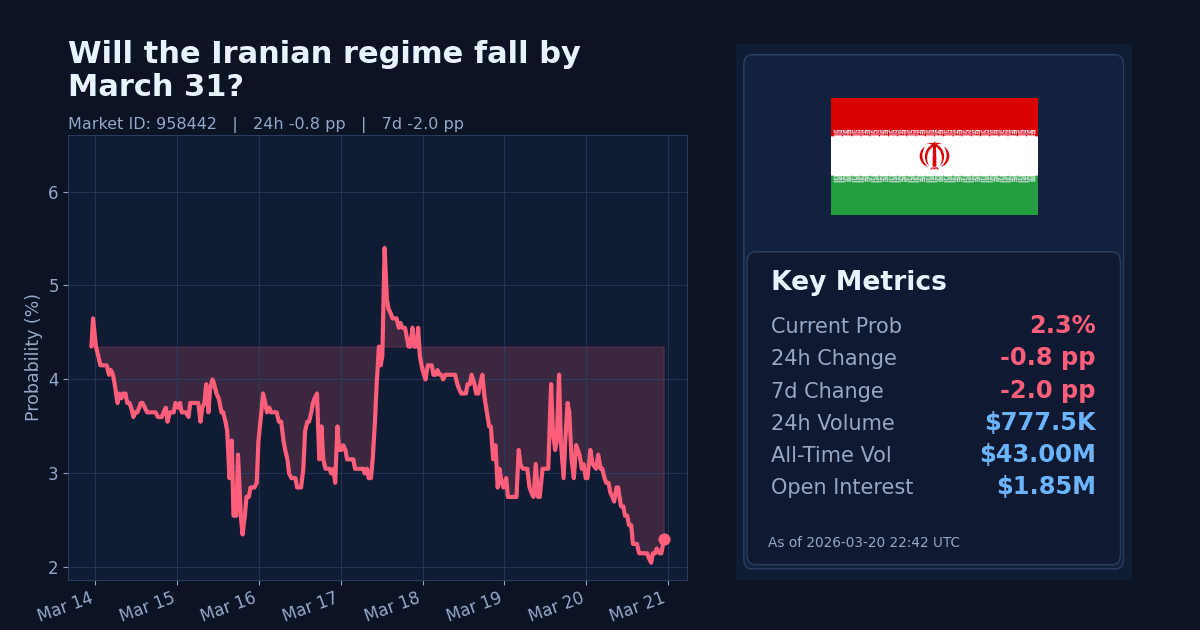
The market on whether the Islamic Republic of Iran’s ruling regime will fall by March 31, 2026 moved down, with the implied probability at 2.3% as of March 20, 2026. Over the past 24 hours, the price edged lower by 0.75 percentage points.
-
Over the past seven days, the contract declined by 2.05 percentage points. The market covers the window from December 17, 2025 through March 31, 2026, 11:59 PM ET.
Why It Likely Moved
- The repricing appears driven by the rapidly narrowing time window to March 31, reducing the likelihood of a regime fall within days.
- Markets reacted to war-related headlines that emphasize conflict intensity but do not indicate the Islamic Republic’s core governing structures imminently ceasing to exercise power by the deadline.
- Cross-market signals show higher odds for a slightly later horizon (April 30) than for March 31, suggesting traders are pushing potential timelines beyond this contract’s end date.
- Elevated energy benchmarks and shipping disruptions appear to underscore regional risk without translating into immediate regime-change signals for this timeframe.
How Strong the Move Is
-
The 24-hour change (-0.75 pp) comes with a normal 24h z-score (0.4), indicating a routine daily move given recent volatility. By contrast, the 7-day decline (-2.05 pp) carries an extreme 7d z-score (11.0), flagging an unusually sharp weekly repricing.
-
Taken together, this looks like a significant weekly de-risking into contract expiry rather than a one-day spike. The direction suggests a continuation lower as the deadline approaches, not a reversal.
Cross-Market Confirmation
- A related market on whether the regime falls by April 30 is priced materially higher (about 14%), a divergence that nonetheless aligns with a timeline push beyond March 31 for any decisive outcome.
- A market on Kharg Island no longer being under Iranian control by March 31 trades near 11%, indicating conflict and territorial risk are priced, while immediate nationwide regime loss remains discounted in this contract.
- A leadership-succession market (Hassan Khomeini as head of state by end-2026 at ~5%) signals uncertainty but does not confirm an imminent break in core regime structures before March 31.
News & Real-World Context
-
Recent headlines focus on intensified fighting: reports of Israeli strikes on Tehran and Iranian attacks on Gulf oil facilities coincide with severe disruptions in the Strait of Hormuz. Coverage also highlights that fertilizer and other shipments are being hindered, with broader trade effects discussed by international bodies.
-
Macro indicators reflect sustained stress in energy markets: Brent crude is around $106.77/bbl (up roughly 51.8% over 30 days) and WTI near $98.09/bbl (up about 50.5% over 30 days). At the same time, gold has fallen about 11% over the past week. These signals underscore elevated geopolitical and economic stakes, even as the market for immediate regime change prices the near-term outcome as unlikely.
Bottom Line
- The market has repriced lower into an extreme 7-day downside move as March 31 approaches, indicating skepticism that the Islamic Republic’s core structures will cease to govern within the remaining days.
- Despite intense conflict headlines and broader economic spillovers, the move appears short-term and timing-driven, with related markets indicating any decisive change is seen as more plausible beyond this contract’s deadline.
Market Conditions at Time of Writing
- Current Probability (%): 2.3
- 24h Change (pp): -0.75
- 7d Change (pp): -2.05
- Volume (24h, $): 777,506.13
- Open Interest ($): 1,852,014.49
- Spread (pp): 0.1
- Z-score (24h): 0.4
- Z-score (7d): 11.0