What Moved the Market
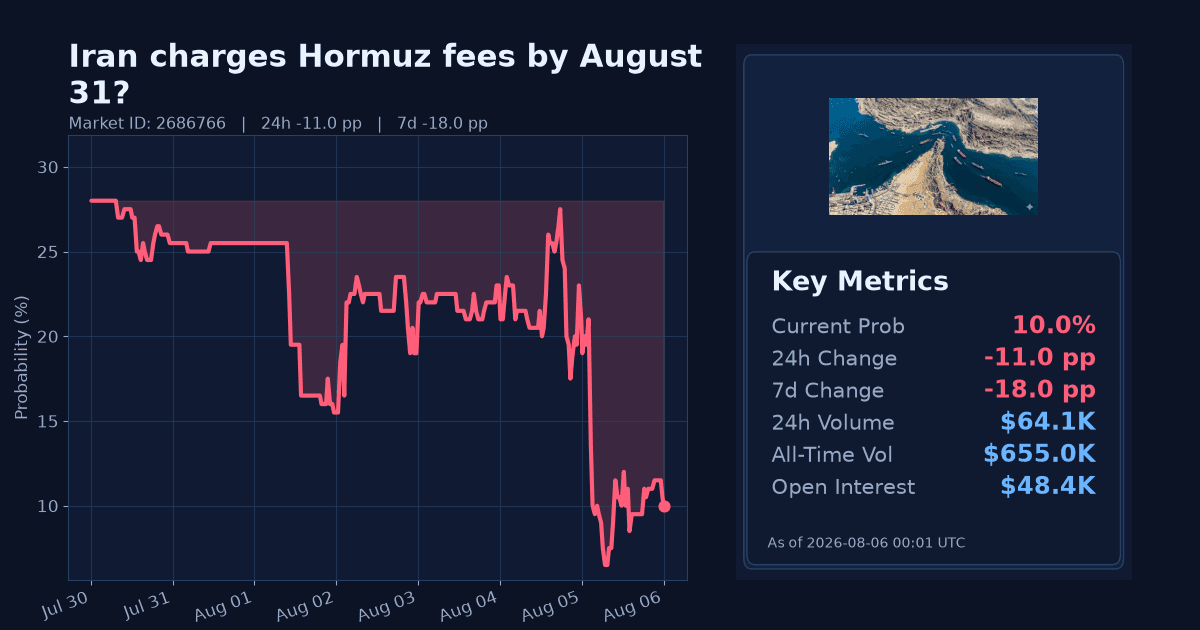
The Polymarket contract “Iran charges Hormuz fees by August 31?” tracks whether Tehran will officially announce and begin collecting mandatory charges on commercial vessels transiting the Strait of Hormuz within the window from June 25, 2026, through August 31, 2026 (11:59 PM ET). Over the past 24 hours, the market’s implied probability dropped 11 percentage points to 10%.
Over the past week, the contract is down 18 percentage points. Liquidity conditions remain active, with a 24-hour volume of $64,146.55 and open interest of $48,414.95 as of August 6, 2026.
Why It Likely Moved
- The repricing appears driven by comments reported on August 5 that a deal to reopen the Strait of Hormuz could come as early as Wednesday, according to AP News. Traders likely interpreted this as reducing the near-term likelihood that Iran would impose new mandatory transit fees before the August 31 deadline.
- Markets reacted to allied military coordination signals: the Netherlands’ Ministry of Defence announced on August 5 that Zr.Ms. De Ruyter is hosting a multinational staff to prepare for a potential Hormuz mission, per the Dutch government. Such preparation can be read as limiting space for unilateral fee measures.
- The repricing follows increased institutional attention to maritime risk in high-risk zones: on August 5, the European Parliament tabled a written question on protecting seafarers in maritime war zones, underscoring regulatory focus without indicating Iranian fee implementation.
- Macro signals are consistent with easing supply-risk premiums: Brent crude is down 12.54% over seven days to $79.36/bbl as of August 5, 04:00 UTC (source: Yahoo Finance). This coincides with the market’s move and may reflect reduced perceived disruption risk around Hormuz.
How Strong the Move Is
The 24-hour decline of 11 percentage points and the seven-day decline of 18 percentage points both register as extreme relative to recent trading history. The 24-hour z-score is 34.0 (extreme, down), and the seven-day z-score is 70.0 (extreme, down), indicating an outsized repricing.
Given the magnitude across both time frames, this looks like a significant, sustained reversal rather than noise. The pattern suggests traders are rapidly marking down the odds of Iran announcing and collecting a mandatory transit fee before August 31.
Cross-Market Confirmation
- “US announces end of Iranian blockade by August 31, 2026?” rose to 76% (+5pp 24h, +35pp 7d), indicating expectations of de-escalation; this aligns with lower odds of Iranian fee imposition.
- “Strait of Hormuz traffic returns to normal by August 31?” sits at 14% (-2pp 24h, +5pp 7d). The mixed signals (down 24h, up 7d) provide only partial confirmation.
- “Strait of Hormuz traffic returns to normal by August 15?” is at 1.5% (-1.05pp 24h, -0.65pp 7d), diverging in the near term and suggesting caution on rapid normalization.
News & Real-World Context
On August 5, AP News reported comments that a deal to reopen the Strait of Hormuz could come as early as Wednesday, amid tensions tied to the Iran war and related U.S. concerns (AP News, Aug 5, 2026). A same-day regional roundup provided additional context on evolving Middle East developments (AP News, Aug 5, 2026).
Government statements reinforced the policy and security backdrop. The Netherlands Ministry of Defence announced preparations for a potential Hormuz mission on August 5, hosting a multinational staff aboard Zr.Ms. De Ruyter — an official signal of allied readiness in the waterway (the Dutch government, Aug 5, 2026). The European Parliament on August 5 submitted a written question on protecting seafarers in maritime war zones and high-risk areas, indicating institutional attention to maritime security conditions. Separately, on August 3 the European Commission approved €20 million in aid to companies in Italy’s Friuli Venezia Giulia region facing higher input costs due to the Middle East crisis, underscoring the conflict’s economic spillovers.
These developments provide a backdrop of prospective de-escalation talks alongside allied operational planning, without any official Iranian announcement of mandatory fees — a key requirement for this market’s resolution.
Bottom Line
Traders marked down the probability that Iran will announce and begin collecting mandatory Hormuz transit fees before August 31, following signals of a potential reopening deal and visible allied coordination. The move is extreme and appears to be a sustained reversal; absent an official Iranian policy announcement and confirmation of collection, the bar for a “Yes” resolution remains high.
Market Conditions at Time of Writing
- Current Probability: 10%
- 24h Change: -11pp
- 7d Change: -18pp
- Volume (24h, $): 64,146.55
- Open Interest ($): 48,414.95
- Spread (pp): 1.0
- Z-score (24h): 34.0