What Moved the Market
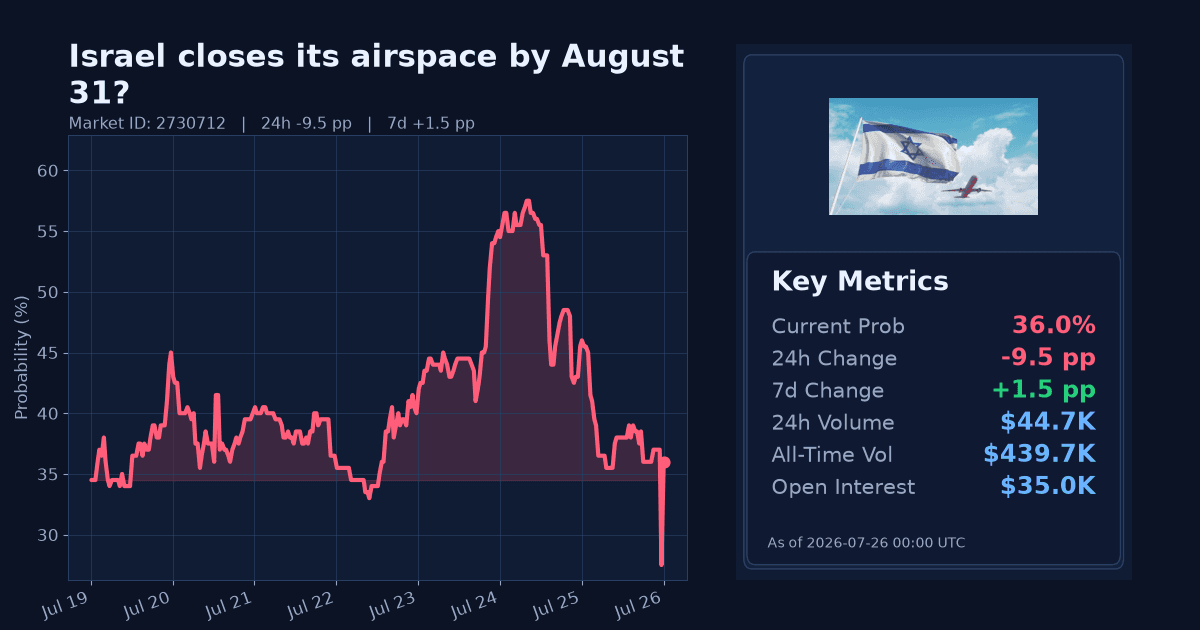
Traders cut the probability that Israel will initiate a major closure of its civilian airspace to 36%, down 9.5 percentage points over the past 24 hours. The market tracks the likelihood of a broad suspension of commercial aviation across most or all Israeli airspace.
Per the listing, the contract window spans June 29 to July 15, 2026, with trading now reflecting expectations at the time of resolution pending final adjudication.
Why It Likely Moved
- The repricing appears driven by reporting that Iran saw no new U.S. strikes on July 25, which may have eased immediate fears of rapid regional escalation, according to AP News (July 25, 2026).
- Markets reacted to the sequencing of events: the U.S. government confirmed the 13th consecutive night of strikes on Iranian military targets (July 24, 2026), followed by the July 25 report of no additional strikes, suggesting a pause that could lower the perceived likelihood of an Israeli airspace shutdown.
- The European Commission’s Oil Coordination Group stated there are “no immediate supply concerns in the EU,” a signal of limited spillover into energy logistics that can temper tail-risk pricing; see the European Commission (July 24, 2026).
- Macro context remains firm but not disorderly: Brent crude is $96.78/bbl, up 9.85% over 7 days and 28.59% over 30 days, while the VIX is 18.58, down about 1.0% over 7 days, indicating no concurrent volatility shock in broad risk assets.
How Strong the Move Is
The 24-hour drop of 9.5 percentage points to 36% registers as extreme versus recent trading, as indicated by the market’s 24h z-score. That places the move well outside typical day-to-day variance.
Over 7 days, the net change is a modest +1.5 percentage points, yet the 7d z-score also screens as extreme relative to recent history. Combined, this looks like a sharp single-day downdraft within a choppy weekly range rather than a steady, directional trend.
Cross-Market Confirmation
- “Israel closes its airspace by July 31?” fell 16.0 pp over 24h and 16.0 pp over 7d, aligning directionally with the downshift in the August-titled contract and reinforcing a broader de-rating of near-term closure risk.
- “Iran leadership change by July 31?” declined 2.6 pp over 24h and 3.55 pp over 7d, consistent with reduced expectations for abrupt political disruption.
- “Kharg Island no longer under Iranian control by July 31?” slipped 1.6 pp over 24h and 2.75 pp over 7d, further signaling lower perceived odds of acute, near-term regional upheaval.
News & Real-World Context
- On July 24, the U.S. government reported it had concluded a 13th night of strikes on Iranian military targets. The subsequent day, AP News (July 25, 2026) reported Iran’s statement that there were no new U.S. strikes, a sequence that likely contributed to lower immediate escalation expectations.
- Separately, the European Commission (July 24, 2026) said its Oil Coordination Group sees no immediate supply concerns in the EU. That assessment, alongside Brent at $96.78/bbl (+9.85% w/w), suggests elevated prices without concurrent signals of acute disruption to energy flows.
- Domestically, Israeli forces detained more than 70 suspects after deadly violence in the West Bank, with security operations ongoing, per AP News (July 25, 2026). While primarily a domestic security development, it adds context without indicating a nationwide aviation halt.
Bottom Line
Pricing for a major Israeli airspace closure moved lower in an extreme 24h downdraft, coinciding with signals of no new U.S. strikes on Iran and a steady official readout on European oil supply risks. The move looks sharp and event-driven, with limited evidence of a sustained directional trend over the week.
Market Conditions at Time of Writing
- Current Probability: 36.0%
- 24h Change: -9.5 pp
- 7d Change: +1.5 pp
- Volume (24h, $): 44,695.76
- Open Interest ($): 35,046.22
- Spread (pp): 3.0
- Z-score (24h): extreme (down)