What Moved the Market
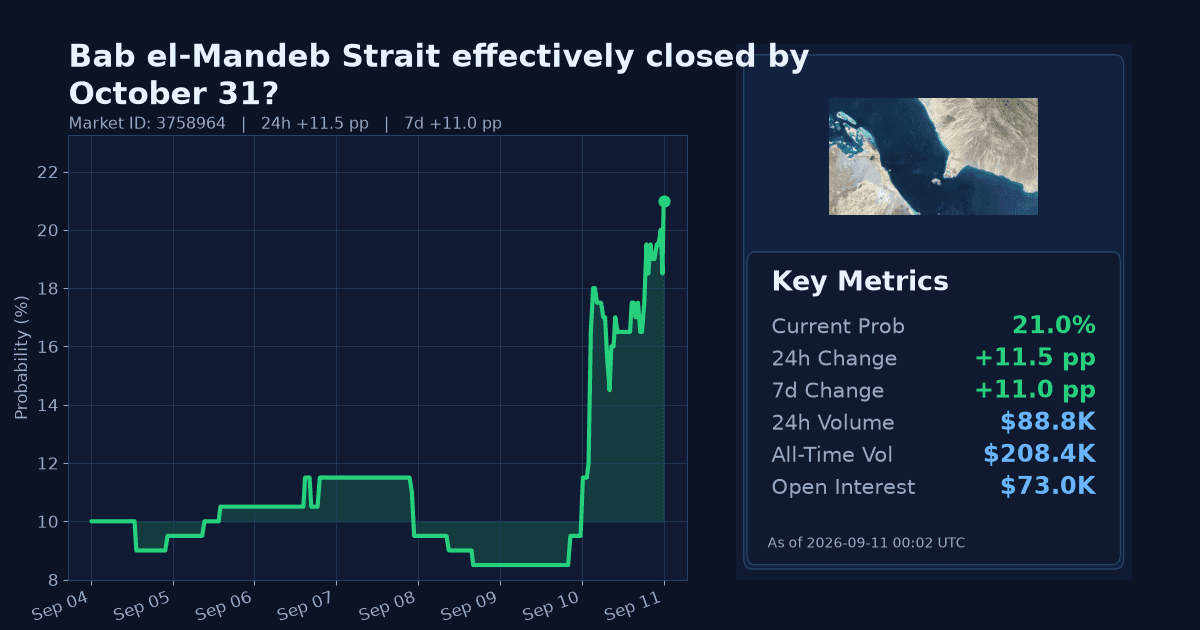
Polymarket traders repriced the “Bab el‑Mandeb Strait effectively closed by October 31?” contract sharply higher. As of Sep 11 (00:02 UTC), the implied probability rose 11.5 percentage points on the day to 21.0%.
Over the past week, the contract is up 11.0 percentage points. The market resolves “Yes” if IMF PortWatch shows a 7‑day moving average of Bab el‑Mandeb transit calls (arrivals) at or below 10 on any date between market creation (Aug 21, 2026) and October 31, 2026.
Why It Likely Moved
- Repricing appears driven by an official UK signal on Yemen: the UK Foreign, Commonwealth & Development Office issued a statement on Sept 10 regarding “the situation in Yemen” and “recent Houthi actions,” elevating attention on risks proximate to the strait (UK government, Sept 10).
- Markets also reacted to broader regional signaling: on Sept 10 the UK addressed Iran at the UN Security Council, framing nuclear concerns and the need for a negotiated path, which may have reinforced perceptions of elevated regional tension (UK government, Sept 10).
- The repricing follows a sharp move in energy benchmarks: Brent crude stands at $109.93, up about 15% over the past week and ~24% over 30 days, consistent with a higher risk premium around supply routes (Yahoo Finance).
- Broader risk appetite looks more defensive: the VIX is up ~25% week-on-week, suggesting higher cross‑asset volatility that can amplify moves in geopolitical risk markets (Yahoo Finance).
How Strong the Move Is
The 24‑hour change (+11.5 pp) and the 7‑day change (+11.0 pp) both register as extreme relative to recent trading history. The market’s 24h z‑score is 40.0 and the 7d z‑score is 42.0, indicating an outsized repricing rather than routine noise.
Given those z‑scores, this is best characterized as a sharp spike, not a gradual trend. The jump occurred with $88.8k in 24h volume and a tight 1.0 pp spread, suggesting the move was competitively priced rather than a thin print.
Cross-Market Confirmation
- Bab el‑Mandeb effectively closed by Sept 30? Up 3.5 pp (24h) and 3.0 pp (7d) to 8.9% — directionally aligned with the October contract’s risk repricing.
- Strait of Hormuz traffic returns to normal by Dec 31? Down 2.0 pp (24h) and 11.0 pp (7d) to 16.0% — a divergence in contract wording (normalization vs. disruption) but consistent with a broader theme of sustained regional maritime risk.
- Strait of Hormuz traffic returns to normal by Sept 30? Little change; down 0.65 pp (7d) to 1.6% — marginal reinforcement of skepticism about near‑term normalization.
News & Real-World Context
- On Sept 10, the UK Foreign, Commonwealth & Development Office issued a statement “on the situation in Yemen” responding to “recent Houthi actions,” an official policy communication directly relevant to shipping risk around the Bab el‑Mandeb (UK government, Sept 10).
- Also on Sept 10, the UK’s Permanent Representative addressed Iran at the UN Security Council, stating that a negotiated settlement is the only long‑term solution to the nuclear issue, an additional indicator of sustained focus on regional security dynamics (UK government, Sept 10).
Macro backdrop: Brent crude is $109.93 (+15% w/w; +24% m/m), and the VIX is 17.84 (+25% w/w), reflecting firmer energy risk premia and higher cross‑asset volatility. These conditions can sensitize markets to official security signals affecting maritime chokepoints.
Bottom Line
Implied odds for a Bab el‑Mandeb “effective closure” by Oct 31 have spiked, apparently catalyzed by UK government statements on Sept 10 and reinforced by a risk‑on energy backdrop. Whether this persists will hinge on subsequent official signals and, ultimately, IMF PortWatch transit data during the Aug 21–Oct 31 window.
Market Conditions at Time of Writing
- Current Probability: 21.0%
- 24h Change: +11.5 pp
- 7d Change: +11.0 pp
- Volume (24h, $): 88,758.89
- Open Interest ($): 73,029.38
- Spread (pp): 1.0
- Z-score (24h): 40.0