What Moved the Market
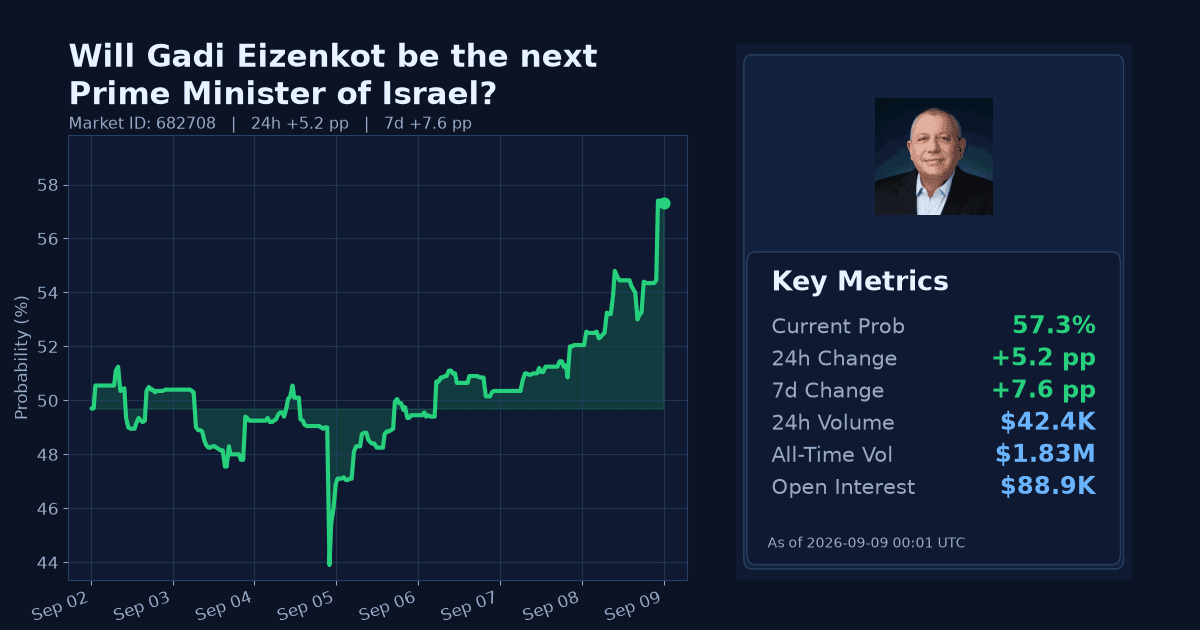
Polymarket traders increased the probability that Gadi Eizenkot will be the next Prime Minister of Israel to 57.3%. That is a 5.25 percentage point rise over the past 24 hours and a 7.6 point gain over the past week.
The contract resolves to the individual officially appointed and sworn in after Israel’s 2026 parliamentary election (scheduled for October 27, 2026) or any earlier snap election; interim or caretaker premiers do not count. Per market rules, if no prime minister is sworn in by December 31, 2027, the market resolves to “Other.”
Why It Likely Moved
- The repricing appears driven by coordinated, high-profile government actions by key partners. On September 8, 2026, Canada, the UK, and France issued a joint statement committing to ban the import of goods from West Bank settlements and to enforce targeted measures to protect a two‑state solution, signaling a concerted policy shift toward Israel’s settlement activity (the Government of Canada, 2026-09-08).
- Markets reacted to multiple UK government policy signals on the same day: the Foreign Secretary’s oral statement to Parliament on Israel‑Palestine (the UK government, 2026-09-08) and a plan to bring forward new powers targeting illegal settlement activity (the UK government, 2026-09-08).
- The repricing follows corroborating coverage that the UK will ban goods from Israeli settlements, reinforcing the policy backdrop and potential diplomatic pressure on Israel’s leadership context (according to AP News, 2026-09-08; see also NPR, 2026-09-08).
- Sentiment may also be influenced by reporting that the UAE warned Israel’s leadership of a major Hamas operation days before the Oct. 7 attack, adding negative headline pressure around the incumbent’s security stewardship narrative (per AP News, 2026-09-08).
How Strong the Move Is
The move is sharp and statistically unusual. The 24-hour shift (+5.25 pp) carries a 24h z-score of 21.2, and the 7-day gain (+7.6 pp) has a 7d z-score of 30.6. Both register as extreme relative to the market’s recent trading history.
Given these z-scores, this looks like a significant, event-driven spike rather than routine noise or a slow trend continuation.
Cross-Market Confirmation
- “Israel closes its airspace by September 30?” sits at 96.0% (24h +0.1 pp; 7d +86.5 pp). This confirms an elevated near-term security posture but does not directly map to leadership outcomes; it offers contextual rather than directional confirmation.
- “Will the U.S. invade Iran before 2027?” is 16.0% (24h +1.0 pp; 7d −1.0 pp), diverging from a broad regional-escalation narrative and providing little direct confirmation of a leadership repricing.
- “Kharg Island no longer under Iranian control by September 30?” is 1.6% (24h +0.4 pp; 7d −0.8 pp), further suggesting that large-scale regional displacement scenarios are not being priced higher alongside the Eizenkot move.
News & Real-World Context
On September 8, 2026, allied governments escalated policy pressure over West Bank settlements. Canada, the UK, and France jointly committed to ban settlement goods and enforce targeted measures to protect a two‑state solution, as set out in a joint statement published by the Government of Canada (2026-09-08). The UK synchronized messaging through the Foreign Secretary’s oral statement to the House of Commons (UK government, 2026-09-08) and announced plans to introduce new powers aimed at illegal settlement activity (UK government, 2026-09-08). France’s foreign ministry also published related allied statements on the same theme (France MFA, 2026-09-08).
These official actions were mirrored in reporting that the UK will ban goods from Israeli settlements (AP News, 2026-09-08) and broader coverage of a coordinated reset by allied governments (NPR, 2026-09-08). Separately, an AP report noted that the UAE warned Israel’s leadership of a major Hamas operation days before Oct. 7, potentially shaping perceptions of past security decision‑making (AP News, 2026-09-08).
Macro signals are mixed: Brent crude is elevated at $99.54, up 5.17% over the week, while global equity volatility remains subdued (VIX 15.72, down 3.79% over 7 days) and the US Dollar Index edged lower over the week (98.784, −0.89%). These provide a broadly risk-aware but non‑panicked backdrop rather than a clear cross‑asset confirmation.
Bottom Line
This is an extreme, policy‑headline‑driven re‑rating of Eizenkot’s chances to become the next Israeli prime minister following the 2026 election (or any earlier snap vote). The move aligns with a concentrated burst of allied government actions on settlements and Israel‑Palestine policy.
Cross‑market and macro signals are mixed, suggesting the repricing is event‑specific rather than part of a generalized regional risk surge. Durability remains uncertain pending further domestic political signals.
Market Conditions at Time of Writing
- Current Probability (%): 57.3
- 24h Change (pp): +5.25
- 7d Change (pp): +7.6
- Volume (24h, $): 42,379.10
- Open Interest ($): 88,917.90
- Spread (pp): 0.3
- Z-score (24h): +21.2