What Moved the Market
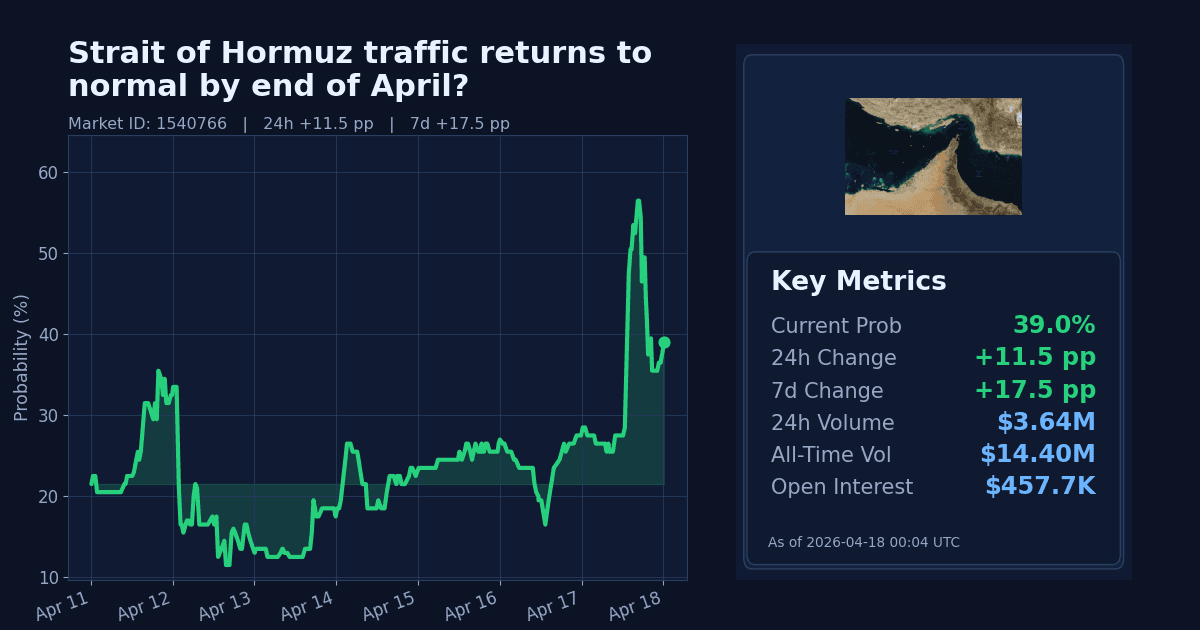
The Polymarket contract on whether Strait of Hormuz traffic returns to “normal” (defined as IMF Portwatch’s 7‑day moving average of transit calls at or above 60) by April 30, 2026 moved higher. The market covers any qualifying date between market creation on March 9, 2026 and April 30, 2026.
Traders bid up the Yes side over the last 24 hours and week, marking a notable upward repricing.
Why It Likely Moved
- The move appears driven by Iran’s April 17 declaration that the Strait of Hormuz is “completely open to commercial traffic” during the Israel–Lebanon ceasefire, a direct positive signal for near‑term transits according to Ground News.
- Markets reacted to political backing for secure passage: on April 17, France’s President Macron and the UK’s Prime Minister Starmer welcomed the reopening, with Starmer noting more than a dozen countries are ready to join a defensive mission to protect shipping, per Ground News.
- The repricing follows official pressure to restore maritime commerce. On April 16, the UK government told the UN General Assembly that attacks on shipping in the Gulf have been “deeply damaging for the world.” The European Parliament flagged legal and energy‑security concerns related to Iran’s actions on April 16.
- Macro conditions align with easing risk: Brent crude is at $91.87/bbl, down 3.5% over 7 days and 14.4% over 30 days, while the VIX is down 9.1% over 7 days, suggesting a reduction in energy and broader risk premia.
- Still, the NPR assessment on April 17 that the strait has reopened after about six weeks of disruption but “risks remain” (mines, potential attacks, higher insurance) underscores that normalization is not assured (NPR).
How Strong the Move Is
By recent trading history, the one‑day change registers as an extreme move. Over the past week, it looks like a sharp repricing rather than ordinary noise.
Taken together, this points to an event‑driven spike that also extends an upward trend over several sessions.
Cross-Market Confirmation
- US × Iran permanent peace deal by April 30, 2026: up on the day and week (delta_24h +2.0pp; delta_7d +13.5pp to 45.0%), broadly consistent with improved odds of normalized shipping.
- Kharg Island no longer under Iranian control by April 30: down on the day and week (delta_24h −0.65pp; delta_7d −5.25pp to 3.3%), a de‑escalatory signal that aligns with higher normalization odds.
- Trump to announce US blockade lifted by April 17, 2026: fell (delta_24h −3.4pp to 1.1%), which does not independently confirm the main move but indicates low expectations of a distinct US announcement.
News & Real-World Context
- On April 17, Iran said the Strait of Hormuz is “completely open to commercial traffic” during the Israel–Lebanon ceasefire, signaling near‑term facilitation of transits (Ground News).
- Also on April 17, President Macron and Prime Minister Starmer welcomed the reopening; Starmer added that more than a dozen countries stand ready for a defensive mission to protect shipping (Ground News).
- On April 16, the UK government told the UN General Assembly that attacks on Gulf shipping have been “deeply damaging,” highlighting the urgency of safeguarding maritime flows.
- On April 16, the European Parliament submitted a priority written question on possible violations of international law and the energy crisis linked to Iran’s actions in the strait, underscoring EU political focus.
- On April 17, NPR reported the strait has reopened after roughly six weeks of curtailed commercial traffic but warned that risks to transit persist amid fragile diplomacy and naval deployments (NPR).
Bottom Line
Odds rose on official signals that the strait is open and that allied protection for shipping is available, while broader risk indicators eased. With less than two weeks until April 30, the move looks event‑driven but still contingent on sustained safety and actual transit counts meeting IMF Portwatch’s threshold.
Market Conditions at Time of Writing
- Current Probability: 39.0%
- 24h Change: +11.5pp
- 7d Change: +17.5pp
- Volume (24h): $3,643,106.11
- Open Interest: $457,738.87
- Spread: 1.0pp
- Z-score (24h): 48.0 (extreme)