What Moved the Market
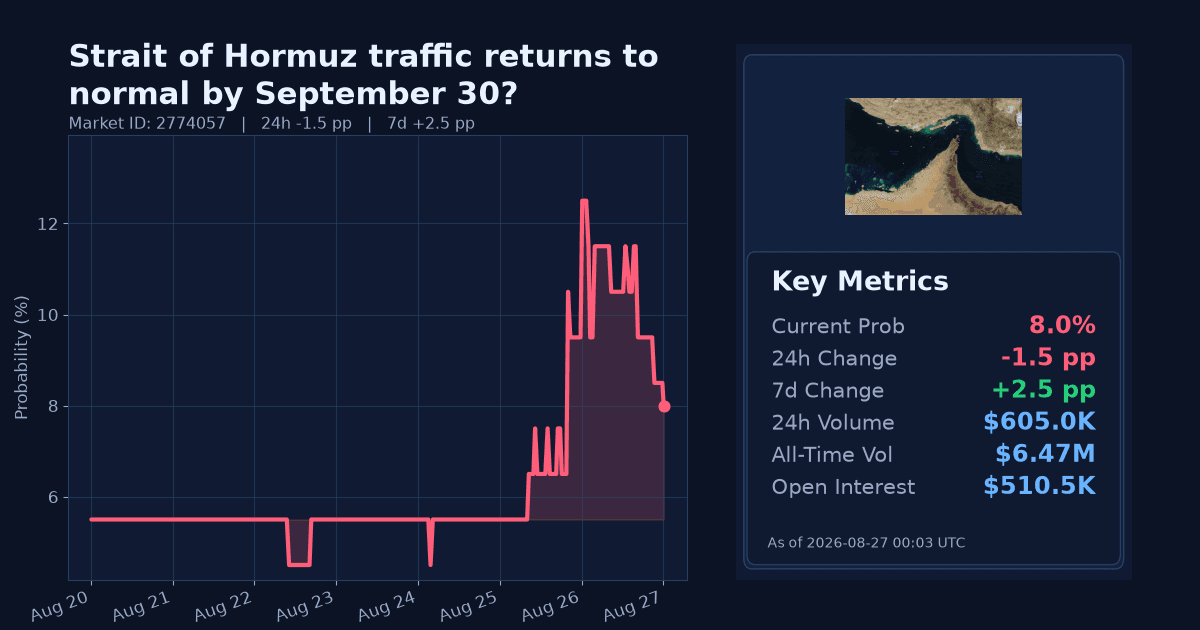
Polymarket traders marked down the probability that Strait of Hormuz traffic returns to “normal” (IMF Portwatch 7-day moving average of transit calls at or above 60) by September 30, 2026. The contract fell 1.5 percentage points over 24 hours to 8.0% as of August 27.
Despite the daily decline, the market is up 2.5 percentage points over the last week, leaving it slightly higher on a 7-day basis while still pricing a low chance of normalization within the contract window (July 2 to September 30, 2026).
Why It Likely Moved
- Repricing appears driven by an August 26 report that Iran warned it could ban military ships from the Strait of Hormuz under a potential agreement with Oman, a signal of persistent maritime security friction that could impede a rapid traffic rebound, according to AP News.
- Markets reacted to continued official attention to Middle East-related disruptions: on August 26, the European Commission approved a €20 million relief scheme citing higher fuel and fertiliser prices “due to the Middle East crisis,” underscoring persistent knock-on effects.
- The repricing follows diplomatic signaling at the UN: on August 26, the UK government urged parties to fulfil commitments under Resolution 2803 and “refrain from actions that undermine peace,” highlighting unresolved tensions.
- Analytical context points to ongoing disruption severity: on August 26, CSIS described the Strait of Hormuz and Qatar’s Ras Laffan LNG exports as effectively shut for over five months, pressuring global LNG supply and exposed importers.
- Macro backdrop is mixed: Brent crude sits at $86.53/bbl and has fallen 5.6% over the past week, while U.S. natural gas rose 3.4% over the same period, suggesting energy market signals are not uniformly aligned with a swift normalization narrative.
How Strong the Move Is
The 24-hour decline is classified as a sharp downtick: the move carries an “extreme” z-score signal, indicating the drop is large relative to this market’s recent trading history.
Over 7 days, the up-move is “elevated” but not extreme, pointing to a modest weekly improvement that today’s decline partially offsets. Overall, the pattern looks like a short-term spike down within an otherwise slightly firmer weekly stance, not a clear reversal of the broader weekly trend.
Cross-Market Confirmation
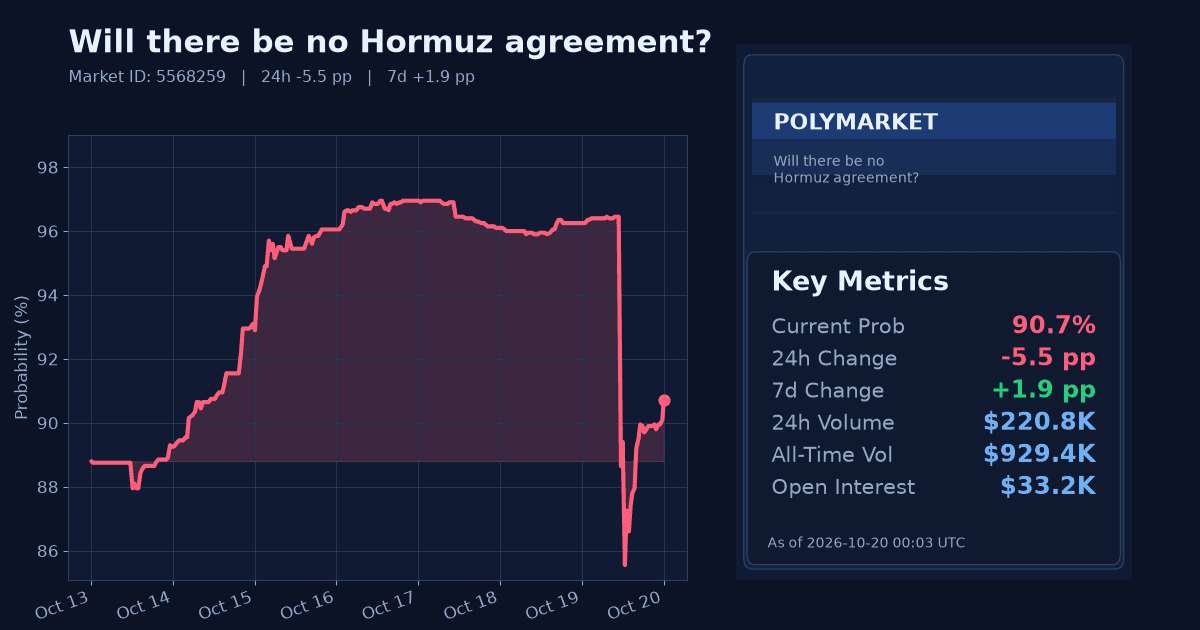
- “Hormuz normal by September 15” fell 0.9 pp in 24h to 1.6% and is only up 0.5 pp over 7d, confirming weaker near-term normalization odds consistent with today’s downtick.
- “Hormuz normal by December 31” dropped 5.0 pp in 24h to 34.0%, aligning with the direction of the main market’s 24h decline.
- “US announces end of Iranian blockade by September 30, 2026” is up 9.0 pp over 7d to 40.0% (24h N/A), a divergence suggesting higher perceived odds of a policy announcement even as traders discount rapid physical traffic normalization by late September.
News & Real-World Context
- On August 26, AP News reported Iran warned it could ban military ships from the Strait of Hormuz under a potential agreement with Oman, indicating possible constraints on maritime transits.
- On August 26, the European Commission approved a €20 million state-aid scheme for Friuli Venezia Giulia agriculture and fisheries, citing increased input costs stemming from the “Middle East crisis,” an official acknowledgment of economic ripple effects.
- On August 26, the UK government told the UN Security Council that both parties must fulfil commitments under Resolution 2803 and avoid actions that undermine peace, a formal signal of ongoing diplomatic concern.
- Also on August 26, Australia’s Department of Defence announced a trilateral Maritime Cooperative Activity with the Philippines and the United States in the region, demonstrating posture and coordination (Australian Government).
- On August 26, CSIS assessed that the Strait of Hormuz and Qatar’s Ras Laffan LNG exports have been effectively shut for over five months, removing roughly 20% of global LNG supply and forcing energy adjustments in Pakistan.
Bottom Line
The contract’s sharp 24-hour downtick to 8% appears linked to fresh signaling of potential constraints on Hormuz transits and continued official focus on regional instability. Cross-market moves broadly confirm weaker near-term odds even as a separate policy-announcement market has strengthened.
Given the contract’s end date of September 30, the move looks like a short-term repricing against tight timelines for physical normalization, with structural uncertainty persisting.
Market Conditions at Time of Writing
- Current Probability: 8.0%
- 24h Change: -1.5 pp
- 7d Change: +2.5 pp
- Volume (24h): $604,968.77
- Open Interest: $510,475.65
- Spread: 1.0 pp
- Z-score (24h): 20.0