What Moved the Market
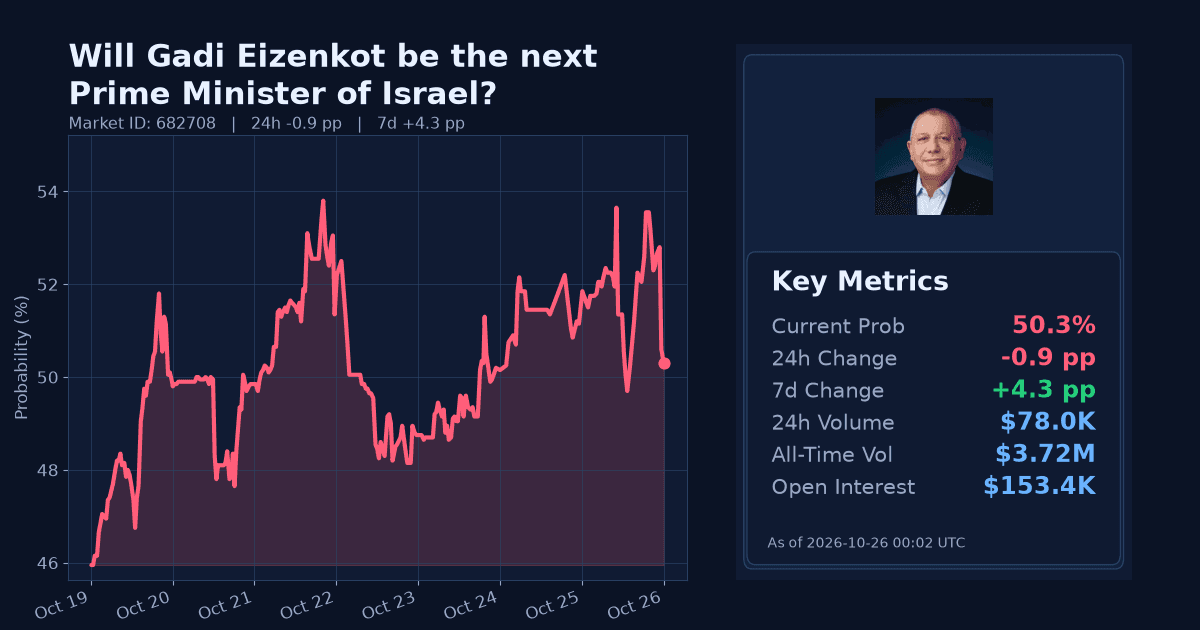
The Polymarket contract on whether Gadi Eizenkot will be the next Prime Minister of Israel moved lower over the past day. The market covers the individual formally appointed and sworn in after Israel’s parliamentary election, with the contract running from November 15, 2025 to October 28, 2026.
The move is a short-term pullback within a larger weekly rise. As of October 26, 2026, the market still prices Eizenkot as the leading named outcome among the provided comparable contracts.
Why It Likely Moved
- The repricing appears driven by election-week uncertainty rather than a single definitive catalyst. Recent reporting frames the vote as pivotal and unusually consequential, with leadership change explicitly in focus.
- Markets reacted to potential turnout effects from Israelis abroad. AP reported on October 25 that tens of thousands of Israeli citizens living overseas were expected to fly in to vote, with diaspora turnout potentially affecting the balance of power and Benjamin Netanyahu’s standing.
- The move also follows security-heavy campaign context. AP reported on October 25 that Israeli authorities were continuing West Bank operations as the election approached, while Israeli officials described the actions as necessary security measures.
- The seven-day rise appears supported by a broader weakening in listed rival outcomes, especially Netanyahu’s market, even as the latest 24-hour move trimmed Eizenkot’s gains.
- Macro signals do not show a fresh global volatility shock at the same timestamp: the VIX was 19.45 as of October 23, down 2.70% over seven days, though still up 30.80% over 30 days.
How Strong the Move Is
The 24-hour move is classified as extreme relative to this market’s recent trading history: Eizenkot fell 0.85 percentage points over 24 hours, with a 24-hour z-score of 6.4. That makes the daily pullback statistically notable, even though the absolute size of the move is modest.
The weekly move is stronger in direction and scale. The market is up 4.35 percentage points over seven days, with a seven-day z-score of 17.6, also classified as extreme. Taken together, this is best read as a trend continuation with a short-term pullback, not a full reversal.
Cross-Market Confirmation
- Benjamin Netanyahu’s next-PM market confirms the relative shift away from Netanyahu: it fell 0.5 percentage points over 24 hours and 2.5 points over seven days.
- Avigdor Lieberman’s market also aligns with broad weakness among alternatives, down 0.3 points over 24 hours and 0.35 points over seven days.
- Naftali Bennett’s market confirms the daily direction among rivals, down 1.0 point over 24 hours; its seven-day change is unavailable, so it cannot confirm the weekly pattern.
News & Real-World Context
NPR reported on October 25 that Israel was holding a general election after years of war and that many voters viewed it as the most consequential vote in decades, with the war reshaping voter priorities and testing whether Netanyahu remains politically viable (NPR). AP’s October 25 reporting added that Israelis abroad were expected to return in large numbers to vote, creating another variable for the balance of power (AP News).
Security conditions remain central to the election environment. AP reported on October 25 that Israel was pressing ahead with West Bank operations as the vote approached, with Palestinian residents and officials describing disruption and Israeli officials framing the operations as security measures (AP News). AP also reported on October 25 that Iranians feared regional tensions and recent strikes could spiral toward wider war as U.S. and Israeli elections approached (AP News).
Official government context in the supplied evidence is not Israel-specific, but it reinforces that security and diplomacy are prominent in the surrounding international environment. On October 25, the Canadian prime minister’s office said Canada and the EU were advancing a partnership covering security, defence, energy, and technology, describing the world as “more dangerous and divided” (Government of Canada). The same day, the Canadian government announced a Canada-UAE engagement focused on economic and security ties, including regional and global challenges (Government of Canada). The UK government also published an October 24 R4 ministerial statement with France, Germany, Italy, and the UK in Istanbul, categorized in the provided context under defence and foreign affairs (UK government).
Bottom Line
Eizenkot’s market remains elevated on the week, but the latest daily move shows traders trimming exposure as the election window approaches. The repricing appears uncertain rather than structural: related markets broadly confirm pressure on rival named candidates, while the day’s move is a pullback inside a larger pro-Eizenkot trend.
Market Conditions at Time of Writing
- Current Probability (%): 50.3
- 24h Change (pp): -0.85
- 7d Change (pp): +4.35
- Volume (24h, $): 77,958.57
- Open Interest ($): 153,410.44
- Spread (pp): 0.1
- Z-score (24h): 6.4