
Shahed-129
An Iranian medium-altitude long-endurance UCAV used for reconnaissance and strike missions
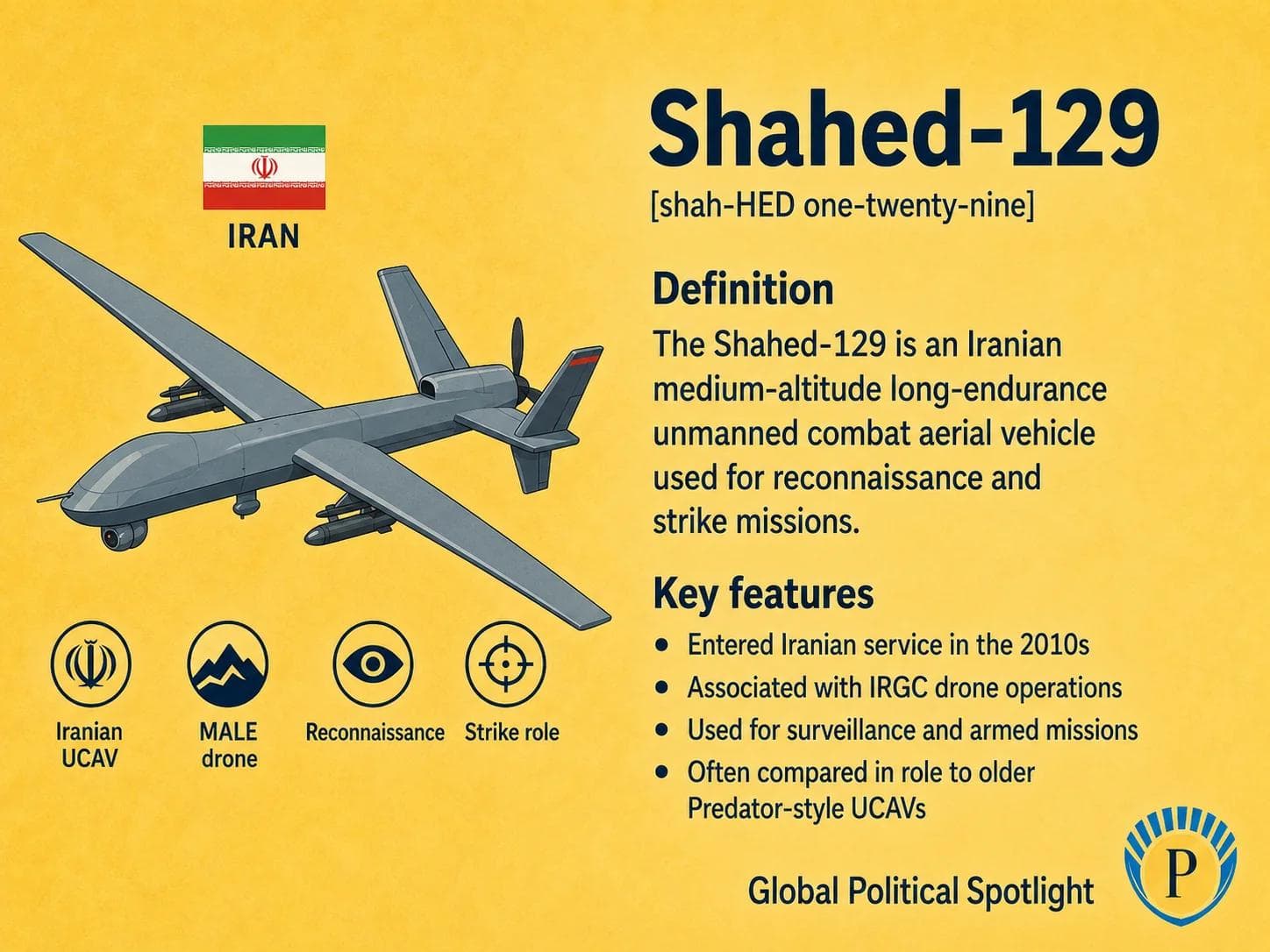
The Shahed-129 is an Iranian medium-altitude long-endurance unmanned combat aerial vehicle used for reconnaissance and strike missions, associated with IRGC drone operations and Predator-style UCAV concepts.
Definition
The Shahed-129 is an Iranian medium-altitude long-endurance unmanned combat aerial vehicle, or MALE UCAV, used for reconnaissance, surveillance, target tracking, and strike missions. It is associated with Iran's expanding drone program and with operations linked to the Islamic Revolutionary Guard Corps.
The aircraft is often compared in broad concept to Predator-style UCAVs because it combines a long-endurance airframe, remote operation, sensor payloads, and the ability to carry guided munitions. Its role is different from one-way attack drones such as the Shahed-136 because the Shahed-129 is intended as a reusable remotely piloted platform.
Why It Matters
The Shahed-129 matters because it represents Iran's move from smaller surveillance drones and one-way attack systems toward larger armed UAVs capable of persistent observation and precision attack. This gives Iran and aligned forces a tool for monitoring borders, maritime approaches, conflict zones, and regional rivals.
It also matters for regional security because Iranian drone capabilities are part of a wider competition involving air defenses, proxy warfare, sanctions, export controls, and the spread of lower-cost precision strike across the Middle East and beyond.
GPS should watch the Shahed-129 as a reference point for Iran's armed drone development, IRGC operational reach, and the diffusion of Predator-style UCAV concepts outside Western militaries. Long-term indicators include upgrades to sensors and munitions, operational use by Iran or partners, export or technology-transfer patterns, sanctions enforcement, and counter-drone adaptation across the Middle East.
Key Facts
- Type
- Medium-altitude long-endurance unmanned combat aerial vehicle
- Country of origin
- Iran
- Associated operator
- Islamic Revolutionary Guard Corps and Iranian drone forces
- Core missions
- Reconnaissance, surveillance, target tracking, and precision strike
- Platform concept
- Reusable remotely piloted UCAV rather than a one-way attack drone
- Comparison point
- Often compared in broad role to Predator-style armed surveillance drones
- Regional role
- Part of Iran's broader drone ecosystem used for deterrence, surveillance, and power projection
- Main constraints
- Vulnerable to air defenses, electronic warfare, communications disruption, and contested airspace depending on mission conditions
FAQ
What is the Shahed-129?
The Shahed-129 is an Iranian medium-altitude long-endurance unmanned combat aerial vehicle used for reconnaissance, surveillance, target tracking, and strike missions.
Is the Shahed-129 the same as the Shahed-136?
No. The Shahed-129 is a reusable remotely piloted UCAV used for reconnaissance and strike missions. The Shahed-136 is a one-way attack drone designed to detonate on impact or near a target.
Why is the Shahed-129 compared to Predator-style drones?
It is compared to Predator-style UCAVs because it combines long endurance, remote operation, sensors, and strike capability in a larger reusable armed drone platform.
Who operates the Shahed-129?
The Shahed-129 is associated with Iranian military and IRGC-linked drone operations. Public reporting has connected it to Iranian activity in regional conflict zones.
Why does the Shahed-129 matter for Middle East security?
It matters because it supports Iran's ability to conduct persistent surveillance and potential precision strikes across regional theaters, contributing to deterrence, proxy conflict dynamics, and counter-drone planning.
What are the limits of the Shahed-129?
The Shahed-129 can be limited by air defenses, electronic warfare, communications links, sensor quality, basing access, weather, operator training, and the risks of flying in contested airspace.
Recent Developments
U.S. aircraft shot down an Iranian Shahed-129 over Syria
The U.S. military said an Iranian-made Shahed-129 was shot down after it approached coalition-backed forces in Syria, illustrating the drone's relevance to regional conflict zones and escalation risks around remotely piloted aircraft.
U.S. Department of DefenseUnited States targeted Iran-linked UAV procurement networks
The U.S. Treasury announced sanctions against networks connected to Iran's unmanned aerial vehicle procurement, reflecting the continuing policy importance of Iranian drone systems, components, and supply chains.
U.S. Department of the TreasurySources6 references
- U.S. Department of Defense
Official U.S. account of a Shahed-129 incident over Syria, illustrating its regional operational relevance.
- U.S. Department of the Treasury
Official sanctions announcement related to Iran-linked unmanned aerial vehicle procurement networks.
- U.S. Defense Intelligence Agency
U.S. defense intelligence reference on Iranian drone systems and their wider strategic relevance.
- Center for Strategic and International Studies Missile Defense Project
Reference source for missile and drone systems, including Iranian uncrewed strike capabilities.
- SIPRI
Institutional research on emerging military technologies, uncrewed systems, and arms-control implications.
- International Institute for Strategic Studies
Institutional research source for military balance, regional security, and drone proliferation analysis.

GPSNews App
Read GPSNews on iPhone
Daily geopolitical briefings, government updates, and prediction signals in one focused app.
Newsletter
Stay Ahead Of The Next Signal
Get briefings in your inbox when new analysis and reports are published.