
Lancet-3
A Russian loitering munition used for tactical battlefield strikes against vehicles, artillery, and air-defense targets
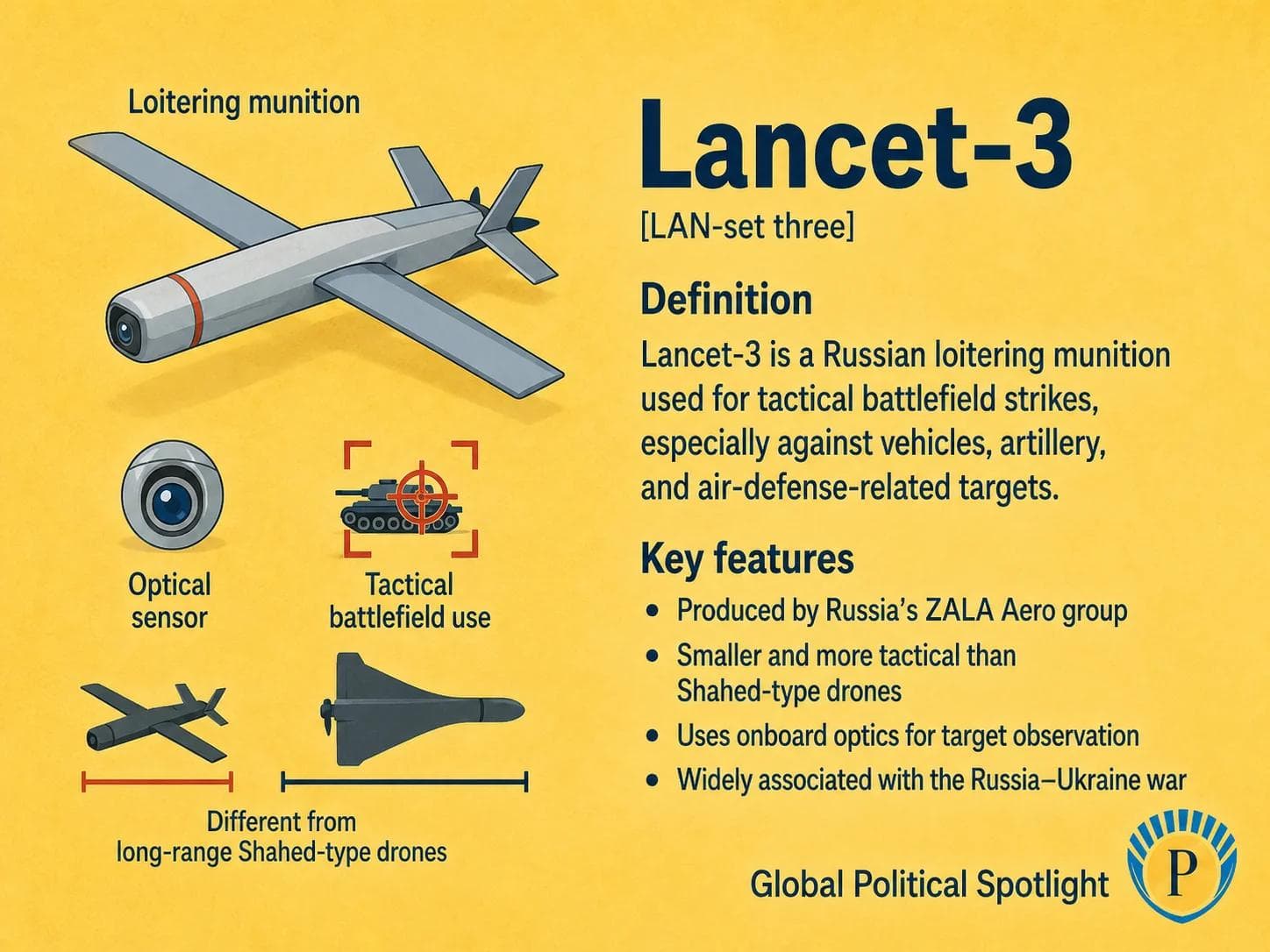
Lancet-3 is a Russian loitering munition associated with ZALA Aero, used for tactical battlefield strikes against vehicles, artillery, radar, and air-defense-related targets.
Definition
Lancet-3 is a Russian loitering munition associated with ZALA Aero, a company linked to Russia's Kalashnikov group. It is designed to fly toward a target area, use onboard sensors and operator guidance to locate or confirm a target, and then conduct a one-way strike.
Unlike larger Shahed-type one-way attack drones used for longer-range attacks on fixed targets and infrastructure, Lancet-3 is generally discussed as a smaller tactical system used closer to the battlefield. It has become visible in the Russia-Ukraine war in strikes against artillery, armored vehicles, radars, and air-defense-related equipment.
Why It Matters
Lancet-3 matters because it shows how loitering munitions can threaten valuable battlefield systems at relatively low cost. Artillery pieces, self-propelled guns, air-defense radars, and logistics vehicles can be vulnerable when persistent surveillance and one-way attack drones are linked together.
The system also matters for modern force protection. Armies must now defend not only against missiles and aircraft but also against smaller loitering munitions that can approach from unexpected angles, exploit exposed positions, and force constant adaptation in camouflage, mobility, electronic warfare, and short-range air defense.
GPS should watch Lancet-3 as a reference point for tactical drone warfare, Russia's adaptation in Ukraine, and the diffusion of loitering munitions into artillery and air-defense battles. Long-term indicators include production scale, sensor and guidance improvements, electronic-warfare countermeasures, export interest, and whether other militaries copy similar low-cost tactical strike concepts.
Key Facts
- Type
- Tactical loitering munition
- Country of origin
- Russia
- Associated manufacturer
- ZALA Aero, linked to the Kalashnikov group
- Core role
- Search, observe, and conduct a one-way strike against battlefield targets
- Sensor emphasis
- Associated with optical targeting and operator-guided engagement
- Typical target set
- Vehicles, artillery, radar systems, air-defense equipment, and exposed battlefield assets
- Operational profile
- Smaller tactical strike system than Shahed-type long-range one-way attack drones
- Conflict relevance
- Widely associated with Russian tactical drone strikes in the Russia-Ukraine war
FAQ
What is Lancet-3?
Lancet-3 is a Russian tactical loitering munition associated with ZALA Aero. It is designed to fly toward a target area, observe or confirm a target, and then conduct a one-way strike.
Is Lancet-3 a drone or a missile?
Lancet-3 combines features of both. It behaves like a drone because it can fly, observe, and be guided before attack, but it functions as an expendable munition because it destroys itself during the strike.
How is Lancet-3 different from Shahed-136?
Lancet-3 is generally a smaller tactical battlefield loitering munition used against vehicles, artillery, and air-defense targets. Shahed-136 is a larger one-way attack drone often associated with longer-range strikes and saturation attacks.
Why does Lancet-3 matter in the Russia-Ukraine war?
It matters because Russia has used Lancet-type loitering munitions to attack valuable Ukrainian battlefield systems, including artillery, vehicles, radar, and air-defense-related targets. This has made counter-drone protection a major tactical concern.
What are the limits of Lancet-3?
Lancet-3 can be affected by electronic warfare, jamming, camouflage, decoys, weather, short-range air defenses, target movement, operator skill, and the availability of reconnaissance data.
Why are optical sensors important on Lancet-3?
Optical sensors help identify and guide attacks against visible targets. In practice, effective use often depends on a wider reconnaissance network that finds targets, tracks movement, and supports the operator before the strike.
Recent Developments
United Kingdom sanctioned ZALA Aero over Russian drone production
The UK government added ZALA Aero to Russia-related sanctions, linking the company to military drone systems used by Russia and highlighting how loitering munitions are tied to defense-industrial and sanctions policy.
UK GovernmentNATO continued to highlight drone and counter-drone lessons from Ukraine
NATO public analysis continued to identify uncrewed systems, electronic warfare, and counter-drone adaptation as important lessons from the war in Ukraine, where tactical loitering munitions such as Lancet-type systems became prominent.
NATOSources6 references
- ZALA Aero
Manufacturer reference source for ZALA unmanned systems; use with awareness that it is a Russian defense-industry source.
- UK Government: The UK Sanctions List
Official UK sanctions source including Russia-related designations relevant to drone manufacturers and defense entities.
- NATO
Institutional background on NATO adaptation and lessons from modern conflict, including uncrewed systems and counter-drone challenges.
- U.S. Congressional Research Service
Reference background on loitering munitions and their military and policy implications.
- SIPRI
Institutional research on emerging military technologies, uncrewed systems, and arms-control implications.
- International Institute for Strategic Studies
Institutional research source for military balance, drone warfare, and conflict analysis.

GPSNews App
Read GPSNews on iPhone
Daily geopolitical briefings, government updates, and prediction signals in one focused app.
Newsletter
Stay Ahead Of The Next Signal
Get briefings in your inbox when new analysis and reports are published.