
CH-4 & CH-5 Rainbow
Chinese Rainbow-series UCAVs used for reconnaissance, strike missions, and armed-drone exports
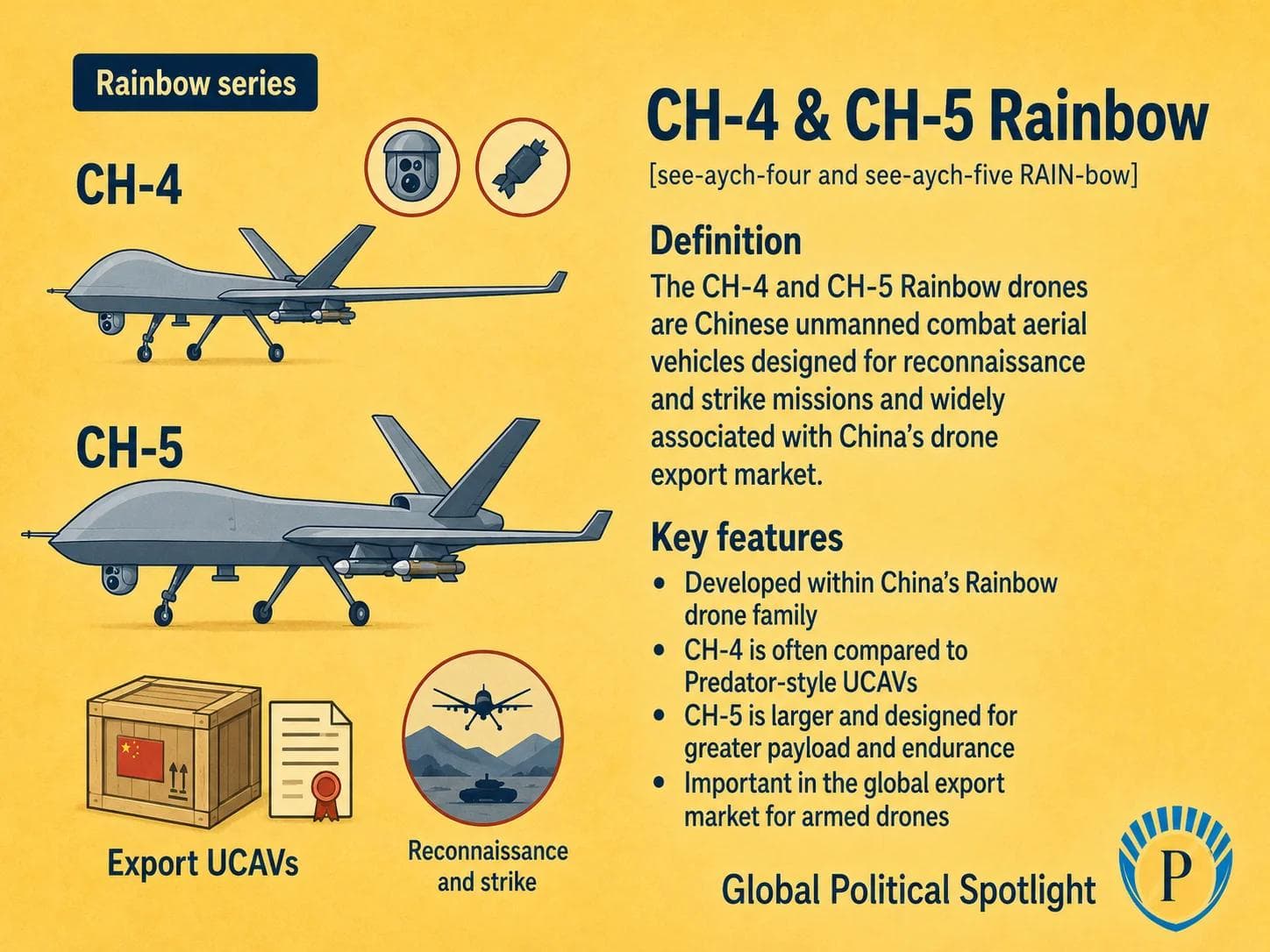
The CH-4 and CH-5 Rainbow are Chinese unmanned combat aerial vehicles designed for reconnaissance and strike missions, associated with China's armed-drone export market and global UCAV proliferation.
Definition
The CH-4 and CH-5 Rainbow are Chinese unmanned combat aerial vehicles in the Rainbow, or Caihong, series. They are designed for intelligence, surveillance, reconnaissance, target acquisition, and precision-strike missions using onboard sensors and guided munitions.
The CH-4 is often discussed as a Predator-style export UCAV used by several militaries, while the larger CH-5 is presented as a higher-end Rainbow-series platform with greater payload and endurance potential. Together, they illustrate China's role in supplying armed drones to countries seeking strike-capable UAVs outside Western export channels.
Why It Matters
The CH-4 and CH-5 matter because they helped expand access to armed drone capabilities beyond a small group of traditional suppliers. For many states, Chinese UCAVs offered a route to persistent surveillance and precision strike without the political restrictions often attached to Western systems.
They also matter for defense markets and regional security. Rainbow-series drones connect Chinese defense exports, counterinsurgency operations, border surveillance, proxy conflicts, air-defense adaptation, and debates over how armed-drone proliferation changes the threshold for using force.
GPS should watch the CH-4 and CH-5 Rainbow as reference points for China's armed-drone exports, UCAV proliferation, and the competitive market for lower-cost reconnaissance-strike systems. Long-term indicators include export customers, battlefield performance, sensor and munition upgrades, after-sales support, counter-drone adaptation, and how Chinese drone exports affect regional balances of power.
Key Facts
- Type
- Chinese unmanned combat aerial vehicles
- Series name
- Rainbow or Caihong series
- Country of origin
- China
- CH-4 role
- Export-oriented MALE UCAV used for surveillance, reconnaissance, and guided strike missions
- CH-5 role
- Larger Rainbow-series UCAV associated with greater payload and endurance ambitions than the CH-4
- Sensor role
- Typically associated with electro-optical and infrared sensors for observation, targeting, and battle damage assessment
- Weapons role
- Designed to carry guided munitions for precision strike against selected targets
- Strategic relevance
- Associated with China's drone export market and the wider global proliferation of armed UAVs
FAQ
What are the CH-4 and CH-5 Rainbow drones?
The CH-4 and CH-5 Rainbow are Chinese unmanned combat aerial vehicles designed for reconnaissance, surveillance, target acquisition, and precision-strike missions.
What is the difference between the CH-4 and CH-5?
The CH-4 is widely discussed as an export-oriented MALE UCAV similar in broad role to Predator-style drones. The CH-5 is a larger Rainbow-series platform associated with greater payload and endurance potential.
Why do CH-4 and CH-5 drones matter?
They matter because they show how China has become an important supplier of armed drones. These systems allow more states to acquire persistent surveillance and precision-strike capabilities.
Are CH-4 and CH-5 drones armed?
Yes. They are designed as unmanned combat aerial vehicles and can carry guided munitions, though exact configurations depend on the customer, mission, and export package.
Who uses CH-4 Rainbow drones?
The CH-4 has been exported to several countries in the Middle East, Africa, and Asia. Publicly reported users have included states seeking armed UAV capabilities for surveillance and strike missions.
What are the limits of CH-4 and CH-5 UCAVs?
Like other non-stealth MALE drones, they can be vulnerable to integrated air defenses, fighter aircraft, electronic warfare, communications disruption, weather, maintenance issues, and gaps in operator training or targeting intelligence.
Recent Developments
Drone proliferation remained a major arms-transfer issue
Institutional arms-control and defense-market research continued to identify armed UAV exports as a major proliferation issue, with Chinese systems such as Rainbow-series drones frequently discussed in relation to the spread of reconnaissance-strike capabilities.
SIPRIModern conflict continued to highlight drone and counter-drone adaptation
NATO public analysis continued to emphasize uncrewed systems, electronic warfare, and counter-drone adaptation as important lessons from recent conflicts, reinforcing the relevance of export UCAVs such as the CH-4 and CH-5.
NATOSources6 references
- SIPRI
Institutional research on emerging military technologies, uncrewed systems, and arms-transfer implications.
- International Institute for Strategic Studies
Institutional research source for military balance, drone proliferation, and regional security analysis.
- RAND Corporation
Research background on unmanned aerial vehicles and their military and policy implications.
- NATO
Institutional background on alliance adaptation, modern conflict lessons, and uncrewed systems.
- U.S.-China Economic and Security Review Commission
Institutional source for analysis of Chinese military modernization, defense industry, and technology competition.
- UN Register of Conventional Arms
International reference source for reported conventional arms transfers, useful for tracking military export patterns.

GPSNews App
Read GPSNews on iPhone
Daily geopolitical briefings, government updates, and prediction signals in one focused app.
Newsletter
Stay Ahead Of The Next Signal
Get briefings in your inbox when new analysis and reports are published.