What Moved the Market
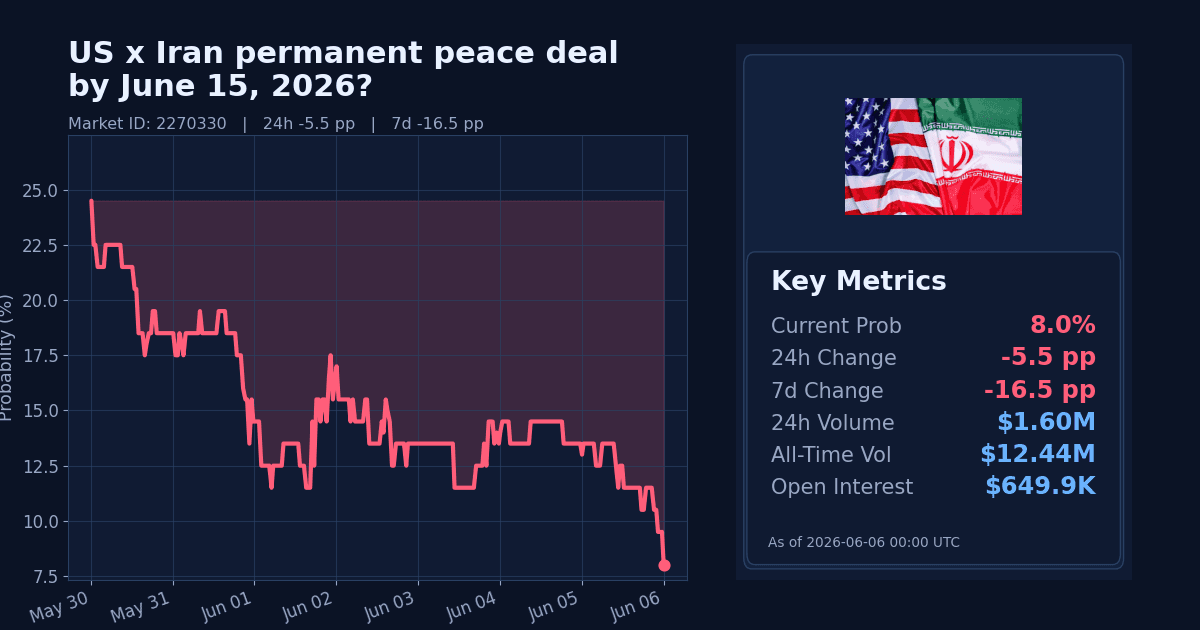
The Polymarket contract on a “permanent peace deal” between the United States and Iran by 11:59 PM ET on June 15, 2026 dropped to 8% as of June 6. That is a 5.5 percentage-point decline over 24 hours and a 16.5pp decline over seven days.
This market resolves “Yes” only if both governments sign or formally adopt a written agreement, or both publicly confirm a definitive, lasting end to military hostilities. With nine days remaining in the contract window (May 15–June 15, 2026), traders marked down the probability sharply.
Why It Likely Moved
- Repricing appears driven by time decay into the June 15 deadline without any qualifying US or Iranian government announcement of a permanent end to hostilities.
- The move aligns with declines in closely related, shorter-dated markets, suggesting a broad reassessment of near-term deal odds rather than an isolated swing.
- Official US communications during the period do not indicate de-escalation steps: a June 5 briefing by the US Department of State referenced Iran-specific visa restrictions around the FIFA World Cup and contained no mention of peace negotiations or agreements (US State Department, 2026-06-05).
- Macro signals provide no relief cue: WTI crude rose 3.3% over the past week to $90.25/bbl and the VIX rose 40% over seven days, conditions that do not reflect easing geopolitical risk.
- Elevated 24h volume ($1.60M) likely facilitated rapid price discovery toward a lower base as the resolution date approaches.
How Strong the Move Is
The 24h and 7d z-scores are both classified as extreme (z=16.0 and z=13.75, respectively), indicating the selloff is unusually sharp versus recent trading history. The 24h shift of -5.5pp into single-digit odds is a decisive move.
Given the parallel seven-day decline (-16.5pp), this looks like an extreme downward spike that also continues a broader trend toward “No” as the contract nears expiry without qualifying signals.
Cross-Market Confirmation
- US x Iran permanent peace deal by June 7, 2026: 1.5% (−1.4pp 24h; −17.05pp 7d) — confirms accelerated discounting for immediate horizons.
- US x Iran permanent peace deal by June 30, 2026: 23% (−1.0pp 24h; −13.0pp 7d) — directionally aligned, with a higher base reflecting the longer window.
- US announces new Iran agreement/ceasefire extension by June 7: 4.1% (−2.0pp 24h; −50.0pp 7d) — corroborates reduced expectations for near-term announcements.
News & Real-World Context
- No US or Iranian government announcements establishing a permanent, lasting end to military hostilities were provided in the supplied period. The market’s resolution criteria prioritize such official confirmations.
- In a June 5 briefing, the US Department of State discussed World Cup-related entry pathways and explicitly noted Iran among exceptions, without signaling any peace initiative or de-escalatory agreement (US State Department, 2026-06-05). This is an official policy signal relevant to the broader bilateral posture during the window.
- Available press coverage in the period focused on unrelated US policy areas, such as remarks on accelerating military use of AI (AP News, 2026-06-05). These do not report on US–Iran negotiations or any peace framework.
Macro backdrop: WTI crude at $90.25/bbl (+3.3% 7d) and the VIX at 21.51 (+40% 7d) offer no concurrent signal of easing MENA risk or global volatility pressure.
Bottom Line
The drop to 8% appears primarily deadline-driven amid the absence of qualifying government statements. Cross-market declines and risk-sensitive macro indicators support the move. Barring an official, definitive announcement from both governments, markets are converging toward “No” as the June 15 resolution date approaches.
Market Conditions at Time of Writing
- Current Probability: 8%
- 24h Change: -5.5 pp
- 7d Change: -16.5 pp
- Volume (24h, $): 1,603,801.46
- Open Interest ($): 649,852.12
- Spread (pp): 1.0
- Z-score (24h): 16.0 (extreme down)