What Moved the Market
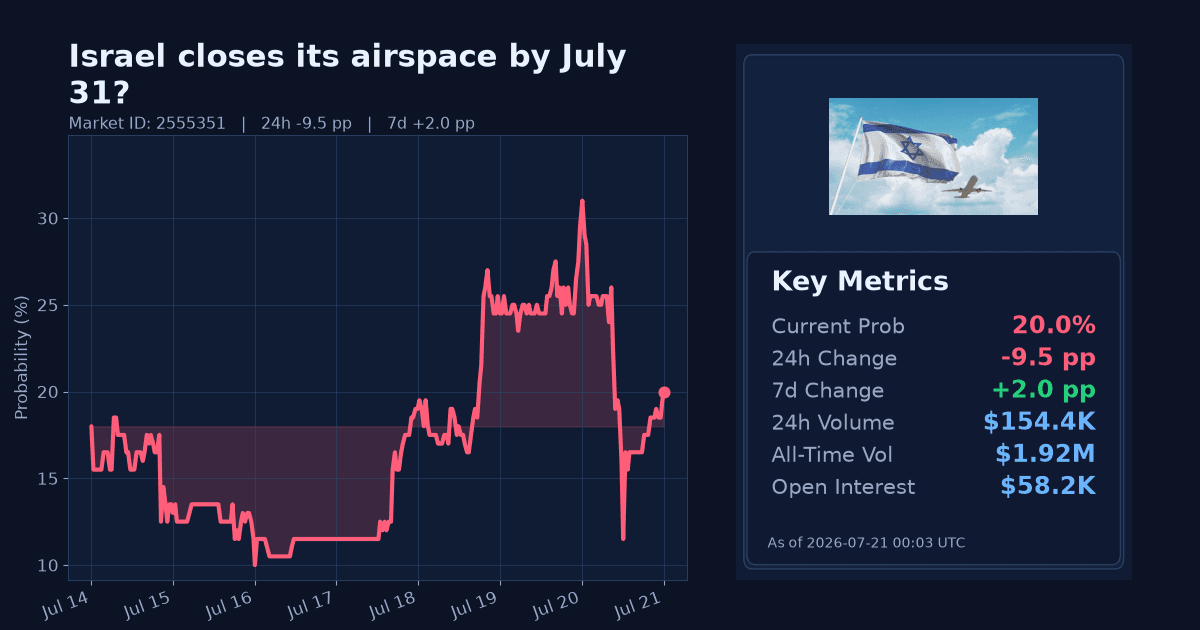
The Polymarket contract “Israel closes its airspace by July 31?” fell sharply over the last 24 hours, dropping 9.5 percentage points to 20%. The move marks an extreme daily decline in this market’s recent trading history.
The market resolves “Yes” only if Israeli authorities initiate a major, nationwide (or majority-of-airspace) commercial closure by 11:59 PM ET on July 31, 2026. As of July 21, the contract sits at 20% with ten days remaining in the resolution window.
Why It Likely Moved
- Repricing appears driven by time-window compression as the July 31 deadline approaches, reducing the remaining window for a qualifying, nationwide closure to be ordered and implemented.
- Markets reacted to the absence of any new, cited official notices from Israeli aviation authorities in the provided source set, consistent with a status quo baseline for commercial air operations.
- The move aligns with broader de-escalation across related, near-term Middle East risk markets (see Cross-Market Confirmation), reinforcing a lower probability of an imminent Israeli airspace shutdown.
- The decline occurred despite firm macro risk indicators — Brent crude near $89/bbl (+6.8% over 7 days) and the VIX at 18.65 (+8.7% over 7 days) — suggesting the adjustment was market-specific rather than driven by a fresh, market-wide risk shock.
- U.S. policy messaging on July 20, 2026 from the U.S. State Department emphasized ongoing maritime-security operations against Iran-linked assets and referenced Hezbollah’s threat in northern Israel, but did not indicate imminent Israeli civil airspace closure; traders may have repriced toward risks centered outside Israeli airspace.
How Strong the Move Is
The 24-hour drop of 9.5 percentage points to 20% comes with an extreme 24h z-score (42.0), classifying the move as a sharp, idiosyncratic spike lower. Over 7 days, the market remains up 2.0pp with a “normal” 7d z-score, indicating the daily move partly reverses prior modest gains.
Overall, this looks like a sharp downward spike and partial reversal of the past week’s upward drift, rather than a confirmed multi-day trend change.
Cross-Market Confirmation
- Israel closes airspace by July 24: down 7.0pp in 24h to 7% (directionally aligned); 7d data not available.
- US announces halt in Iran offensive operations by July 21: down 1.75pp in 24h to 3.9% (aligned); 7d data not available.
- Kharg Island no longer under Iranian control by July 31: down 1.5pp in 24h to 2.3% and down 1.15pp over 7d (aligned on both horizons).
These parallel declines in adjacent regional risk markets support the main market’s lower repricing.
News & Real-World Context
- On July 20, 2026, the U.S. State Department stated that U.S. strikes continue against Iran-linked assets targeting global commercial shipping in the Strait of Hormuz and referenced Hezbollah’s threat to northern Israel. The remarks emphasized maritime security and regional deterrence without signaling Israeli civil airspace closure.
- Also on July 20, 2026, Yemen’s Houthi movement said it would block Saudi shipping at a key Red Sea gateway, heightening maritime, not aviation, risk according to AP News.
Macro backdrop: Brent crude traded around $89/bbl (+6.8% over 7 days) and the VIX stood at 18.65 (+8.7% over 7 days), indicating firm energy prices and elevated equity volatility; these moves did not translate into higher pricing for an Israel airspace closure in this window.
Bottom Line
The market’s sharp drop to 20% appears primarily tied to the shrinking time window and a lack of fresh, cited government signals indicating a nationwide Israeli airspace shutdown by July 31. Cross-market moves in related contracts confirm a near-term de-risking. Absent authoritative notices from Israeli aviation authorities, this repricing looks short-term and event-window driven.
Market Conditions at Time of Writing
- Current Probability (%): 20.0
- 24h Change (pp): -9.5
- 7d Change (pp): +2.0
- Volume (24h, $): 154,395.50
- Open Interest ($): 58,193.93
- Spread (pp): 1.0
- Z-score (24h): 42.0