What Moved the Market
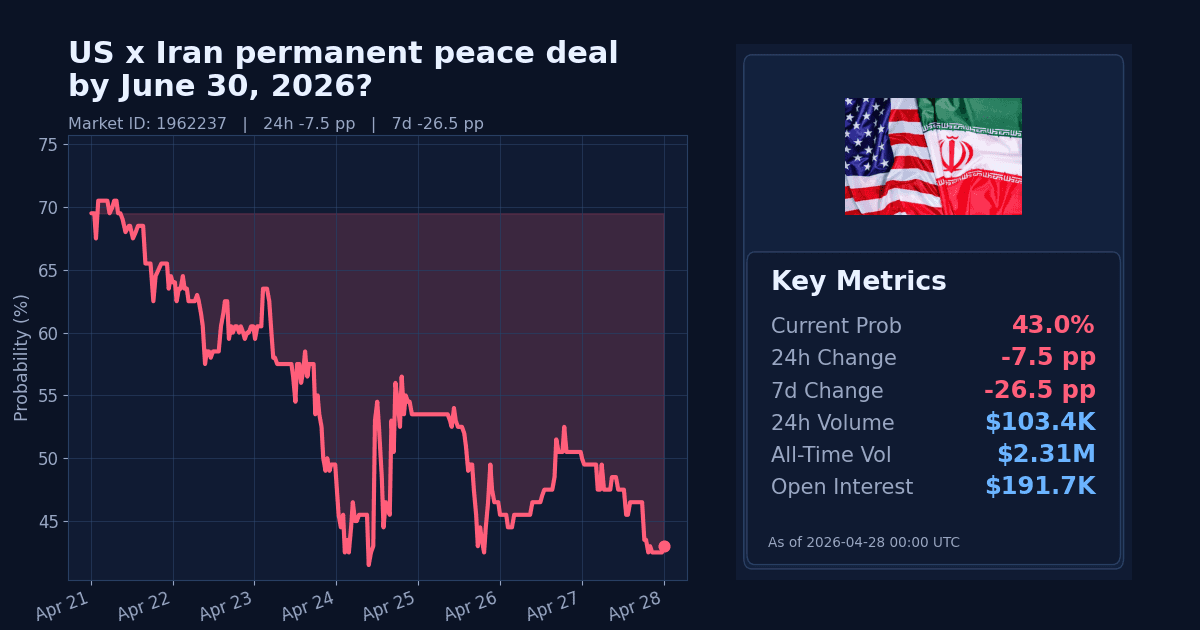
The Polymarket contract on a “US x Iran permanent peace deal by June 30, 2026” dropped to 43%, down 7.5 percentage points over 24 hours and 26.5 points over the past week. The contract requires an explicit, lasting end to military hostilities, confirmed by both governments or via a signed agreement, by 11:59 PM ET on June 30, 2026.
This is a sharp downward repricing within the contract’s window (deadline June 30, 2026), reflecting reduced expectations of a definitive, permanent accord being announced in time.
Why It Likely Moved
- The move appears driven by public confrontations over Iran’s nuclear program at the opening of the UN Nonproliferation Treaty review on April 27, where U.S. and Iranian delegations clashed over transparency and compliance, signaling diplomatic headwinds, according to AP News.
- Repricing follows reporting that, despite a new Iranian proposal, negotiations with the U.S. remain “in flux,” with key points unsettled and no clarity on a permanent peace framework, per AP News on April 27.
- Markets reacted to indications that talks are on hold while Iran pursued high-level outreach in Moscow, as noted by NPR on April 27; parallel reporting of Russia–Iran strategic alignment adds to uncertainty over a near-term U.S.–Iran breakthrough (Ground News, April 27).
- The repricing is consistent with the UK government’s April 27 statement at the UN Security Council calling to step up efforts to safeguard international waterways—an official signal of ongoing security concerns in the region that does not point to imminent de-escalation (UK government, April 27).
- Macro context aligns: WTI crude oil is $96.74/bbl and up about 8% over the past week, indicating elevated energy risk premia often associated with Middle East tensions, which is directionally consistent with lower odds of a rapid, permanent peace.
How Strong the Move Is
The 24-hour decline (−7.5pp) carries an extreme z-score of 32.0 relative to recent trading, indicating this is not routine noise. The 7-day drawdown (−26.5pp) is also extreme (z-score 112.0), underscoring a sustained reset in expectations.
In classification terms, this looks like an extreme, directional repricing rather than a transient spike. The week-long deterioration suggests a shift in the base case away from a timely, definitive deal before June 30, 2026.
Cross-Market Confirmation
- US x Iran permanent peace deal by April 30, 2026: Probability 1.6%, delta_24h −0.5pp, delta_7d −32.95pp. Confirms broader de-risking of near-term permanent-deal outcomes.
- US x Iran permanent peace deal by May 31, 2026: Probability 27.0%, delta_24h −2.0pp, delta_7d −31.0pp. Directionally aligned with the main market’s decline.
- US x Iran diplomatic meeting by April 30, 2026: Probability 8.0%, delta_24h +1.0pp (minor divergence), delta_7d −81.5pp (strong deterioration). The weekly collapse in engagement odds supports the main thesis despite a small 24h uptick.
News & Real-World Context
On April 27, U.S. and Iranian delegates publicly clashed at the UN Nonproliferation Treaty review, with Washington criticizing Tehran’s nuclear activities and transparency while Iran pushed back—signaling hardened positions that complicate diplomacy, according to AP News.
The same day, AP News reported that, despite a new Iranian proposal, ceasefire-related talks with the U.S. remain unsettled and in flux. Complementing this, NPR noted talks are on hold as Iran’s foreign minister engaged in rapid diplomacy, including a visit to Russia. In parallel, Ground News highlighted statements on April 27 emphasizing continued Russia–Iran strategic ties.
Government signals underscore security concerns: the UK government (April 27) urged stepped-up efforts to protect international waterways at the UN Security Council, an official policy stance consistent with persistent regional risk rather than imminent, comprehensive de-escalation.
Bottom Line
Traders sharply marked down the likelihood of a permanent, explicitly worded U.S.–Iran peace agreement before June 30, 2026. The move aligns with public diplomatic frictions, unsettled negotiations, and official signals of ongoing security concerns. The week-long, extreme repricing suggests a structural reassessment, though the market remains sensitive to definitive government announcements.
Market Conditions at Time of Writing
- Current Probability (%): 43.0
- 24h Change (pp): -7.5
- 7d Change (pp): -26.5
- Volume (24h, $): 103422.09
- Open Interest ($): 191684.66
- Spread (pp): 1.0
- Z-score (24h): 32.0