What Moved the Market
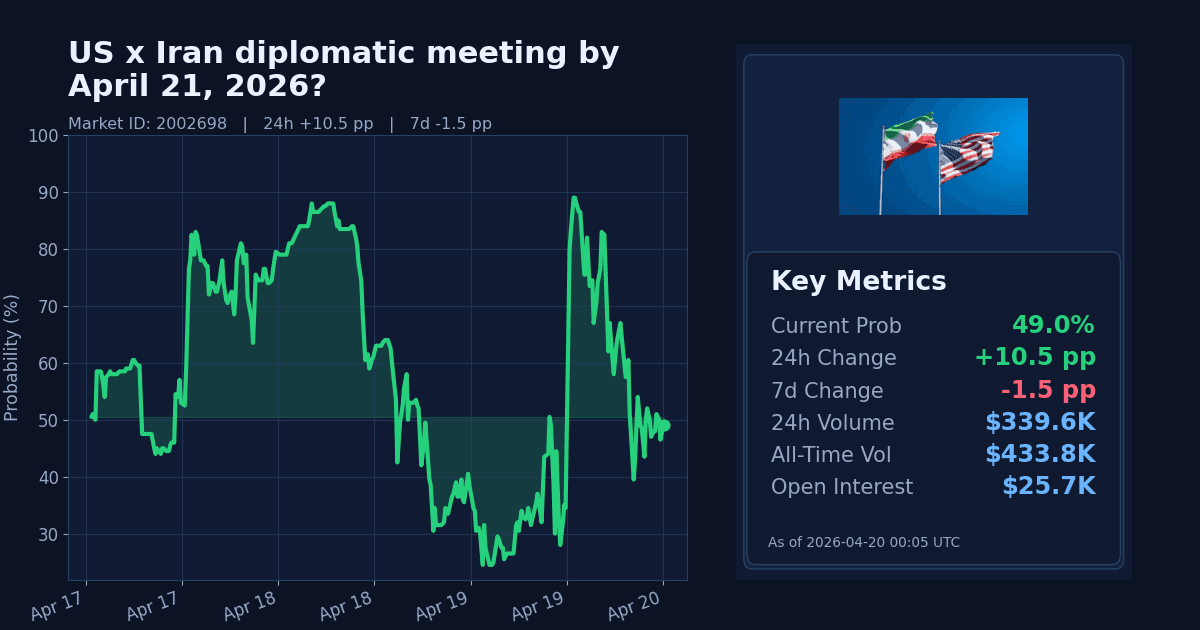
The Polymarket contract on whether the United States and Iran will hold a diplomatic meeting by 11:59 PM ET on April 21, 2026 rose sharply to 49%, up 10.5 percentage points over 24 hours. The move comes with less than two days remaining in the contract window, heightening sensitivity to near‑term signals.
Over the past week, pricing is broadly flat (−1.5pp), but the latest 24‑hour z‑score is 34.0, indicating an extreme daily repricing relative to recent trading history.
Why It Likely Moved
- The repricing appears driven by reporting of last‑ditch engagement efforts using Pakistan as a venue with Iranian officials and intermediaries ahead of a ceasefire deadline, which could facilitate in‑person or indirect in‑person contact that fits the market’s qualifying criteria, according to Axios (Apr 19).
- Markets reacted to escalating urgency as a U.S.–Iran ceasefire expired with no new deal and Iran again closed the Strait of Hormuz, raising the stakes for rapid diplomacy before the market’s end date, per NPR (Apr 19).
- The repricing follows a U.S. government briefing in which Secretary of War Pete Hegseth urged Iran to work in good faith toward a deal during the ceasefire and blockade period, signaling openness to engagement (U.S. government, Apr 16).
- European and UK official statements highlighting harm to Gulf shipping and questioning Iran’s actions in Hormuz underscore international pressure for de‑escalation that can catalyze talks: a European Parliament written question (Apr 16) and a UK statement at the UN (Apr 16).
How Strong the Move Is
The 24‑hour change (+10.5pp) registers an extreme z‑score (34.0), characterizing the move as a sharp, event‑driven spike rather than routine volatility. By contrast, the 7‑day picture is flat (−1.5pp) with a normal 7‑day z‑score, indicating no established longer‑term trend.
Given the contract’s imminent April 21 end date, this looks like a time‑sensitive repricing focused on immediate prospects of an in‑person or indirect in‑person diplomatic encounter being publicly acknowledged.
Cross-Market Confirmation
- “US x Iran diplomatic meeting by April 20, 2026?” fell 5pp in 24h to 9%. This diverges for the earlier window but aligns with a timing shift: lower odds for April 20 while April 21 rises.
- “US x Iran permanent peace deal by April 22, 2026?” is down 3pp in 24h to 17%, suggesting traders are not extrapolating a near‑term meeting into an immediate comprehensive settlement.
- “US x Iran permanent peace deal by April 30, 2026?” is down 5pp in 24h to 34% (despite a +20pp 7d move), reinforcing that today’s shift is concentrated on meeting odds rather than a durable deal.
News & Real-World Context
NPR reported on April 19 that a U.S.–Iran ceasefire expired with no new agreement and Iran again closed the Strait of Hormuz, threatening global shipping and elevating the urgency for direct or mediated diplomacy before escalation resumes (NPR). Axios the same day described last‑ditch talks in Pakistan involving U.S. envoys engaging Iranian officials and regional intermediaries ahead of the deadline (Axios).
Government signals echo the pressure for engagement. On April 16, the U.S. government publicly urged Iran to work in good faith toward a deal during the ceasefire and blockade period (U.S. government). The same day, the UK government highlighted at the UN that attacks on Gulf shipping have been “deeply damaging,” and the European Parliament raised concerns about legal violations and the energy crisis linked to Hormuz—both consistent with mounting diplomatic pressure.
Broader markets are not reflecting an acute, generalized risk spike: Brent crude is $90.38/bbl (−5.06% over 7 days; −19.44% over 30 days), the VIX is 17.48 (−9.10% over 7 days), and the U.S. Dollar Index is 98.301 (−0.35% over 7 days). These stats suggest the repricing is specific to diplomatic odds rather than a broad macro shock.
Bottom Line
Traders sharply increased the probability of a qualifying in‑person (including indirect) U.S.–Iran diplomatic meeting by April 21, likely on last‑minute engagement signals and official statements during a narrowing window. The move looks short‑term and event‑driven, with related markets indicating a timing shift toward April 21 but no concurrent jump in permanent‑deal expectations.
Market Conditions at Time of Writing
- Current Probability: 49%
- 24h Change: +10.5pp
- 7d Change: −1.5pp
- Volume (24h, $): 339,605.96
- Open Interest ($): 25,669.8
- Spread (pp): 2.0
- Z-score (24h): 34.0