What Moved the Market
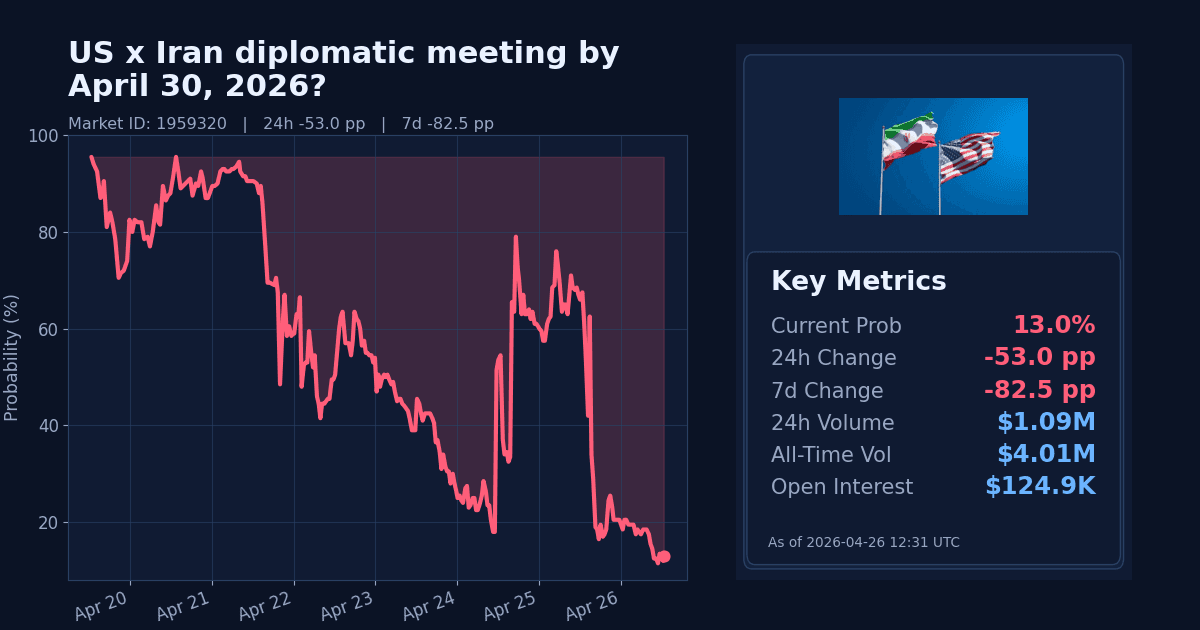
The Polymarket contract asking whether the United States and Iran will hold a diplomatic meeting by April 30, 2026 fell sharply over the past 24 hours. Implied probability dropped 53 percentage points to 13% as of April 26.
Over the past week, the contract is down 82.5 percentage points, marking a decisive late-window repricing with just days remaining until the April 30, 2026 resolution deadline.
Why It Likely Moved
- The selloff appears driven by reports that Pakistan-hosted talks were put on hold after Iran’s top diplomat left Islamabad and envoys for Donald Trump did not attend, stalling efforts at de-escalation, according to AP News (Apr 26) and NPR (Apr 26). Markets appear to have marked down the likelihood of any qualifying, in-person U.S.–Iran diplomatic engagement before April 30.
- Repricing follows an official U.S. posture signaling heightened maritime enforcement toward Iran: the U.S. government announced on Apr 24 that a joint force is enforcing a maritime blockade in the Gulf of Oman and globally, authorizing lethal force to protect maritime interests. Traders appear to have interpreted this as reducing near-term prospects for direct diplomacy.
- Macro context is consistent with elevated geopolitical risk: Brent crude stands at $99.13/bbl, up 9.68% over 7 days, while the VIX is up 7.04% over the week (Yahoo Finance, Yahoo Finance). This backdrop aligns with a repricing away from imminent diplomatic breakthroughs.
- Broader official signals reflect regional disruption rather than imminent de-escalation: the European Parliament published (Apr 24) a written question on risks of aviation fuel shortages due to war in the Middle East; the UK government issued (Apr 25) a UK–UAE Joint Statement, underscoring active regional diplomacy but not pointing to a direct U.S.–Iran track.
How Strong the Move Is
By the platform’s own measures, this is an extreme move. The 24-hour z-score of 222.0 categorizes the decline as highly atypical for recent trading. The 7-day z-score of 5.64 also flags an extreme, persistent downshift.
With the contract window closing on April 30, 2026, the combination of deadline pressure and negative headlines has produced a decisive late-stage repricing rather than routine noise. The pattern is consistent with a deadline-driven collapse in perceived odds of a qualifying, in-person diplomatic meeting.
Cross-Market Confirmation
- The sister market “US x Iran diplomatic meeting by April 27, 2026?” fell 53.75pp in 24h to 1.6%, confirming the downshift in near-term meeting odds.
- The “by April 28, 2026?” market dropped 57.0pp in 24h to 5.0%, aligning directionally with the main move.
- The “by April 29, 2026?” market declined 56.0pp in 24h to 10.0%, reinforcing the broad, date-adjacent repricing.
Across these closely related markets, simultaneous, large declines in the 24-hour window corroborate the main contract’s move rather than diverging from it.
News & Real-World Context
- On April 26, AP News reported that talks in Pakistan were put on hold after Iran’s top diplomat left Islamabad and envoys for Donald Trump did not attend, interrupting negotiations aimed at a ceasefire. NPR noted the pause in discussions and the planned return of Iran’s foreign minister to Islamabad.
- On April 24, the U.S. government stated that a joint force is enforcing a maritime blockade in the Gulf of Oman and globally, with authorization of lethal force to protect maritime interests.
- Also on April 24, the European Parliament published a written question highlighting risks of aviation fuel shortages tied to the war in the Middle East, underscoring ongoing regional disruption.
- On April 25, the UK government released a UK–UAE Joint Statement, reflecting continued official engagement on regional matters. Separately, French efforts to reopen the Strait of Hormuz were reported on April 26 amid energy-supply concerns, per Ground News.
Bottom Line
The collapse in odds reflects a deadline-driven reassessment after Pakistan-hosted talks paused and amid an official U.S. maritime enforcement posture toward Iran. Cross-market and macro signals align with reduced expectations of an in-person, publicly acknowledged U.S.–Iran meeting before April 30, 2026. The move looks acute and near-term rather than structural.
Market Conditions at Time of Writing
- Current Probability: 13.0%
- 24h Change: -53.0pp
- 7d Change: -82.5pp
- Volume (24h, $): 1,085,144.96
- Open Interest ($): 124,888.21
- Spread (pp): 1.0
- Z-score (24h): 222.0