What Moved the Market
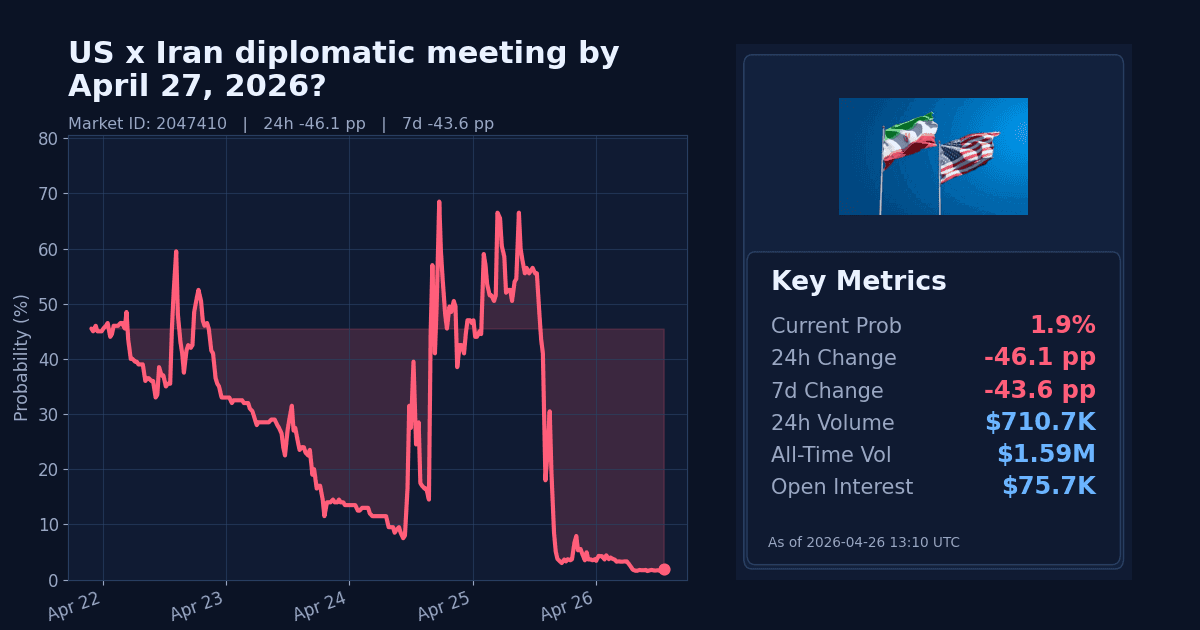
The Polymarket contract on whether the United States and Iran would hold a diplomatic meeting by April 27, 2026, dropped sharply over the past day. Implied probability fell 46.1 percentage points to 1.9% as of April 26.
The contract window runs April 21–27, 2026 (11:59 PM ET). With less than two days remaining and a requirement for an in-person, publicly acknowledged meeting (direct or indirect via mediators), traders repriced the near-term likelihood to very low.
Why It Likely Moved
- Repricing appears driven by a hardened US operational posture: on April 24, the US government announced joint-force enforcement of a maritime blockade targeting Iran-linked shipping, with authorization of lethal force in the Gulf of Oman and beyond, signaling confrontation rather than imminent diplomacy (US government, 2026-04-24).
- Markets reacted to reports that talks in Pakistan were put on hold after Iran’s top diplomat left Islamabad and US envoys did not attend, undercutting prospects for a publicly acknowledged, in-person engagement before the deadline (AP News, 2026-04-26; NPR, 2026-04-26).
- Repricing follows broader signals of sustained regional disruption, including French efforts to reopen the Strait of Hormuz and industry warnings on energy supply strains (Ground News, 2026-04-26).
- Macro context is consistent with elevated geopolitical risk: Brent crude at $99.13/bbl is up 9.68% over 7 days, while the VIX rose 7.04% over the week, indicating higher risk premia alongside Middle East tensions.
- Additional institutional signals underscore conflict spillovers rather than de-escalation: concerns in the European Parliament about aviation fuel shortages linked to the Middle East war (written question dated April 24) highlight persistent disruption, not imminent US–Iran engagement (European Parliament, 2026-04-24).
How Strong the Move Is
The 24-hour decline of 46.1 percentage points registers as an extreme down move by the market’s own z-score metric (z ≈ 52.9). Liquidity conditions were active, with ~$711k in 24-hour volume and a tight 0.1pp spread, suggesting broad participation rather than a thin print.
Over seven days, the probability is down 43.6pp. Despite the magnitude, the market’s 7-day z-score reads as normal relative to its weekly volatility profile, indicating that the latest drop is a decisive final-week repricing rather than a sudden outlier without precedent in this series.
Cross-Market Confirmation
- US x Iran meeting by April 28, 2026: 5.0% (24h -42.5pp). Direction aligns, confirming a broader near-term de-rating.
- US x Iran meeting by April 29, 2026: 10.0% (24h -47.5pp). Confirms continued skepticism beyond April 27.
- US x Iran meeting by April 30, 2026: 14.0% (24h -48.5pp; 7d -78.5pp). Strongest corroboration that markets see minimal chances across adjacent expiries.
News & Real-World Context
Talks aimed at de-escalation were paused as Iran’s foreign minister departed Islamabad and US envoys did not appear, according to reports on April 26. This directly undercuts the specific requirement for an in-person, acknowledged diplomatic meeting within the contract window (AP News, NPR).
On April 24, the US government stated that a joint force is enforcing a maritime blockade in the Gulf of Oman and globally to interdict Iran-related shipping, with lethal-force authorization, signaling a military-first posture incompatible with an imminent publicly acknowledged diplomatic meeting (US government, 2026-04-24). The European Parliament also flagged risks to aviation fuel supplies tied to the Middle East war in a written question to the Commission on April 24, reflecting continued systemic disruption rather than de-escalation (European Parliament, 2026-04-24). Separately, the UK government issued a UK–UAE joint statement on April 25 focused on foreign affairs and defence ties, underscoring sustained regional security coordination (UK government, 2026-04-25).
Bottom Line
The market’s collapse to 1.9% appears to be a late-window repricing driven by paused talks and a confrontational US operational stance. Cross-market drops for later expiries reinforce that traders see little chance of an in-person, acknowledged US–Iran diplomatic meeting in the immediate term.
Market Conditions at Time of Writing
- Current Probability: 1.9%
- 24h Change: -46.1pp
- 7d Change: -43.6pp
- Volume (24h): $710,698.59
- Open Interest: $75,725.44
- Spread: 0.1pp
- Z-score (24h): 52.9 (extreme down)