What Moved the Market
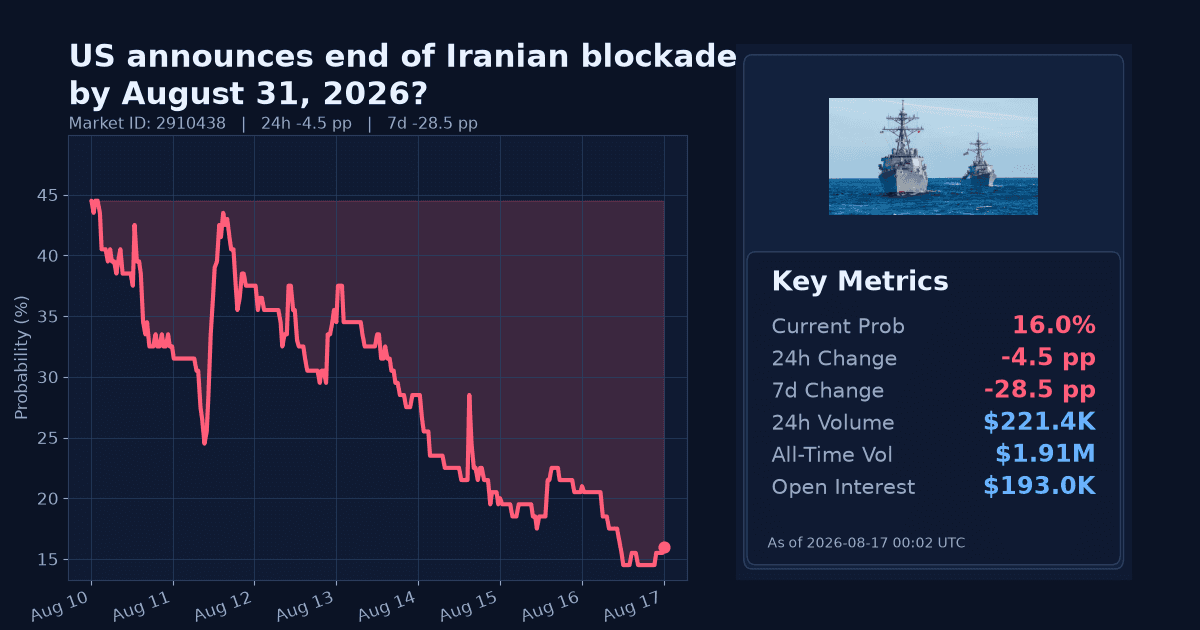
The Polymarket contract on whether the United States will officially announce the end or suspension of its naval blockade on Iranian ships and customers by August 31, 2026 fell to 16%. Over the past 24 hours, the price declined by 4.5 percentage points; over seven days, it is down 28.5 percentage points.
The move registers as statistically extreme for this market’s recent trading: the 24-hour z-score is 20.0 and the 7-day z-score is 10.47, with elevated 24-hour volume of $221,409.74 and a tight 1.0pp spread.
Why It Likely Moved
- Repricing appears driven by the absence of any qualifying US government announcement to end or suspend the blockade as the August 31, 2026 resolution deadline approaches, narrowing the remaining window.
- Markets reacted to parallel declines in earlier-dated, highly related contracts (e.g., August 22 and September 30 maturities), reinforcing a near-term consensus that no announcement is imminent.
- The only recent official foreign-policy item in the supplied context is a UK/EU-led joint statement on August 12 addressing executions in Iran, which does not indicate any US policy move on maritime restrictions; traders likely interpreted the lack of relevant government signaling as status quo persistence, per the UK government.
- The repricing follows a week in which Brent crude rose 6.19% to $88.72/bbl, yet odds still fell, suggesting the move is timing and policy-signal driven rather than linked to broader oil-price dynamics.
How Strong the Move Is
The decline is pronounced. The 24-hour drop of 4.5pp to 16% is categorized as extreme by the market’s own volatility metrics (24h z-score 20.0). The 7-day fall of 28.5pp also screens as extreme (z-score 10.47), indicating sustained selling pressure rather than a transient fluctuation.
Taken together, the pattern points to a sharp downward repricing concentrated in the near-term window of this contract (July 13–August 31, 2026), consistent with time running out absent new official signals.
Cross-Market Confirmation
- US announces end by August 22, 2026: down 3.0pp (24h) and 22.0pp (7d) to 5.0% — confirms broad near-term downside.
- US announces end by September 30, 2026: down 1.0pp (24h) and 24.0pp (7d) to 41.0% — aligns directionally, though the 24h move is smaller.
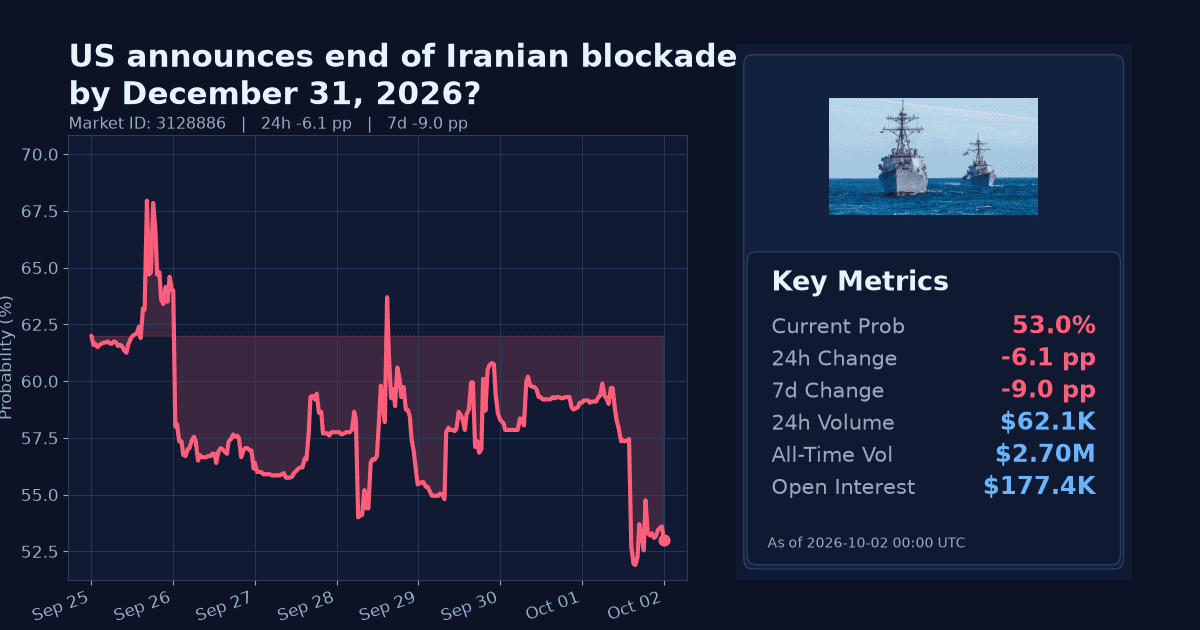
- US announces end by December 31, 2026: up 1.45pp (24h) but down 4.05pp (7d) to 81.1% — slight 24h divergence, but longer-dated optimism remains while the weekly drift is lower.
News & Real-World Context
- On August 12, a joint statement led by the United Kingdom and the High Representative of the European Union addressed executions in Iran; it did not reference maritime policy or US sanctions/blockade decisions, offering no direct signal toward ending the blockade, per the UK government.
- Separately, on August 16, AP reported that President Trump ordered the Pentagon to scale back joint exercises with South Korea, a move unrelated to Iran policy and not indicative of changes to the blockade posture (AP News).
No qualifying US announcement ending or suspending the blockade appears in the supplied official communications, and the news flow provided does not include policy shifts tied to Iran’s maritime restrictions.
Bottom Line
This is a sharp, deadline-driven selloff: as August 31 approaches without a qualifying US statement, traders are pricing a lower likelihood of an official end to the blockade within the current window. Cross-market moves confirm broad near-term skepticism while longer-dated contracts retain higher confidence.
Market Conditions at Time of Writing
- Current Probability: 16.0%
- 24h Change: -4.5pp
- 7d Change: -28.5pp
- Volume (24h): $221,409.74
- Open Interest: $192,971.79
- Spread: 1.0pp
- Z-score (24h): 20.0