What Moved the Market
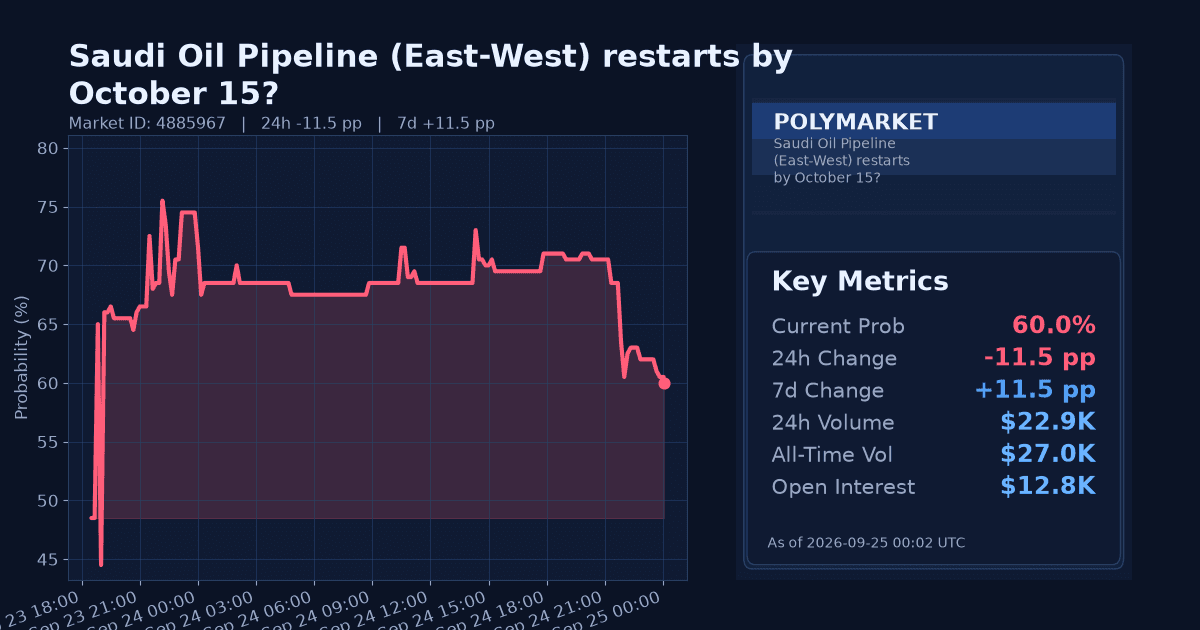
The Polymarket contract on whether Saudi Arabia’s East–West (Petroline) oil pipeline will restart by October 15 fell to 60% as of September 25, down 11.5 percentage points over the past 24 hours. The market opened on September 23 and will resolve on an on-or-before basis if the Saudi government states the pipeline is operating (including at reduced capacity) by 11:59 PM ET on October 15; otherwise it resolves “No.”
The recent downtick follows a stretch in which weekly pricing is still higher versus seven days ago (+11.5pp), leaving the contract above last week’s level but notably lower on the day.
Why It Likely Moved
- The repricing appears driven by official signals underscoring ongoing regional security risks: the G7 Foreign Ministers on September 22 condemned continued Houthi strikes in Yemen and flagged threats to regional stability and global energy security, including navigational rights in the Red Sea and Bab al-Mandab, according to the UK government and Global Affairs Canada.
- Markets also reacted to the UK’s September 22 announcement of additional defensive military support to Saudi Arabia in response to renewed Houthi attacks, per the UK government, which likely tempered confidence in an imminent Saudi restart announcement that meets the market’s strict resolution criteria.
- Humanitarian reporting points to continued conflict intensity in adjacent theaters: the IOM Displacement Tracking Matrix documented new displacement on Yemen’s west coast in its September 23 update, indicating persistent insecurity that traders may factor into operational risk assessments (IOM).
- Macro confirmation is limited: Brent crude is $106.08/bbl (as of Sep 24), up 19.8% over 30 days but roughly flat day over day. The flat daily print suggests the drop in restart odds is more event-risk specific than driven by broader oil price moves.
How Strong the Move Is
The 24-hour decline of 11.5pp registers as an extreme downside move by this market’s own history (z-score 44.0). That indicates a sharp, outsized repricing rather than routine noise.
Over seven days the change is +11.5pp and statistically normal (7d z-score labeled “normal”), implying the contract remains in an elevated range versus last week. Taken together, this looks like a sharp pullback within an otherwise stable weekly profile, not a clear trend reversal.
Cross-Market Confirmation
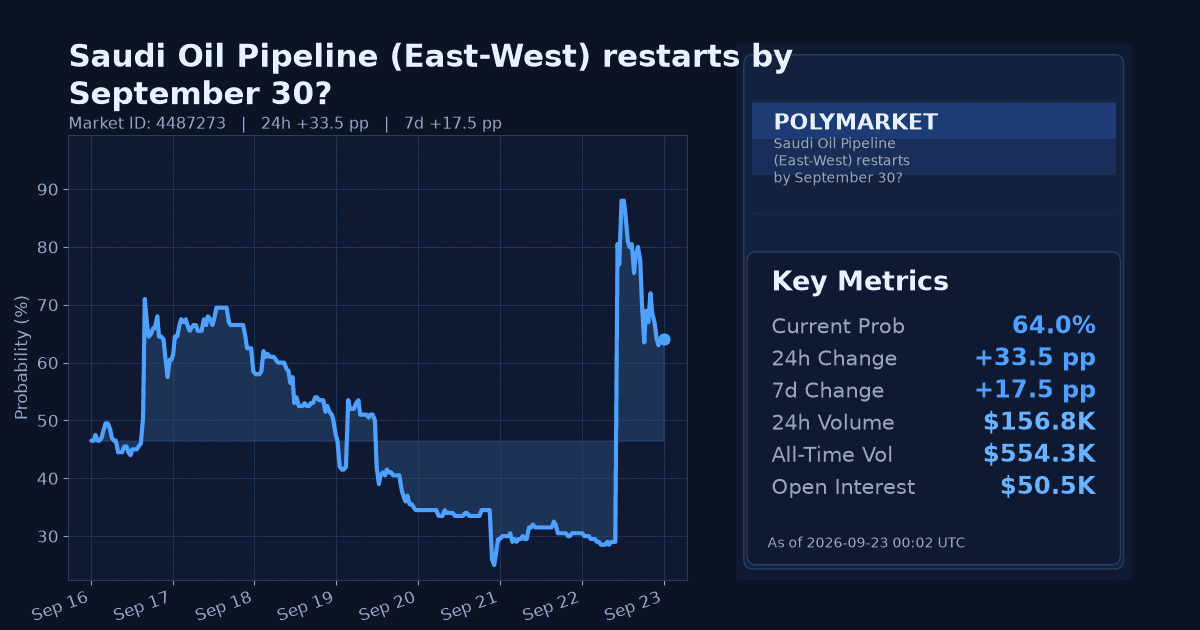
- “Saudi Oil Pipeline (East–West) restarts by September 30?” fell 11.5pp in 24h to 36% and is down 22pp over 7d, aligning with weaker near-term restart expectations and confirming the direction of today’s move.
- “Bab el-Mandeb Strait effectively closed by October 31?” shows 24h change N/A and a 7d decrease of 2pp to 9%, a mild divergence that suggests maritime-closure risk has not risen in tandem.
- “Bab el-Mandeb Strait effectively closed by December 31?” is up 2pp in 24h to 20% but down 1pp over 7d, a mixed signal that does not offer clear confirmation of the main move.
News & Real-World Context
Per the market description, Saudi Arabia’s Ministry of Energy announced on September 11, 2026 that the East–West pipeline was shut down. Since resolution requires a fresh Saudi government statement affirming that the pipeline is presently operating, traders are highly sensitive to official security signaling around the Kingdom and its vicinity.
On September 22, the G7 Foreign Ministers—joined by the EU High Representative—condemned ongoing Houthi strikes and warned of risks to regional stability, energy security, and navigational freedoms in the Red Sea and Bab al-Mandab, as published by the UK government and Global Affairs Canada. The same day, the UK government announced additional defensive military support to Saudi Arabia in response to renewed Houthi attacks.
Humanitarian monitoring corroborates a challenging security environment nearby: the IOM reported newly displaced populations along Yemen’s west coast in its September 23 update, reflecting conflict dynamics that can complicate regional energy logistics (IOM).
Bottom Line
The drop in restart odds appears tied to authoritative government statements emphasizing ongoing regional threats rather than to broad oil-market moves. With resolution contingent on a specific Saudi government announcement by October 15, pricing reflects reduced confidence in a near-term qualifying statement.
This looks like a short-term repricing driven by policy and security signals; absent a direct Saudi update, volatility around headline risk is likely to persist within the contract window (Sep 23–Oct 16 ET).
Market Conditions at Time of Writing
- Current Probability: 60%
- 24h Change: -11.5pp
- 7d Change: +11.5pp
- Volume (24h, $): $22,876.38
- Open Interest ($): $12,830.06
- Spread (pp): 1.0
- Z-score (24h): 44.0