What Moved the Market
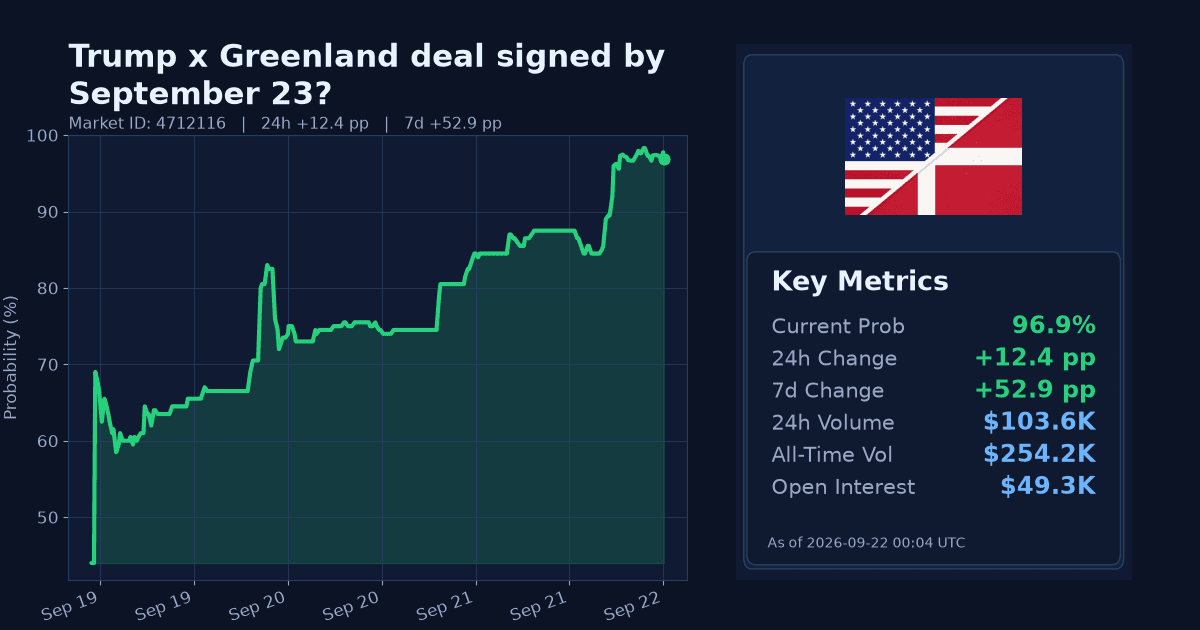
The Polymarket contract “Trump × Greenland deal signed by September 23?” rose sharply to 96.9%, up 12.4 percentage points over the past 24 hours and 52.9 points over the week. The market trades on whether the United States and Denmark will formally sign any Greenland-related agreement by September 23, 2026, 11:59 PM ET.
Liquidity also deepened, with 24h volume at $103.6k and open interest at $49.3k, while the spread tightened to 0.3 percentage points.
Why It Likely Moved
- Repricing appears driven by an official September 18 statement from the Greenland government (Naalakkersuisut) flagging an “expected agreement to strengthen security in the Arctic and North Atlantic area,” a direct policy signal relevant to U.S.–Danish arrangements involving Greenland, published by the Government of Greenland.
- Markets reacted to a September 22 report that the United States plans to establish two new military bases in Greenland, a Reuters exclusive cited via Ground News, which would imply expanded U.S. presence contingent on Danish/Greenlandic consent frameworks.
- The repricing follows Danish/Allied framing that NATO shares responsibility for Arctic security under an associated Greenland arrangement, per a September 21 article summarized by Ground News, reinforcing the defense context of any prospective deal.
- Parallel government signals of heightened Arctic security coordination by close allies—Canada and Norway—add to the policy backdrop: Canada’s Prime Minister’s Office highlighted Arctic security cooperation in readouts and a joint statement on September 21 and 20 respectively (PMO Readout; Joint Statement), while Norway’s Armed Forces noted closer U.S.–Norwegian military cooperation on September 21 (Forsvaret).
- Broader Arctic governance activity—such as the EU Commission’s September 21 note on strengthening Greenland emergency response amid rising climate risks (European Commission)—may have incrementally reinforced the sense of imminent, formalized frameworks.
How Strong the Move Is
The 24-hour move is extreme by historical standards (z-score 52.0), indicating an outsized re-pricing concentrated in a short window. The 7-day change of +52.9pp registers as normal relative to recent volatility, suggesting a continuation of a fast-building trend rather than a sudden reversal.
With price near 97% and a tight spread, the market is now priced for a high likelihood of a signed U.S.–Denmark Greenland-related agreement within the contract’s window (by September 23, 2026, 11:59 PM ET).
Cross-Market Confirmation
- Closely related: “Trump × Greenland deal signed by September 25?” rose to 99.2% (delta_24h: +8.65pp; 7d: N/A), confirming directional alignment and confidence spilling over into adjacent-deadline markets.
- Broader security risk proxies (only loosely related): “NATO × Russia military clash by October 31, 2026?” rose to 20.0% (delta_24h: +3.5pp; delta_7d: +5.5pp), and the December 31, 2026 variant to 31.0% (delta_24h: +3.0pp; delta_7d: +8.0pp). These upticks do not directly confirm the Greenland-specific thesis but indicate a mild parallel increase in security-risk pricing.
News & Real-World Context
- The Greenland government (Naalakkersuisut) stated on September 18 that an agreement is expected to strengthen security in the Arctic and North Atlantic (Government of Greenland). As Greenland’s external affairs are handled by Denmark, such a signal is highly germane to a U.S.–Danish Greenland agreement requiring formal signatures.
- On September 22, a Reuters-exclusive report (via Ground News) said the U.S. plans two new bases in Greenland, implying concrete steps toward expanded U.S. access and basing—arrangements that typically necessitate bilateral accords.
- A September 21 piece summarized by Ground News recounts Denmark’s emphasis that NATO shares responsibility for Arctic security under the Greenland-related agreement framing, underscoring the alliance context.
- Allied governments flagged parallel Arctic security coordination: Canada’s PMO highlighted deepened Arctic security and defense ties with Norway on September 21 and issued a detailed joint statement on September 20 (PMO Readout; Joint Statement); Norway’s Armed Forces cited closer U.S.–Norwegian cooperation on September 21 (Forsvaret). The European Commission on September 21 noted strengthened Greenland emergency response amid climate risks (EC DG ECHO).
- Macro backdrop is not pointing to broad risk stress: the VIX is 14.87, down 13% over 7 days, and the U.S. Dollar Index is up ~0.97% over the week. Brent crude sits at $96.17, down ~9% over 7 days. This supports the view that the Greenland move is idiosyncratic rather than macro-driven.
Bottom Line
An official Greenland signal of an expected security agreement, combined with reporting on planned new U.S. bases, has pushed the market to price a very high chance of a signed U.S.–Denmark Greenland agreement by the September 23 deadline. The 24h move is an extreme spike and, with corroborative policy signals from allied governments, looks like a late-window conviction trade.
Absent publication of signed documents, residual headline risk remains, but current pricing implies markets expect formal signatures imminently.
Market Conditions at Time of Writing
- Current Probability: 96.9%
- 24h Change: +12.4pp
- 7d Change: +52.9pp
- Volume (24h, $): 103,625.47
- Open Interest ($): 49,335.05
- Spread (pp): 0.3
- Z-score (24h): 52.0