What Moved the Market
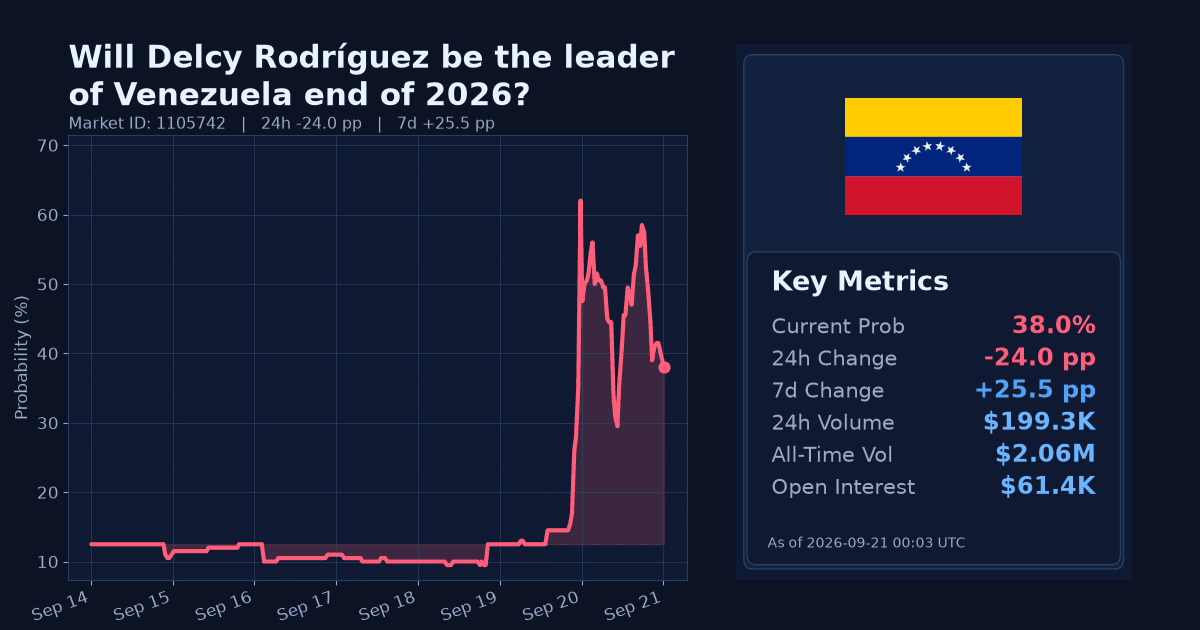
Polymarket traders sharply cut the probability that Delcy Rodríguez will be Venezuela’s head of state on December 31, 2026 (12 PM ET). The contract fell 24 percentage points over the past 24 hours to 38%.
Across the past week, however, the market is still up 25.5 percentage points. The juxtaposition of a steep daily drop within a strong weekly gain points to heavy two-way repositioning rather than a settled trend.
Why It Likely Moved
- The repricing appears driven by a rotation into the related Nicolás Maduro end‑2026 market, which rose 22.6pp in 24h, suggesting traders reallocated leadership odds away from Rodríguez toward Maduro.
- Markets reacted to elevated turnover and relatively tight pricing: $199k traded in 24h with a 3pp spread, consistent with an active, order‑flow‑driven move rather than illiquidity noise.
- The shift also aligns with a busy diplomatic calendar around the UN General Assembly’s high‑level week (Sept 20–23) flagged by the Danish Foreign Ministry on Sept 20; participants often rebalance exposure ahead of potential official signals, even absent a direct Venezuela announcement in the feed.
- Broader macro conditions provide a neutral-to-mixed backdrop rather than a clear catalyst: WTI crude is $95.89/bbl and down 4.16% over 7 days, while the US Dollar Index is up 1.18% over 7 days and the VIX is down 6.5% over 7 days.
How Strong the Move Is
The 24‑hour swing is classified as extreme by the market’s own z‑score measures, indicating an unusually sharp downside move versus recent trading patterns. By contrast, the 7‑day change is also extreme but to the upside, underscoring elevated volatility and rapid reassessment of leadership scenarios within the contract window.
Taken together, this looks like a sharp, order‑flow‑driven reversal inside a broader weeklong up‑move, not yet a durable trend.
Cross-Market Confirmation
- Nicolás Maduro end‑2026 market: +22.6pp (24h), −26.9pp (7d). The 24h jump inversely confirms the Rodríguez selloff; the 7d decline diverges from Rodríguez’s weekly rise, highlighting churn rather than consensus.
- US announces end of Iranian blockade by Dec 31, 2026: +0.55pp (24h), +0.5pp (7d). Largely unrelated; no confirming signal.
- US announces end of Iranian blockade by Sept 30, 2026: N/A (24h), −2.5pp (7d). Unrelated; no confirming signal.
News & Real-World Context
- The US Department of State’s Office of the Historian released South America chapters (including Venezuela) from the 1981–1988 Foreign Relations series on Sept 18, 2026. While historical in nature and not a policy change, it is an official US government publication that references US‑Venezuela relations in that era, per the State Department.
- The Danish Foreign Ministry noted on Sept 20 that its foreign minister will attend the UN General Assembly’s opening high‑level week (Sept 20–23), with agendas spanning Ukraine, the Middle East, Africa, and AI, per the official announcement. This confirms a dense diplomatic window, though the provided feed includes no Venezuela‑specific government statements tied to leadership outcomes.
- No Venezuela‑specific developments appear in the supplied news items. This absence of a direct catalyst supports the interpretation that today’s move is primarily cross‑market and positioning‑led.
Bottom Line
Today’s drop in Rodríguez’s end‑2026 odds looks like a sharp, internally driven rotation toward the Maduro contract, not a repricing anchored to a new public policy signal in the provided sources. With extreme z‑scores in both the 24h and 7d windows pointing in opposite directions, the signal is short‑term and unsettled rather than structural.
Market Conditions at Time of Writing
- Current Probability (%): 38.0
- 24h Change (pp): -24.0
- 7d Change (pp): +25.5
- Volume (24h, $): 199,298.94
- Open Interest ($): 61,410.77
- Spread (pp): 3.0
- Z-score (24h): 104.0 (extreme)