What Moved the Market
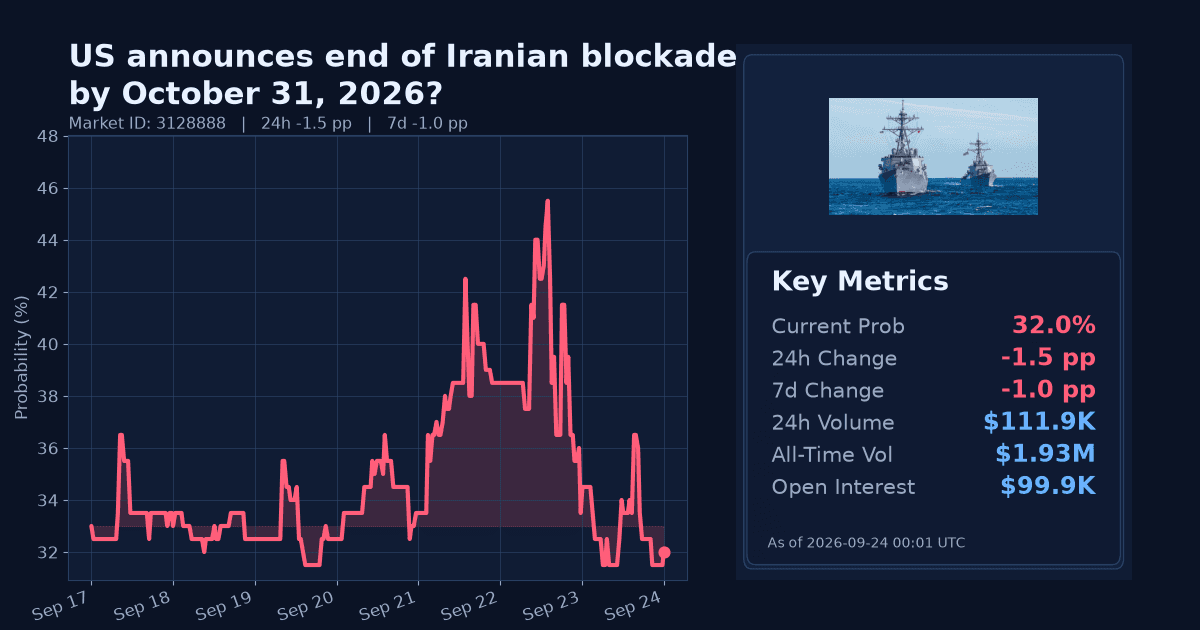
The Polymarket contract "US announces end of Iranian blockade by October 31, 2026?" fell 1.5 percentage points over the past 24 hours to 32.0% as of September 24, 2026. Over the past week, it is down 1.0 percentage point.
This market resolves "Yes" if an authorized US government announcement ends, lifts, or suspends the US naval blockade on Iranian ships and customers by 11:59 PM ET on October 31, 2026. The contract window runs from market creation on July 27, 2026, through October 31, 2026.
Why It Likely Moved
- The repricing appears driven by policy signals that maintain or tighten pressure on Iran rather than foreshadowing an easing. Canada announced additional sanctions on five individuals and five entities on September 23, 2026, according to Global Affairs Canada.
- Markets reacted to Australia’s September 23 statement underscoring concern over Iran’s actions at sea, with the foreign minister highlighting “weaponisation of the Strait of Hormuz” and joining the EU-led “No Fees/No Tolls” pledge, per the Australian Department of Foreign Affairs and Trade.
- The repricing follows reporting on continued efforts to move Iranian oil despite US restrictions, suggesting ongoing enforcement dynamics rather than de-escalation; see NPR on September 23.
- Broader market context shows reduced near-term stress in energy and volatility benchmarks, which may temper expectations of an imminent US policy reversal: Brent crude is down 7.6% week-over-week to $97.78/bbl and the VIX is down 14% week-over-week, per Yahoo Finance.
How Strong the Move Is
The 24-hour decline (−1.5 pp) carries an extreme z-score of 14.0 relative to the market’s recent trading history, indicating an outsized daily move in statistical terms. The magnitude in absolute terms is modest, but the dispersion relative to recent intraday behavior is elevated.
On a 7-day basis, the −1.0 pp change is classified as normal volatility. This looks like a sharp daily downtick rather than a sustained trend shift.
Cross-Market Confirmation
- End by September 30, 2026 (related market): Current probability 7.0%; 7d change −6.0 pp; 24h change N/A. Directionally aligns with lower odds of a near-term announcement.
- End by December 31, 2026 (related market): Current probability 62.0%; 24h change −3.25 pp; 7d change +1.05 pp. Mixed signal—near-term dip aligns with today’s move, but the weekly rise implies longer-window optimism.
- “Will the U.S. invade Iran before 2027?”: Current probability 13.0%; 24h change −1.0 pp; 7d change −3.0 pp. This decline aligns with reduced escalation risk, indirectly consistent with lower odds of an abrupt policy reversal by October 31.
News & Real-World Context
- On September 23, 2026, Canada announced additional sanctions on Iranian individuals and entities, reinforcing a tightening posture rather than signaling relaxation (Global Affairs Canada; backgrounder).
- Also on September 23, Australia’s foreign minister emphasized maritime security concerns, specifically citing Iran’s disruptions in the Strait of Hormuz and joining the EU-led “No Fees/No Tolls” pledge, per the Australian government.
- Reporting on September 23 highlighted continued flows of Iranian oil via sanction-evasion practices and framed these dynamics amid high-level US–China diplomatic engagement (NPR).
Bottom Line
Odds for a US announcement ending the Iranian naval blockade by October 31 edged lower, with an extreme daily z-score but modest absolute change. Cross-market signals lean cautious for near-term reversal while keeping year-end scenarios comparatively open.
Absent a qualifying US announcement, recent government actions and statements from Canada and Australia point to continued pressure, making this move look short-term cautious rather than structural.
Market Conditions at Time of Writing
- Current Probability: 32.0%
- 24h Change: −1.5 pp
- 7d Change: −1.0 pp
- Volume (24h): $111,850.27
- Open Interest: $99,854.94
- Spread: 1.0 pp
- Z-score (24h): 14.0 (extreme)