What Moved the Market
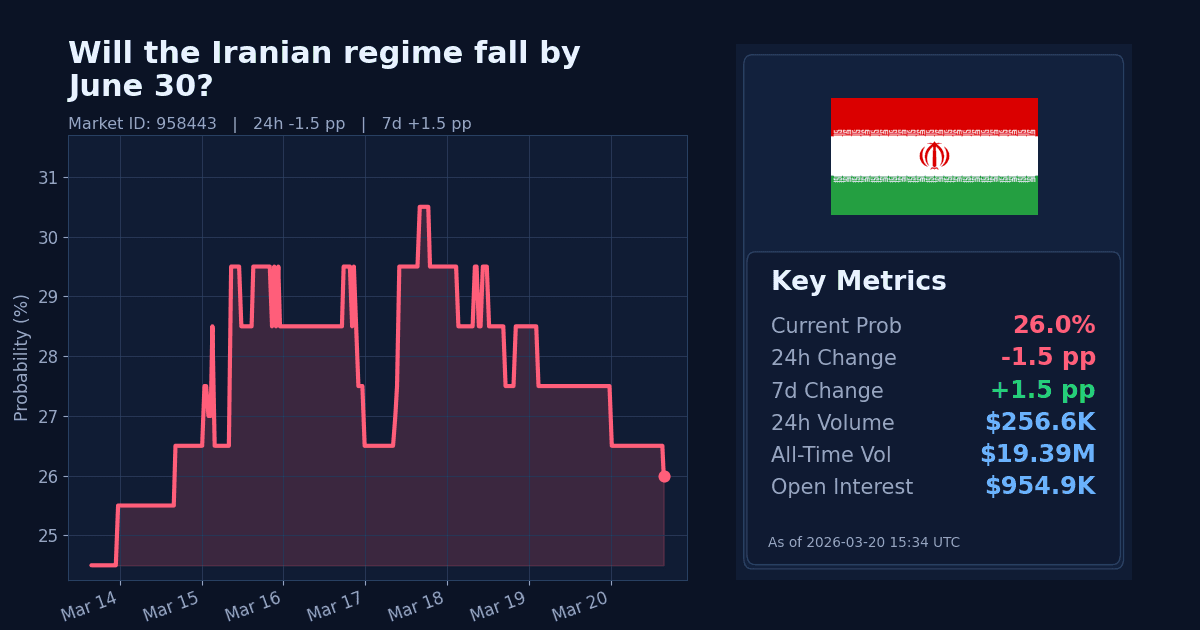
The Polymarket contract on whether the Iranian regime will fall by June 30, 2026, saw its probability decline from approximately 27.5% to 26.0% over the past 24 hours. This represents a 1.5 percentage point drop in the market's assessment of regime collapse within the specified timeframe. The market remains open until June 30, 2026, and this movement reflects recent shifts in sentiment about the regime's stability.
Why It Likely Moved
- The decline appears driven by ongoing military actions and heightened conflict in the region, including Israeli strikes on Tehran and Iranian attacks on Gulf oil facilities.
- Market participants may be repricing the likelihood of regime collapse downward due to the persistence of the Islamic Republic's control despite external pressures.
- The high probability (99.8%) of Iran taking military action against a Gulf state on March 20, 2026, suggests escalating tensions that could reinforce regime resilience or provoke further conflict rather than immediate collapse.
- The market's reaction aligns with reports of international efforts to secure the Strait of Hormuz, indicating concerns about regional stability but not necessarily imminent regime change.
How Strong the Move Is
The 1.5 percentage point decline over 24 hours, combined with a positive 7-day change of 1.5 points, indicates some short-term volatility rather than a sustained trend. The 24-hour z-score of 8.0 signals that this move is statistically significant and not mere noise, suggesting active trading and reassessment of probabilities. However, the overall probability remains relatively low at 26%, indicating market skepticism about near-term regime collapse.
Cross-Market Confirmation
- The related market on whether another country will conduct military action against Iran by April 15, 2026, holds a 38% probability, which is higher and suggests ongoing conflict risk.
- The near-certain expectation (99.8%) that Iran will take military action against a Gulf state on March 20, 2026, confirms heightened regional tensions.
- The low probability (3.7%) of Iran legalizing gay marriage reflects the market's view of limited internal reform, consistent with regime persistence.
- These related markets collectively confirm a context of escalating conflict and regime durability rather than imminent collapse.
News & Real-World Context
- Israeli airstrikes on Tehran and Iranian attacks on Gulf oil infrastructure have intensified, contributing to regional instability.
- European nations, Japan, and Canada have announced coordinated efforts to secure the Strait of Hormuz, underscoring international concern over shipping and energy security.
- Global trade growth is expected to slow to 1.9% this year, with the Iran conflict cited as a contributing factor, reflecting broader economic impacts.
- Despite these pressures, the Islamic Republic's core structures remain intact, with no credible reports of regime dissolution or replacement.
- Oil prices remain elevated, with WTI crude at $96.35 per barrel and Brent crude at $105.19 per barrel, reflecting ongoing geopolitical risk but stable energy markets.
Bottom Line
The recent decline in the probability of the Iranian regime falling by June 30, 2026, appears to be a short-term market adjustment in response to escalating military conflict and regional tensions. While the situation remains volatile, the market does not currently signal a structural shift toward imminent regime collapse. Continued monitoring of conflict dynamics and political developments will be essential to reassess this outlook.
Market Conditions at Time of Writing
- Current Probability: 26.0%
- 24h Change: -1.5 percentage points
- 7d Change: +1.5 percentage points
- Volume (24h): $256,588.68
- Open Interest: $954,919.70
- Spread: 1.0 percentage point
- Z-score (24h): 8.0