What Moved the Market
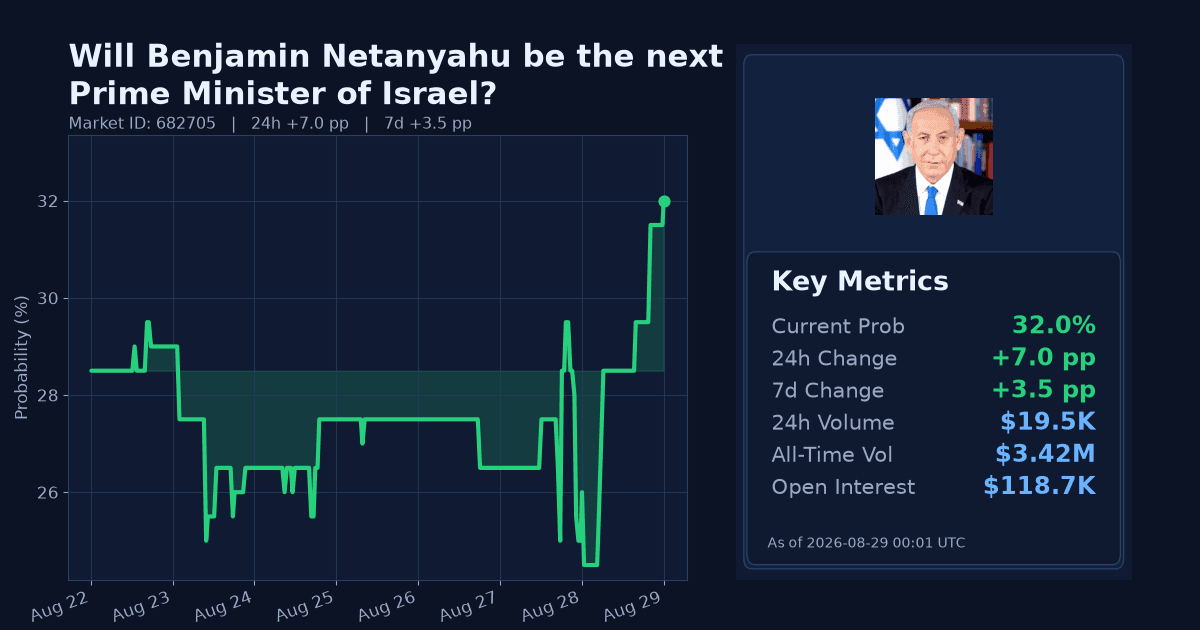
Polymarket traders lifted the probability that Benjamin Netanyahu will be the next officially sworn-in Prime Minister of Israel to 32%, up 7 percentage points over the past 24 hours. The 7‑day change is +3.5pp.
The contract resolves to the individual sworn in as Prime Minister following Israel’s next parliamentary election, scheduled for October 27, 2026; the market’s current trading window runs through December 31, 2026.
Why It Likely Moved
- Repricing appears driven by intensified UK diplomatic signaling on the Middle East: on August 26, the UK government told the UN Security Council that both parties must fulfill their commitments under Resolution 2803 and avoid actions undermining peace, a prominent official stance that can reframe expectations around Israel’s policy environment (UK government, 2026-08-26).
- Markets reacted to reporting that the UK warned Israel against removing it from a Gaza ceasefire coordination center, highlighting near-term diplomatic friction around Israel’s crisis management (AP News, 2026-08-28).
- Repricing follows signals of evolving regional risk posture, with U.S. diplomats and family members beginning a phased return to Middle East embassies, suggesting a managed-security environment rather than acute escalation (AP News, 2026-08-28).
- Additional European scrutiny is evident: a Norwegian parliamentary question on August 28 pressed for stronger measures in response to Israel’s policies, adding to the diplomatic backdrop traders may be incorporating (Stortinget/Norway, 2026-08-28).
- Macro conditions point away from a broad risk shock: the VIX sits at 14.43, down 4.6% over 7 days, indicating subdued market-wide volatility; this supports the view of a market-specific repricing rather than a macro-driven swing.
How Strong the Move Is
The 24-hour move (+7pp) registers as extreme versus recent trading history (z-score: 26.0). The 7‑day move (+3.5pp) is also extreme (z-score: 12.0).
Given both z-scores, this is best classified as a sharp, headline-driven spike rather than routine noise. The direction over a week suggests momentum, but the magnitude points to sensitivity to near-term signals.
Cross-Market Confirmation
- Israel PM candidate (Ofer Winter) — probability 1.6%, delta_24h −1.2pp: modest decline in an alternative-candidate market aligns directionally with a consolidation toward leading figures, offering weak confirmation.
- U.S. invade Iran before 2027 — probability 13.0%, delta_24h +1.0pp, delta_7d −3.0pp: mixed signals; a slight 24h uptick does not provide clear confirmation for Israel-specific political repricing.
- NATO–Russia clash by Oct 31, 2026 — probability 16.0%, delta_24h +0.5pp, delta_7d +3.5pp: broader geopolitical risk is mildly higher over 7 days, but moves are modest and not directly tied; this neither strongly confirms nor contradicts the main move.
News & Real-World Context
- On August 28, the United Kingdom warned Israel against removing the UK from a Gaza ceasefire coordination center, underscoring friction over ceasefire implementation mechanics (AP News).
- At the UN Security Council on August 26, the UK government urged all parties to meet commitments under Resolution 2803 and to refrain from actions undermining peace — a formal diplomatic position relevant to Israel’s security and political context (UK government).
- A written question in Norway’s parliament on August 28 pressed the foreign minister on deploying stronger measures in response to Israel’s conduct, reflecting heightened European attention to Israel policy (Stortinget/Norway).
- Also on August 28, the State Department began slowly returning U.S. diplomats and family members to Middle East embassies, indicating a calibrated security environment (AP News).
Bottom Line
This is an extreme, headline-sensitive repricing in favor of Netanyahu as the next sworn-in PM, appearing to track fresh diplomatic signals surrounding Israel. Without direct domestic electoral updates in the provided context, durability looks uncertain and likely short-term.
Market Conditions at Time of Writing
- Current Probability: 32.0%
- 24h Change: +7.0pp
- 7d Change: +3.5pp
- Volume (24h): $19,503.05
- Open Interest: $118,668.89
- Spread: 1.0pp
- Z-score (24h): 26.0