What Moved the Market
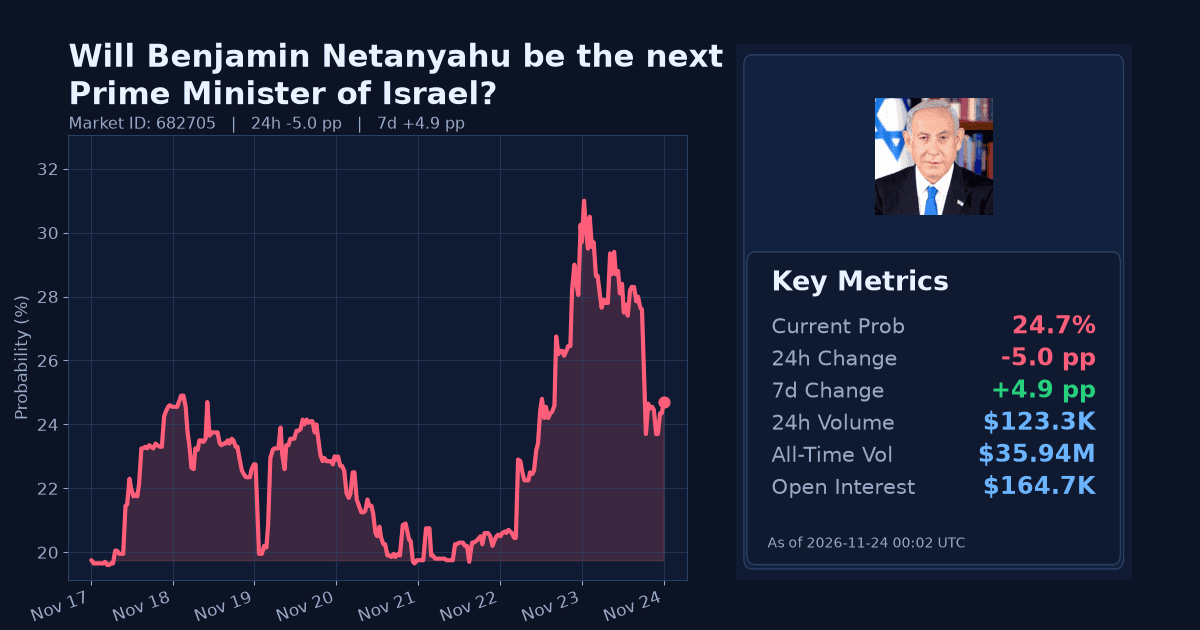
The Polymarket contract asks whether Benjamin Netanyahu will be the next individual formally appointed and sworn in as Prime Minister of Israel after the 2026 parliamentary election. The market opened on 2025-11-15 and is listed with an end date of 2026-10-28, following the scheduled 2026 election window; the resolution rules also note that a formally sworn-in prime minister is required, and caretaker status does not count.
Netanyahu’s price moved lower over the latest daily window, falling by roughly five percentage points. That drop came despite the contract still being modestly higher over the past week, making the latest move a near-term pullback rather than a simple continuation of the prior weekly direction.
Why It Likely Moved
- The repricing appears driven by a leadership-outcome rotation within Israeli prime-minister markets. The closest related contract, Gadi Eizenkot to be the next prime minister, moved in the opposite direction over the same daily window.
- Markets reacted to official diplomatic attention on Israel/Palestine, including a 2026-11-23 French foreign ministry item on Israeli settler attacks in the West Bank. The supplied evidence does not show a direct electoral trigger, but it does show renewed official focus on the issue set surrounding Israel’s government.
- The move also follows a broader diplomatic backdrop involving regional intermediaries: Canada announced on 2026-11-23 that it would host Qatar’s prime minister and foreign minister for the first annual Canada-Qatar Strategic Dialogue. That is an indirect signal, but it keeps regional diplomacy in focus.
- A higher-volatility macro setting may have made political contracts more sensitive to new signals. The VIX stood at 26.62 as of 2026-11-23 and was up 16.19% over seven days, indicating a risk backdrop that can amplify event-market moves.
How Strong the Move Is
The one-day move is statistically strong for this contract. The 24-hour z-score is 20.0, and the supplied interpretation labels the move as “extreme” and downward relative to the market’s recent trading history. That supports classifying the latest move as a sharp reversal rather than routine noise.
The weekly picture is more mixed. The seven-day z-score is 1.6501, with the supplied interpretation describing the move as “elevated” and upward, but not extreme. In other words, the daily selloff cut against the broader one-week gain, leaving the market in a short-term reversal inside an elevated weekly repricing.
Cross-Market Confirmation
- Gadi Eizenkot’s next-prime-minister market confirms the substitution signal: it rose 3.25 pp over 24 hours while Netanyahu fell, though it was down 1.0 pp over seven days, so the confirmation is strongest in the daily window.
- The “Trump out as President before 2027?” market does not confirm a broader political-risk shock. It moved -0.6 pp over 24 hours and -0.8 pp over seven days, directionally separate from the Israeli leadership rotation.
- The “U.S. invade Iran before 2027” market provides limited confirmation. Its 24-hour change is unavailable, and it fell 2.0 pp over seven days, which does not align with an escalation-driven explanation for Netanyahu’s drop.
News & Real-World Context
No correlated news articles were supplied in the evidence set. The available real-world context instead comes from official government and institutional announcements, which are primary policy signals but vary in direct relevance to this Israeli leadership market.
On 2026-11-23, the French foreign ministry published an item on “Israël/Palestine - Attaques de colons israéliens en Cisjordanie” concerning Israeli settler attacks in the West Bank during the night of 21-22 November, according to the French Ministry for Europe and Foreign Affairs. Separately, on 2026-11-23, Global Affairs Canada announced that Canada’s foreign minister would host Qatar’s prime minister and foreign minister in Ottawa on 2026-11-24 for the first annual Canada-Qatar Strategic Dialogue. These announcements do not directly name Netanyahu as an election issue, but they are the most relevant official signals supplied around Israel/Palestine and regional diplomacy.
Other official items in the context are less directly tied to the Israeli premiership question. On 2026-11-23, NATO announced New Zealand’s participation in an airworthiness initiative. The European Parliament also published written questions on 2026-11-23 regarding an agricultural reserve and minority protections. These are official documents, but the supplied descriptions do not establish a direct connection to the Netanyahu market.
Bottom Line
The move appears to be a short-term reversal in Netanyahu’s next-prime-minister odds, with the clearest market signal being rotation toward Gadi Eizenkot. Official diplomatic context around Israel/Palestine may have contributed to sensitivity, but the supplied evidence does not establish a direct causal link to Israeli electoral outcomes. The structural direction remains uncertain because the weekly move is still positive even after the sharp daily decline.
Market Conditions at Time of Writing
- Current Probability (%): 24.7%
- 24h Change (pp): -5.0 pp
- 7d Change (pp): +4.95 pp
- Volume (24h, $): $123,285.95
- Open Interest ($): $164,652.31
- Spread (pp): 0.7 pp
- Z-score (24h): 20.0