What Moved the Market
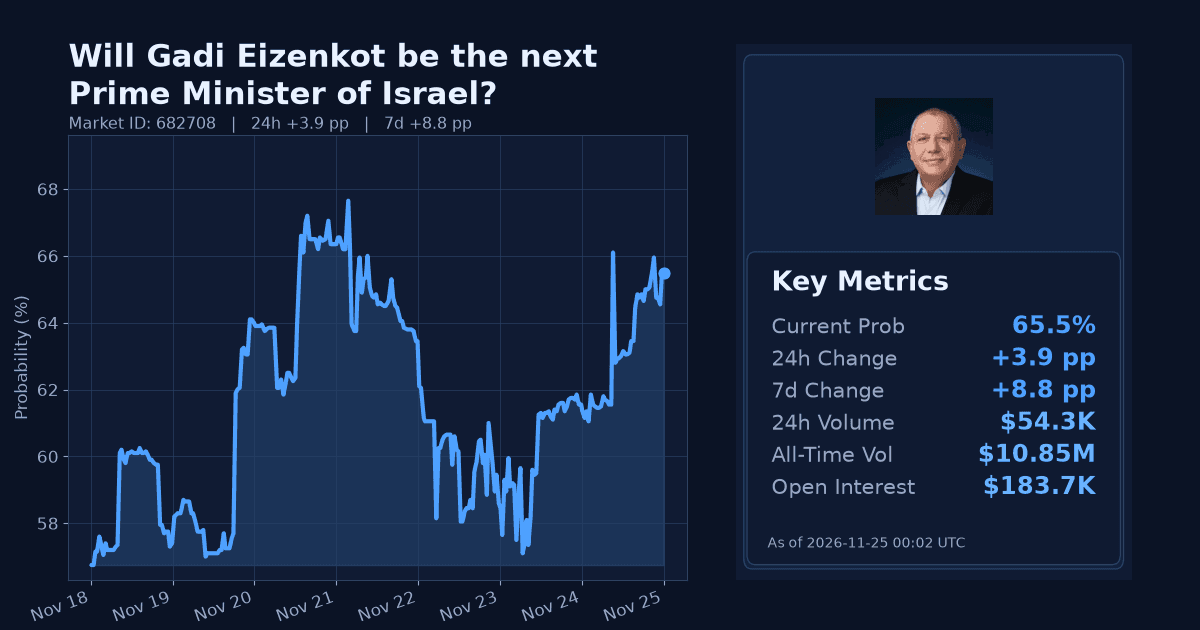
Polymarket’s contract on whether Gadi Eizenkot will be the next Prime Minister of Israel moved higher. The market covers the individual formally appointed and sworn in after Israel’s next parliamentary election, with the listed contract window running from Nov. 15, 2025 to Oct. 28, 2026, and resolution tied to official Israeli government information or credible reporting.
At the time of writing, Eizenkot is priced at 65.5%, up 3.95 percentage points over 24 hours and 8.75 points over seven days. The move lifts him further ahead of other named candidates in the supplied related markets.
Why It Likely Moved
-
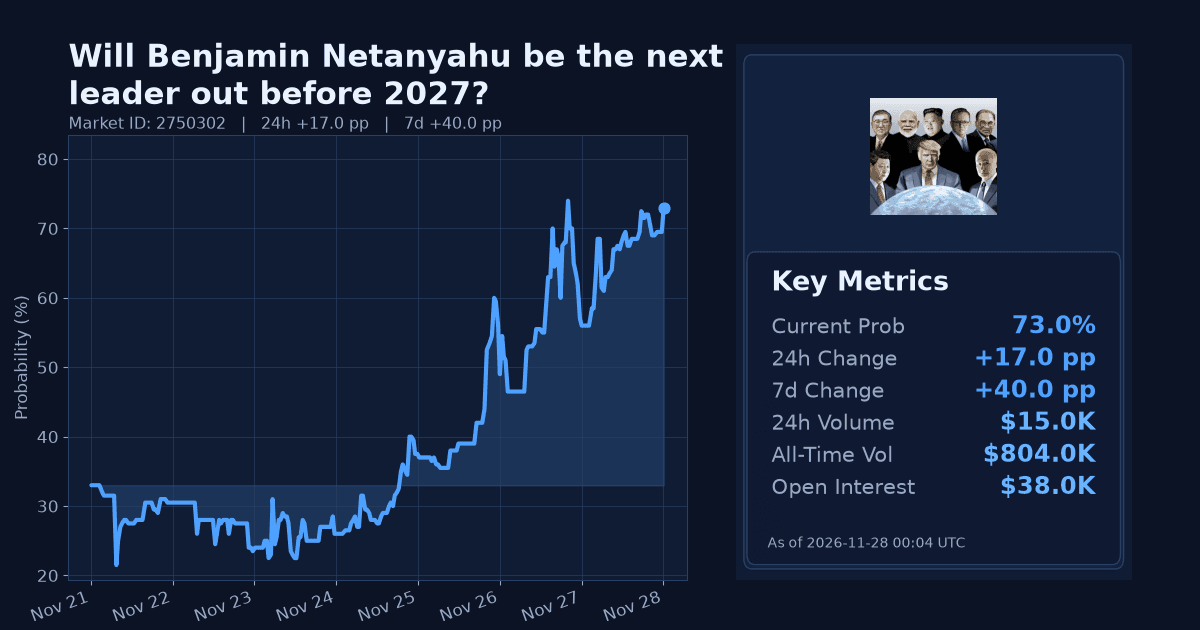
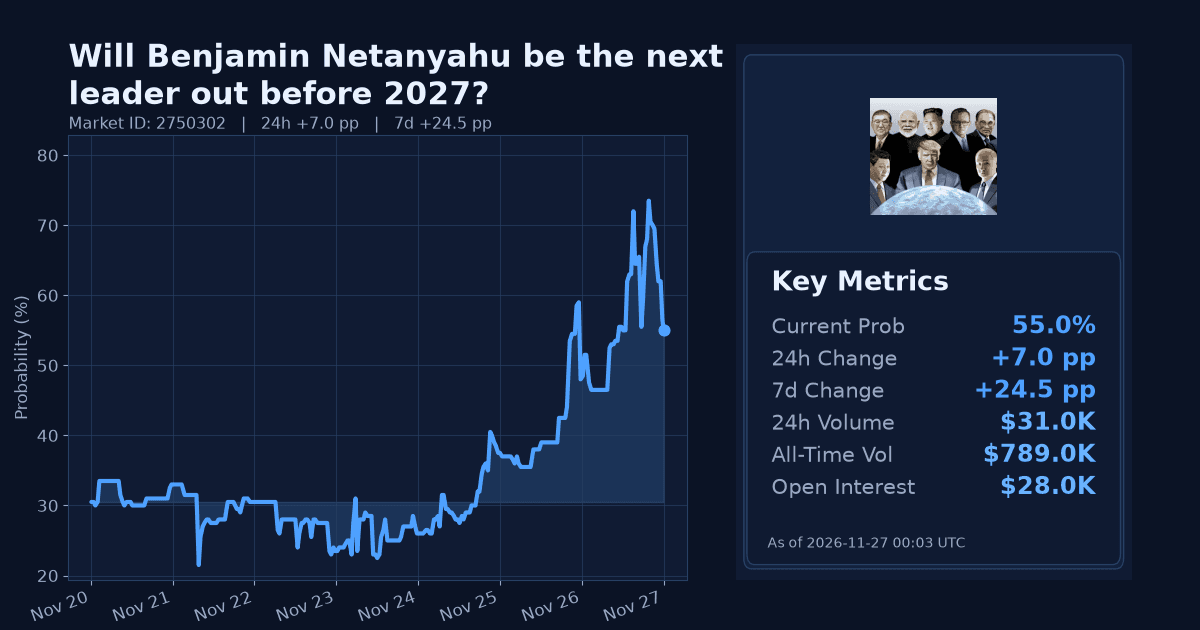
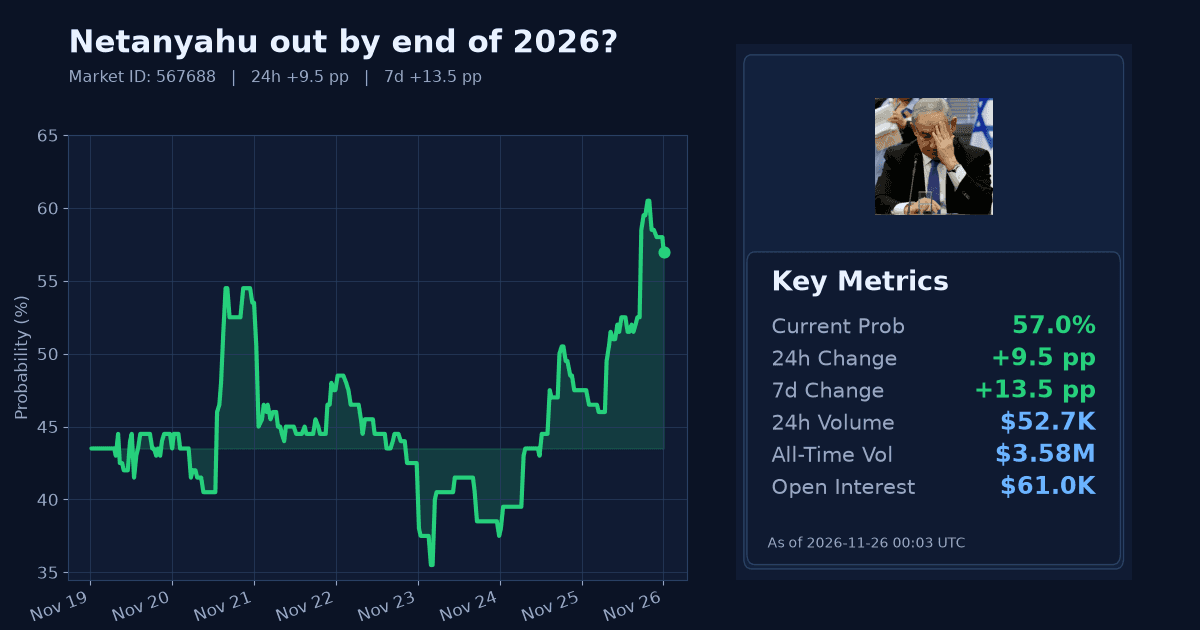
The repricing appears driven by a candidate-specific rotation toward Eizenkot, rather than a broad rise across all Israeli PM succession contracts. The closest related markets for Benjamin Netanyahu and Avigdor Lieberman both moved lower over the same period.
-
Markets reacted to official Israel/Palestine-related policy signals in Europe, including a French government statement on settler attacks in the West Bank and European Parliament activity on UNRWA funding. These do not directly identify an Israeli election outcome, but they add contemporaneous diplomatic context around Israeli politics.
-
The move also follows a broader risk backdrop in which volatility remains elevated: the VIX stood at 26.36 and was up 3.53% over seven days, with a 35.53% rise over 30 days. That supports a market environment in which political and geopolitical contracts can reprice quickly.
-
The lack of supplied candidate-specific news means the most defensible explanation is market positioning: Eizenkot strengthened while the other major named Israeli alternatives in the dataset weakened.
How Strong the Move Is
This is an extreme upward move by the market’s own recent trading history. The 24-hour z-score is 15.0, and the supplied interpretation classifies the one-day move as “extreme” to the upside. The seven-day z-score is also extreme at 10.2709, indicating that the week-long rise is not just a one-session anomaly.
The structure looks like a trend continuation rather than a reversal: the 24-hour gain extends the larger seven-day advance. With 280 series points used since the effective series start on Nov. 18, the move is large relative to the available recent sample, though the dataset does not establish a specific external catalyst.
Cross-Market Confirmation
-
Benjamin Netanyahu’s related market diverged from Eizenkot’s move, slipping 0.1 points over 24 hours and 0.35 points over seven days. That modest decline confirms some rotation away from Netanyahu, but the magnitude is small.
-
Avigdor Lieberman’s related market provides clearer confirmation, falling 1.7 points over 24 hours and 1.75 points over seven days while Eizenkot rose. That directional split supports the candidate-rotation reading.
-
The “Trump out as President before 2027?” market moved up 0.9 points over 24 hours and 0.2 points over seven days. Given its lower similarity and different subject, it does not confirm the Israeli PM move.
News & Real-World Context
No correlated news articles were supplied with this market packet. The available real-world context comes from official government and parliamentary sources, which are policy signals rather than direct evidence about Eizenkot’s electoral position.
On Nov. 23, 2026, the French government published a statement titled “Israël/Palestine - Attaques de colons israéliens en Cisjordanie,” addressing Israeli settler attacks in the West Bank, according to France Diplomatie. On Nov. 24, 2026, the European Parliament published a written question on implementation of the 2026 budget reinforcement and funding for UNRWA. Also on Nov. 24, the European Parliament issued an “EP TODAY” press release, and a Danish foreign-affairs announcement said the Foreign Policy Committee would meet that day, according to the Danish government notice. These items show active European official attention to foreign-affairs issues touching Israel/Palestine, but they do not state a position on the Israeli premiership market.
Bottom Line
Eizenkot’s market has made an extreme upward move, with related Israeli PM contracts weakening at the same time. The evidence supports a strong candidate-rotation interpretation, while the absence of direct candidate news leaves the durability of the move uncertain. On the supplied data, this looks like a sharp short-term repricing that could become structural only if reinforced by further political evidence.
Market Conditions at Time of Writing
- Current Probability (%): 65.5
- 24h Change (pp): +3.95
- 7d Change (pp): +8.75
- Volume (24h, $): 54,250.40
- Open Interest ($): 183,662.14
- Spread (pp): 1.2
- Z-score (24h): 15.0