What Moved the Market
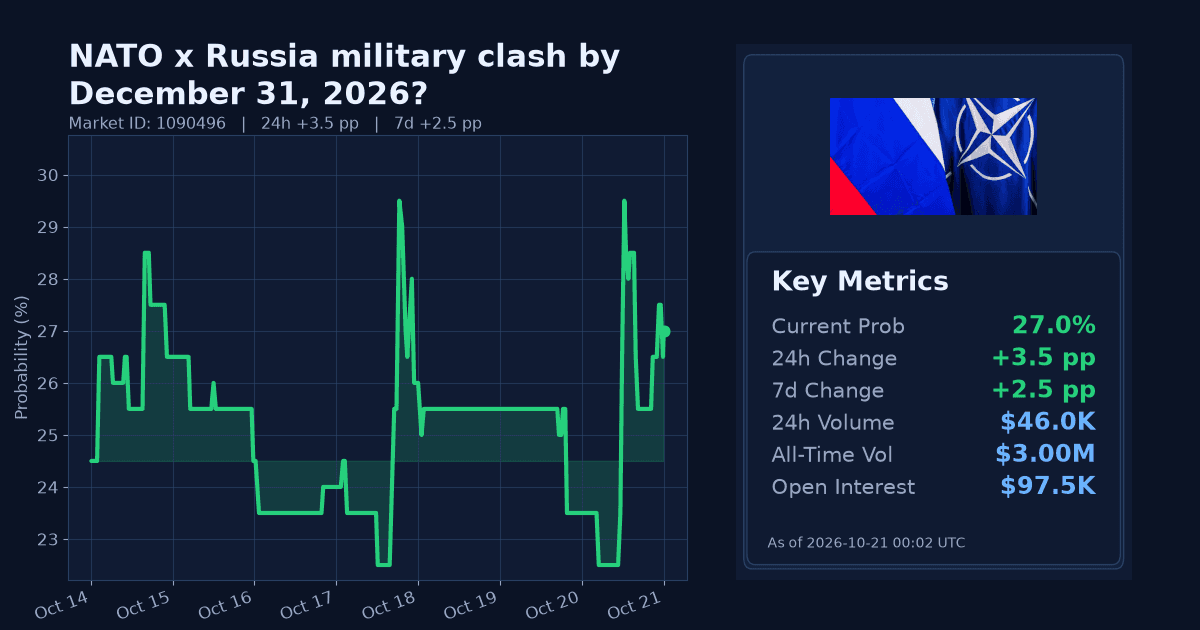
Polymarket’s contract on whether NATO and Russian military forces have a qualifying direct military encounter by December 31, 2026 moved higher, with the “Yes” probability now at 27.0%. The market resolves on incidents involving direct use of force, such as missile strikes, artillery fire, gunfire, or the shooting down of qualifying UAVs; warning shots, cyberattacks, airspace violations, and interception of munitions aimed at third parties do not qualify on their own.
The listed market window uses a market_start_date of January 13, 2026 and a market_end_date of December 31, 2026; the question date is the governing end-date source. The observed move is therefore a repricing of risk within the remaining 2026 contract window, not a change in the resolution criteria.
Why It Likely Moved
- The move appears driven by fresh Black Sea risk signals after reports that NATO would deploy aircraft and drones to improve surveillance following attacks on commercial shipping and drone crashes near the coast.
- Markets reacted to official allied policy activity: on October 19, NATO said Allies and partners met in Bucharest to strengthen responses to Russia’s hybrid activities, reinforcing the perception of elevated NATO-Russia friction.
- Repricing follows reports that Russia’s defence ministry said it struck cargo vessels and logistics hubs in Ukraine, including a site it described as a U.S. logistics centre, though the supplied summary notes no independent verification.
- Ukraine-related air-defence headlines likely added to the risk narrative, including Zelenskyy’s statement that an early-warning system for Russian missile attacks had resumed after a call with Rubio.
- Broader market conditions were also consistent with higher geopolitical risk pricing: the VIX stood at 17.31 and was up 13.36% over seven days, while Brent crude was at $109.36/bbl and up 3.47% over the same period.
How Strong the Move Is
The contract rose 3.5 percentage points over 24 hours and 2.5 percentage points over seven days. Both the 24-hour and seven-day readings are classified as extreme relative to this market’s recent trading history, with z-scores of 12.0 and 8.0 respectively.
This is best classified as a significant upward spike rather than noise. Because the one-day move is larger than the weekly move, the latest repricing appears concentrated in the most recent session rather than evenly distributed across the week.
Cross-Market Confirmation
- The closest related NATO-Russia market, “NATO x Russia military clash by October 31, 2026?”, confirms the direction: it is at 8.0%, with a +2.0 pp 24-hour move and +1.5 pp seven-day move.
- The “Will the U.S. invade Iran before 2027?” market diverges, falling 1.0 pp over 24 hours and 3.0 pp over seven days, suggesting the repricing is not a broad bid for all military-escalation contracts.
- The “US announces end of Iranian blockade by December 31, 2026?” market also diverges, down 0.95 pp over 24 hours and 5.5 pp over seven days, reinforcing that the main move is Russia/NATO-specific rather than Iran-driven.
News & Real-World Context
On October 20, reporting said NATO would send planes and drones to the Black Sea to strengthen surveillance after attacks on commercial shipping and a series of drone crashes, with the deployments framed as improving maritime monitoring and deterring further incidents, according to Ground News. The same day, Zelenskyy said an early-warning system for Russian missile attacks had resumed after a call with Rubio, according to AP News.
Official statements point in the same general direction of heightened allied preparedness. On October 19, NATO stated that Allies, partners, EU, and industry representatives met in Bucharest to strengthen responses to Russia’s hybrid activities. On October 20, the UK government stated that the Armed Forces, NHS, and allies tested plans for battlefield injury response in possible future operations. Separately, reports said Russia’s defence ministry claimed strikes on cargo vessels and logistics hubs in Ukraine, including a site it described as a U.S. logistics centre, according to Ground News.
Bottom Line
The market move appears tied to a cluster of NATO-Russia risk signals centered on the Black Sea, Ukraine logistics, and official allied defence activity. The size of the repricing is extreme for this market’s recent history, but the evidence supports a short-term spike more clearly than a proven structural shift in the probability of a qualifying direct clash.
Market Conditions at Time of Writing
- Current Probability (%): 27.0
- 24h Change (pp): +3.5
- 7d Change (pp): +2.5
- Volume (24h, $): 46,042.67
- Open Interest ($): 97,490.56
- Spread (pp): 1.0
- Z-score (24h): 12.0