What Moved the Market
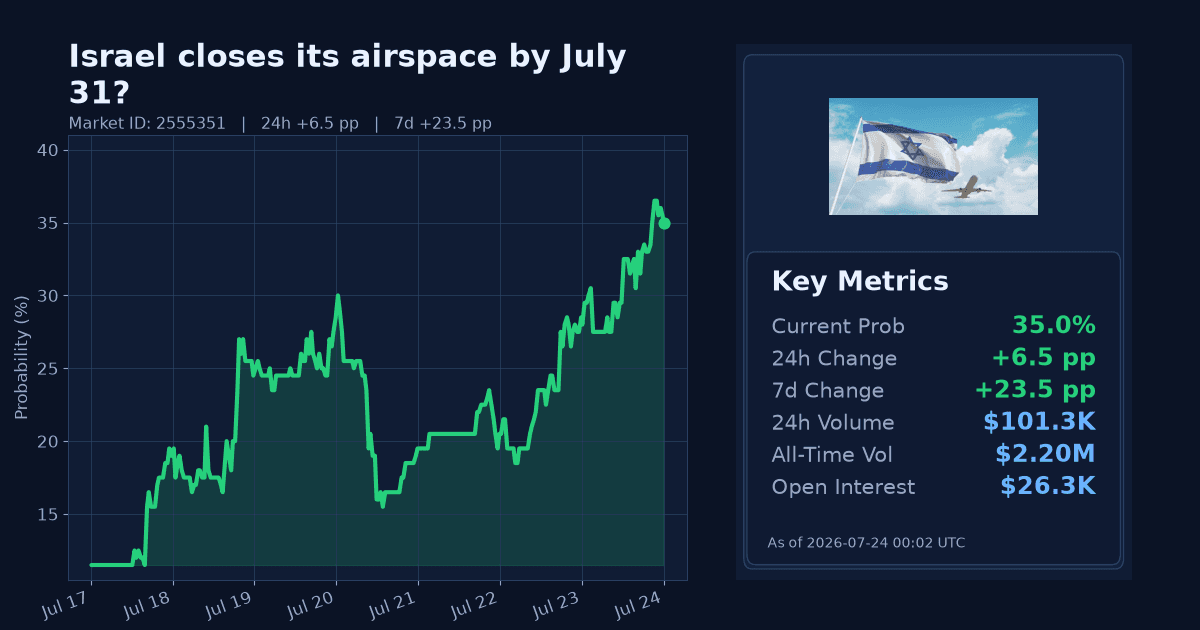
The Polymarket contract "Israel closes its airspace by July 31?" rose to 35% as of July 24, up 6.5 percentage points over 24 hours and 23.5 points over the past week. The contract resolves Yes if Israeli authorities initiate a major, broad closure of civilian airspace by 11:59 PM ET on July 31, 2026; otherwise No.
This market covers the window from June 15, 2026 through July 31, 2026. The latest move represents a sharp repricing late in the contract period, with liquidity conditions tight (1.0pp spread) but active (notable 24h volume).
Why It Likely Moved
- Repricing appears driven by concentrated Iran-war–related context around regional airspace: a July 23 analysis highlighted increased rerouting over Syria tied to the Iran war, signaling wider regional aviation disruptions (CSIS, Jul 23).
- Markets reacted to continued U.S. policy focus on Iran operations: the U.S. House again advanced a war-powers resolution on July 23 to halt or limit action against Iran, underscoring ongoing hostilities on the policy agenda (AP News, Jul 23).
- European official statements increased Israel-related headline flow: the European Parliament (Jul 23) published a written question on Europol–Israel data exchange and another on EU differentiation toward Israeli settlements (Jul 23); the Government of the Netherlands (Jul 21) announced measures restricting goods from Israeli settlements.
- Additional official signals kept Israel on the diplomatic agenda: the UK government’s FCDO (Jul 23) issued a statement on Gaza’s IPC snapshot; the French MFA held a press briefing on July 23.
- Macro backdrop: Brent crude traded near $100.44/bbl, up 19.2% over 7 days and 30.3% over 30 days, a pattern often associated with elevated Middle East risk premia, even if not determinative for this specific contract.
How Strong the Move Is
By statistical measures, the repricing is extreme relative to recent trading: the 24-hour z-score is 32.0 (extreme) and the 7-day z-score is 10.21 (extreme). Coupled with a 23.5pp weekly gain, this reads as a sharp, event-window spike rather than routine noise.
Given the contract’s imminent July 31 end date, the magnitude suggests urgency pricing into the tail of the resolution window. Whether this solidifies into a sustained trend depends on direct signals from Israeli aviation authorities, which are not present in the provided context.
Cross-Market Confirmation
- Israel closes airspace by July 24: 9.0%, down 2.5pp (24h). This diverges on timing — traders lowered near-term closure odds while lifting end-of-month risk, implying a shift later in the window rather than broad confirmation.
- US announces halt in Iran offensive operations by July 24: 3.4%, down 2.95pp (24h). This decline in a de-escalation proxy indirectly aligns with higher closure risk, though it is not a direct confirmation.
- Kharg Island no longer under Iranian control by July 31: 3.3%, up 1.65pp (24h) and 0.95pp (7d). The modest uptick weakly aligns with broader escalation risk but remains low-probability.
News & Real-World Context
On July 23, the U.S. House again advanced a war-powers resolution seeking to halt or limit military action in Iran, reflecting bipartisan concern over authorizing further strikes and keeping Iran operations central to U.S. policy debate (AP News). The same day, analysis noted that war-driven rerouting has boosted Syrian overflight revenue, illustrating how regional airspace usage is already being reshaped by the conflict environment (CSIS, Jul 23).
European official communications added policy salience: the European Parliament (Jul 23) published a written question on Europol–Israel data sharing, alongside another on the EU’s differentiation policy toward Israeli settlements (Jul 23). The Government of the Netherlands (Jul 21) announced national measures to restrict goods from Israeli settlements. On July 23, the UK government issued an FCDO statement on Gaza’s food security snapshot, and the French MFA held a press briefing. Separately, defense-industrial news reported Greece’s plan to acquire an Israeli air-defense system (Ground News, Jul 23).
Bottom Line
This is an extreme, late-window repricing toward a July 31 airspace closure without direct confirmation from Israeli aviation authorities in the provided material. The move appears news- and policy-flow driven, with heightened Iran-war context and European government statements raising perceived tail risk.
Absent official Israeli notices, the shift looks tactical rather than structural; durability hinges on developments or advisories closer to the contract deadline.
Market Conditions at Time of Writing
- Current Probability (%): 35.0
- 24h Change (pp): +6.5
- 7d Change (pp): +23.5
- Volume (24h, $): 101,277.19
- Open Interest ($): 26,346.99
- Spread (pp): 1.0
- Z-score (24h): 32.0