What Moved the Market
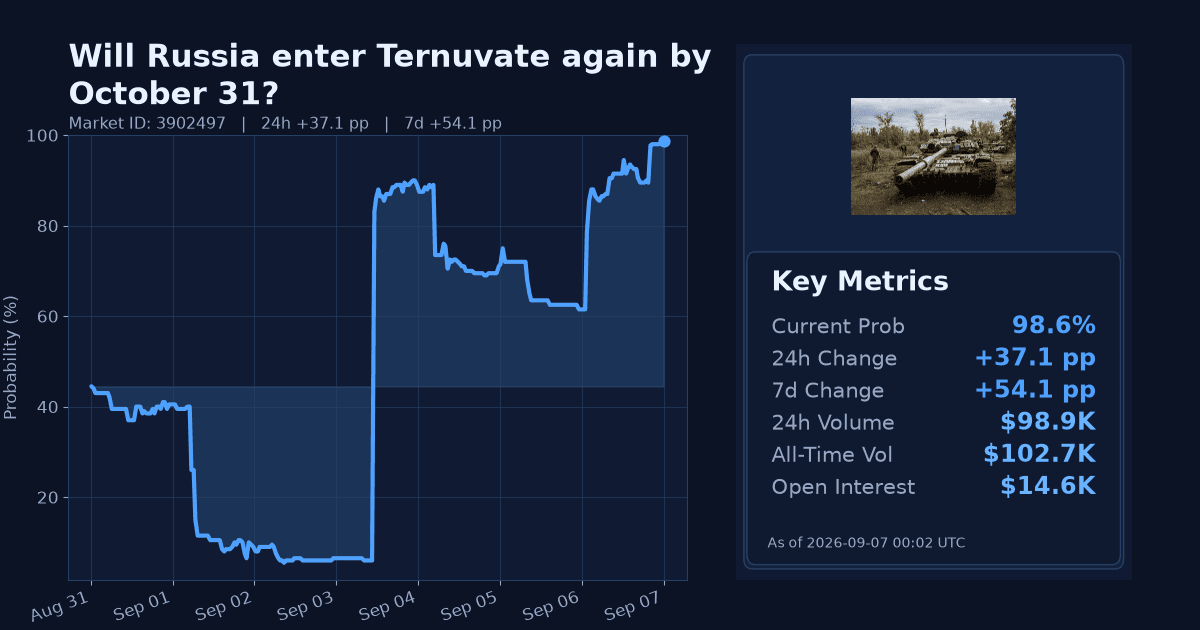
The Polymarket contract “Will Russia enter Ternuvate again by October 31?” surged to 98.6%, up 37.1 percentage points in the past 24 hours and 54.1 points over the week. The bid-ask spread is tight at 0.5pp.
This contract resolves Yes if the ISW map shows any qualifying Russian control over the specified Ternuvate area (Zaporizhzhia Oblast) at any time between market creation (Aug 26, 2026) and market close (Nov 1, 2026 UTC; Oct 31, 2026 ET), with persistence through the next ISW update cycle as defined in the rules.
Why It Likely Moved
- Repricing appears driven by the contract’s permissive resolution mechanics: any qualifying ISW shading at any point through Oct 31 (ET) secures a Yes, and subsequent loss of control does not negate resolution.
- Markets reacted to a visible uptick in conflict activity reports, including Ukrainian drones reportedly striking the Ryazan oil refinery and targets across Russia, and related civilian infrastructure disruptions such as Sochi airport limiting flights and Rosneft halting refueling after drone activity (Ground News/Reuters, Sep 6, 2026; Ground News, Sep 6, 2026).
- The repricing follows high-level shuttle diplomacy, with US envoys Steven Witkoff and Jared Kushner meeting Putin in Moscow and then heading to Kyiv, signaling active engagement on the war’s trajectory (AP News, Sep 6, 2026).
- Elevated geopolitical risk is consistent with broader macro signals: Brent crude stands at $96.28/bbl, up 7.8% over 7 days and 15.2% over 30 days, indicating a firmer risk premium in energy markets.
- In parallel, the Australian government reiterated a preference for de-escalation and highlighted conflict-driven cost pressures, an official stance underscored by the Assistant Minister for Foreign Affairs on Sep 6, 2026 (Australian Government/DFAT, Sep 6, 2026). While not Ukraine-specific, it reflects government-level assessments of rising global conflict costs.
How Strong the Move Is
By any short-horizon metric, this is an extreme repricing. The 24-hour change is +37.1pp, and the 7-day change is +54.1pp. Both the 24h and 7d z-scores are flagged as extreme relative to recent trading history, indicating a sharp, atypical move rather than routine volatility.
The pattern resembles a rapid trend acceleration toward perceived near-certainty, consistent with traders converging on a Yes outcome within the contract’s window, rather than a minor or reversible fluctuation.
Cross-Market Confirmation
- “Israel closes its airspace by September 30?” rose to 73.0% (+5.0pp 24h, +65.0pp 7d), a confirming sign of broader geopolitical risk appetite moving higher.
- “Will China invade Taiwan by end of 2026?” is largely unchanged at 3.9% (+0.2pp 24h, +0.2pp 7d), offering no confirmation from the Indo-Pacific theater.
- “US announces end of Iranian blockade by October 31, 2026?” fell to 36.0% (-1.0pp 24h, -2.0pp 7d), a divergence that tempers a uniform risk-up narrative.
News & Real-World Context
- Ukrainian drones reportedly struck the Ryazan oil refinery and multiple Russian cities, signaling continued cross-border strike activity (Ground News/Reuters, Sep 6, 2026).
- Sochi airport limited flights and Rosneft halted refueling following drone incidents, indicating direct operational disruption inside Russia (Ground News, Sep 6, 2026).
- US envoys Steven Witkoff and Jared Kushner met Vladimir Putin in Moscow and were set for talks in Kyiv, reflecting active diplomatic engagement on the conflict (AP News, Sep 6, 2026).
- Separately, the Australian government emphasized de-escalation and flagged conflict-related cost-of-living impacts during a televised interview on Sep 6, 2026, an official policy signal on broader conflict externalities (Australian Government/DFAT, Sep 6, 2026).
Bottom Line
This is an extreme upward repricing toward a Yes outcome, consistent with heightened conflict signals and contract mechanics that reward any qualifying ISW-confirmed incursion through Oct 31 (ET). Absent direct, Ternuvate-specific reporting, the move looks driven by generalized escalation cues and market structure rather than a confirmed local development.
The shift appears more like a short-term spike converging to near-certainty; confirmation risk remains tied to ISW map updates covering the specified area and persistence criteria.
Market Conditions at Time of Writing
- Current Probability: 98.6%
- 24h Change: +37.1pp
- 7d Change: +54.1pp
- Volume (24h, $): 98,887.22
- Open Interest ($): 14,636.12
- Spread (pp): 0.5
- Z-score (24h): 147.8