What Moved the Market
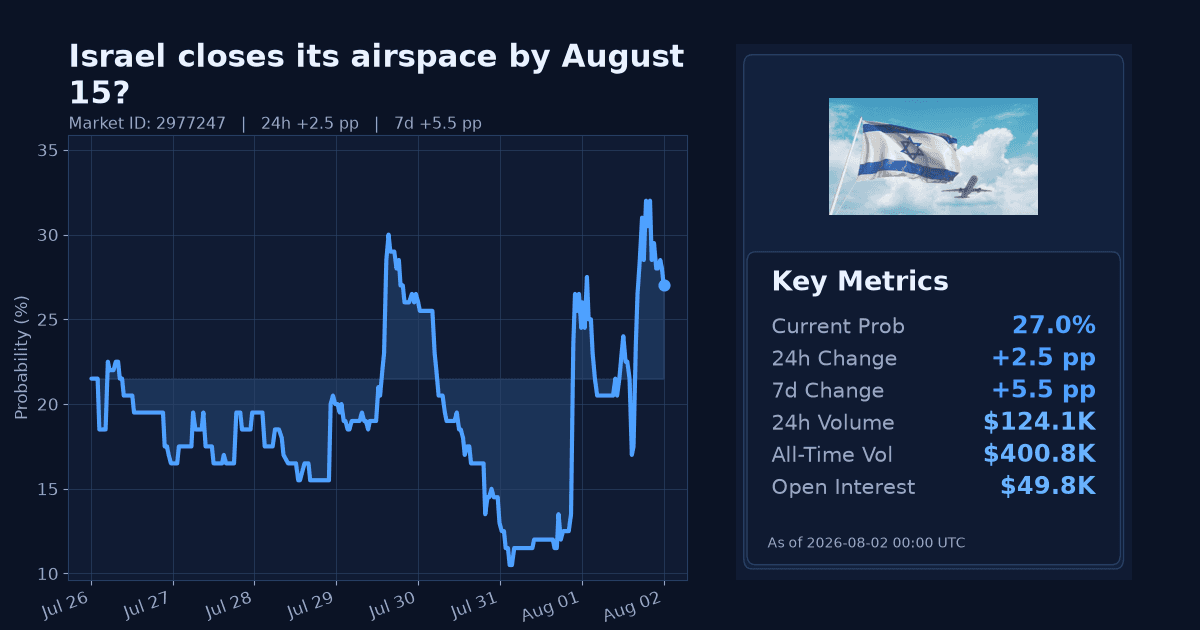
The Polymarket contract “Israel closes its airspace by August 15?” rose to a 27% implied probability as of August 2, up 2.5 percentage points over 24 hours and 5.5 percentage points over the past week. The market resolves “Yes” if Israel initiates a broad, government-ordered closure of civilian airspace by 11:59 PM ET on August 15; limited or localized disruptions do not qualify.
The contract window runs from July 18 to August 15, 2026. Pricing reflects the likelihood of an official, nationwide or majority-of-airspace suspension of commercial aviation in that period.
Why It Likely Moved
- The repricing appears driven by Iran-related security rhetoric, notably reporting that Donald Trump threatened additional strikes on Iran, adding to regional risk signals AP News (August 1).
- Markets reacted to a cluster of official statements on Israel-Palestine security dynamics, including the French government’s announcement of an agreement on Hamas disarmament French Ministry for Europe and Foreign Affairs (July 31) and the UK government’s statement on escalating violence in the West Bank UK Government (July 30).
- Broader Middle East disruption signals—such as efforts to reroute oil exports amid Strait of Hormuz closures AP News (August 1)—may have contributed to a general risk premium for regional airspace.
- The repricing follows reporting of cyber activity likely tied to Iran targeting US water systems, highlighting cross-domain security risk Wired (August 1).
How Strong the Move Is
The 24-hour and 7-day moves are both flagged as extreme by the market’s own z-score signals (z=8.0 and z=18.0, respectively). That points to a sharp repricing relative to recent trading history.
With a 2.5pp rise in 24 hours and 5.5pp over the week, this looks like a spike rather than slow accumulation. Liquidity appears decent for this market context (tight 2pp spread and solid 24h volume), reinforcing that the move is meaningfully priced rather than illiquidity noise.
Cross-Market Confirmation
- “Israel closes its airspace by August 31?” is at 36%; delta_24h -1.0pp diverges from the main market’s 24h uptick, but delta_7d +6.0pp aligns with the weekly upward repricing.
- “Iran leadership change by August 31?” is 4.2% with delta_24h -1.0pp and delta_7d -3.1pp, a divergence that suggests markets are not pricing near-term regime shocks as a driver.
- “Kharg Island no longer under Iranian control by September 30?” is 8.0% with delta_24h -0.5pp, another modest divergence from the airspace-closure move.
Overall, related markets show mixed confirmation: the August 31 airspace market corroborates the 7-day trend, while Iran-centric regime or territorial scenarios do not.
News & Real-World Context
On August 1, reporting noted that Donald Trump threatened further strikes on Iran, adding to a series of regional security headlines AP News. The same day, AP highlighted local sentiment in Gaza around potential Hamas disarmament and uncertainty over Israeli military posture AP News (August 1).
Government statements provided formal signals: on July 31, the French government announced an agreement on Hamas disarmament French Ministry for Europe and Foreign Affairs, and on July 30 the UK government issued a statement on escalating violence in the West Bank UK Government. Regionally, authorities are working around maritime disruptions, with Iraq and Turkey agreeing to route oil via pipeline amid Strait of Hormuz closures AP News (August 1). In parallel, cyber incidents likely tied to Iran were reported against water systems in seven US states Wired (August 1).
Macro risk proxies do not show a concurrent risk-off surge: Brent crude is $90.12, down 6.88% over 7 days, the US Dollar Index is 99.803, down 1.64% over 7 days, and the VIX is 15.99, down 13.94% over 7 days. This backdrop points to an idiosyncratic repricing specific to the contract’s security focus rather than broad market stress.
Bottom Line
This is an idiosyncratic, security-driven spike in odds that Israel orders a broad airspace closure before August 15. The move aligns with a week-long drift higher but lacks uniform cross-market confirmation.
Absent corroborating macro risk signals, the shift looks short-term and headline-sensitive rather than structural.
Market Conditions at Time of Writing
- Current Probability: 27%
- 24h Change: +2.5pp
- 7d Change: +5.5pp
- Volume (24h, $): 124,132.22
- Open Interest ($): 49,752.23
- Spread (pp): 2.0
- Z-score (24h): 8.0