What Moved the Market
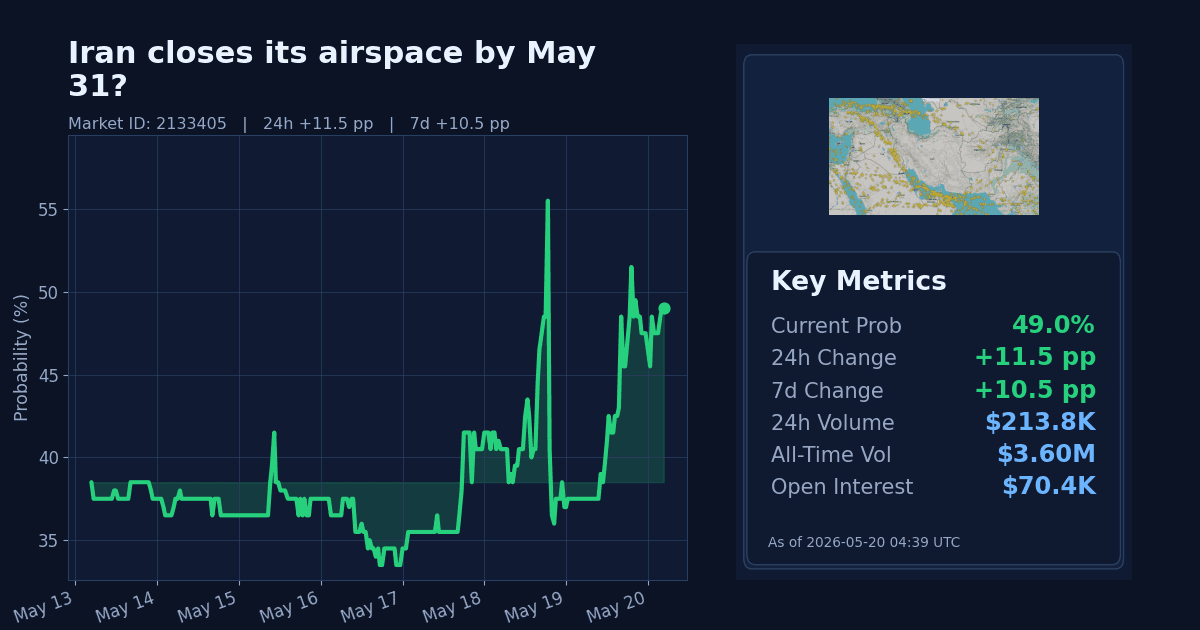
The Polymarket contract "Iran closes its airspace by May 31?" rose sharply to a 49% implied probability as of May 20, 2026 (04:39 UTC), up 11.5 percentage points over the last 24 hours and 10.5 points over the week. The market covers a major, non-weather airspace closure initiated by 11:59 PM ET on May 31, 2026.
The move reflects an extreme one-day repricing relative to recent trading history, with elevated activity into the latter half of the contract window (May 1–May 31, 2026).
Why It Likely Moved
- Repricing appears driven by high-level government signals about disruptions in and around the Strait of Hormuz. On May 19, the UK government warned the world “cannot wait any longer” to reopen the Strait, underscoring severity and urgency.
- Markets reacted to EU energy-security messaging. On May 18, the European Commission said regional jet fuel supply constraints could arise in weeks if the Hormuz blockage persists, highlighting aviation-related operational risk.
- The security backdrop was reinforced on May 19 by an EU Parliament written question on ship safety in Hormuz, a formal signal of concern over corridor safety.
- Broader defense posture statements may have added to risk perception: on May 19, a U.S. policy brief via war.gov outlined prioritization in theaters of consequence, sustaining focus on strategic chokepoints.
- Macro pricing is consistent with elevated supply risk: Brent crude at $110.46/bbl is up 4.6% over 7 days and 15.7% over 30 days, indicating a persistent risk premium around Middle East energy flows.
How Strong the Move Is
The 24-hour shift (+11.5pp) registers an extreme z-score (48.0), classifying the move as a spike rather than routine noise. Liquidity appears supportive of the reprice with $213,752 in 24-hour volume and a 1.0pp spread.
Over seven days, the change (+10.5pp) is labeled sharp (z ≈ 2.45), suggesting the market is not only reacting to a single headline but undergoing a broader upward reassessment of closure risk into month-end.
Cross-Market Confirmation
- Iran closes airspace by May 21: up to 14% (delta_24h +6.0pp; delta_7d +2.5pp) — confirms near-term risk is being priced higher.
- Iran closes airspace by May 24: up to 30% (delta_24h +7.5pp; delta_7d +3.5pp) — aligns directionally, reinforcing a rising probability profile across adjacent windows.
- US x Iran diplomatic meeting by May 31, 2026: down to 13% (delta_24h −7.0pp; delta_7d −10.0pp) — diverges from de-escalation catalysts, consistent with higher perceived disruption risk.
News & Real-World Context
- On May 19, the UK government urged reopening the Strait of Hormuz, citing looming food-security impacts — an official indication of sustained corridor disruption.
- On May 18, the European Commission warned of potential jet fuel supply constraints if Hormuz blockage continues, and prepared a coordinated response — directly relevant to aviation operations.
- On May 19, an EU Parliament written question addressed ship safety in Hormuz, highlighting formal scrutiny of transport security.
- On May 19, AP News reported video and satellite evidence of a large oil spill on Shidvar Island tied to recent Iran–U.S. hostilities, illustrating ongoing regional friction.
- On May 19, Ars Technica detailed Iran’s move to seek fees for undersea internet cables near Hormuz, signaling assertive stances on critical infrastructure.
Bottom Line
An extreme one-day spike has lifted odds of an Iran airspace closure by May 31 to essentially a coin flip. The repricing aligns with authoritative government signals about sustained Hormuz disruptions and aviation fuel concerns, with cross-market contracts moving in the same direction.
Barring direct evidence of an Iranian airspace order, this looks like a risk-premium spike within a broader upward trend rather than a confirmed event.
Market Conditions at Time of Writing
- Current Probability: 49%
- 24h Change: +11.5pp
- 7d Change: +10.5pp
- Volume (24h, $): 213,752.43
- Open Interest ($): 70,412.66
- Spread (pp): 1.0
- Z-score (24h): 48.0