What Moved the Market
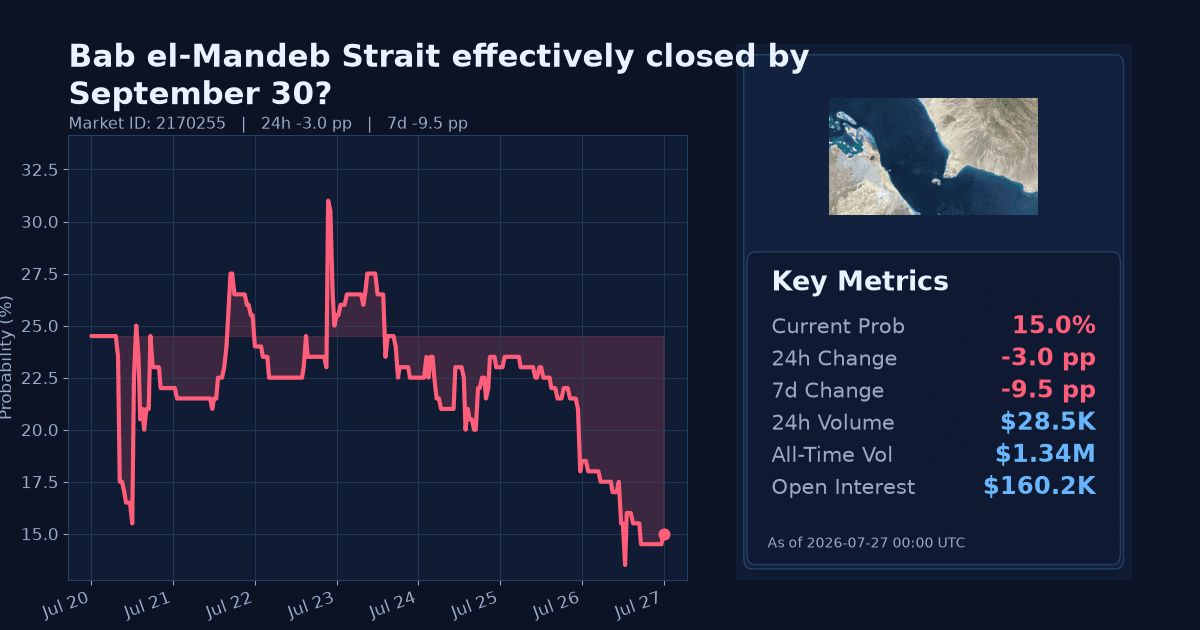
The Polymarket contract on whether the Bab el‑Mandeb Strait will be “effectively closed” by September 30 (defined as IMF PortWatch’s 7‑day moving average of arrivals at or below 10) fell to 15%. That is a 3 percentage‑point decline over 24 hours and a 9.5 percentage‑point drop over seven days.
This contract resolves “Yes” if IMF PortWatch reports a qualifying 7‑day moving average at any point from market creation (May 6, 2026) through September 30, 2026; otherwise it resolves “No.”
Why It Likely Moved
- Repricing appears driven by official reassurance on supply security: the European Commission’s Oil Coordination Group stated on July 24 that there are “no immediate supply concerns in the EU,” signaling limited perceived disruption risk to seaborne flows through chokepoints such as the Red Sea/Bab el‑Mandeb (European Commission, 2026‑07‑24).
- Markets reacted to a reported lull in US–Iran hostilities: US forces paused offensive strikes against Iran for a second straight day, with Tehran also refraining from attacks, reducing near‑term escalation signals that could threaten Red Sea shipping lanes (AP News, 2026‑07‑26).
- The Australian Government’s July 24 decision to raise travel advisories for several Middle Eastern states to “Do not travel” underscores wider regional risk, but the market repricing follows more directly from official EU supply assessments and the reported strike pause (Australian Government, 2026‑07‑24).
- Macro backdrop: Brent crude sits at $91.94/bbl, up 4.36% over 7 days and 27.7% over 30 days as of July 26. Despite firmer oil, the specific probability of Bab el‑Mandeb crossing a closure threshold was marked down, suggesting traders distinguish broader price strength from the narrow PortWatch-based “effective closure” criterion.
How Strong the Move Is
The decline is statistically extreme by this market’s standards: a 24‑hour z‑score of 14.0 and a 7‑day z‑score of 40.0 indicate an unusually sharp repricing. With a 3pp day‑over‑day drop and 9.5pp week‑over‑week slide, this reads as a significant bearish shift rather than routine noise.
Given the contract’s binary resolution tied to a specific data threshold, the move looks like a decisive reduction in the perceived odds of IMF PortWatch reporting a 7‑day average of arrivals at or below 10 before September 30.
Cross-Market Confirmation
- Bab el‑Mandeb “by August 31?” fell to 7% (−2.5pp 24h; −12.5pp 7d), aligning with the main market’s downward repricing.
- Strait of Hormuz “returns to normal by August 31?” edged up to 14% (+1.5pp 7d), a modestly supportive signal for de‑escalation in regional maritime risk.
- “Israel closes its airspace by July 31?” declined to 6% (−2.0pp 24h; −23.5pp 7d), further indicating risk premia easing across adjacent theaters.
News & Real-World Context
- The European Commission’s Oil Coordination Group, convening experts from EU states, industry, the IEA and NATO, reported on July 24 that there are “no immediate supply concerns in the EU,” an official assessment that markets often treat as a stabilizing signal for seaborne energy flows (European Commission, 2026‑07‑24).
- AP reported on July 26 a second consecutive day of paused US and Iranian offensive strikes, creating a temporary lull in hostilities that reduces near‑term escalation risk around key Middle Eastern waterways (AP News, 2026‑07‑26).
- Separately, Australia raised travel advisories on July 24 for Bahrain and Kuwait to “Do not travel,” adding to a list that includes Iran, Iraq, Lebanon, Palestine, Syria and Yemen, and cautioning that airspace and borders can close at short notice (Australian Government, 2026‑07‑24).
Bottom Line
Traders marked down the probability that IMF PortWatch will register a Bab el‑Mandeb “effective closure” before September 30. The move appears anchored in authoritative EU supply guidance and a reported US–Iran pause in strikes, outweighing broader regional caution. Near‑term signals point to a cyclical de‑risking rather than a structural shift.
Market Conditions at Time of Writing
- Current Probability: 15%
- 24h Change: −3.0pp
- 7d Change: −9.5pp
- Volume (24h, $): 28,467.64
- Open Interest ($): 160,228.69
- Spread (pp): 1.0
- Z-score (24h): 14.0