What Moved the Market
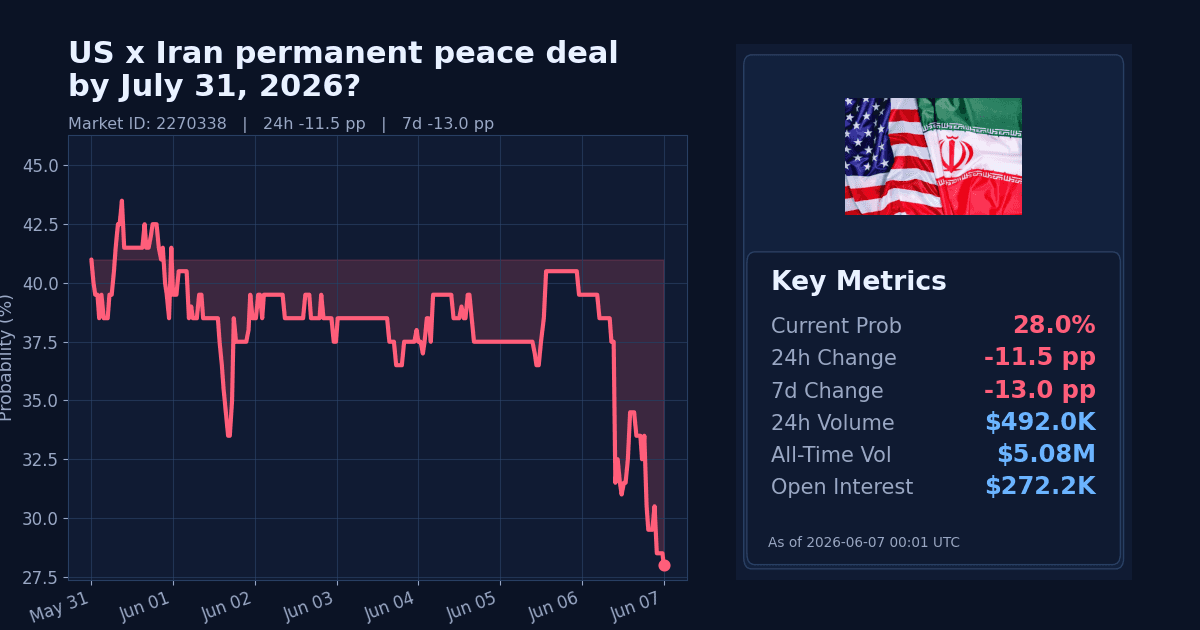
The Polymarket contract "US x Iran permanent peace deal by July 31, 2026?" fell sharply over the past day. Implied probability dropped 11.5 percentage points to 28.0%, marking a pronounced downside move within its recent trading range.
Over the past week, the market is down 13.0pp. The contract window runs from May 15, 2026 through 11:59 PM ET on July 31, 2026, and resolves Yes only if the United States and Iran establish an explicit, lasting end to military hostilities via a signed agreement or clearly confirmed government announcements.
Why It Likely Moved
- The repricing appears driven by fresh reports of hostilities: on June 6, the U.S. military said it shot down Iranian drones launched toward U.S. Gulf allies, according to NPR.
- Markets reacted to an absence of offsetting, new official government announcements in the provided dataset indicating progress toward a comprehensive peace framework.
- The weekly risk backdrop points to elevated geopolitical risk premia: WTI crude is at $90.54/bbl and up 3.6% over 7 days, while the VIX is 21.51 and up 40% over 7 days, suggesting broader stress consistent with reduced odds of a near-term de-escalatory deal.
- The move also aligns with sharp declines in nearer-dated Iran-related agreement markets, indicating traders are marking down the probability of any imminent breakthrough spilling into the July window.
How Strong the Move Is
By the platform’s risk metrics, the 24-hour move registers as extreme (z-score 44.0), indicating an outlier selloff relative to recent daily volatility. The 7-day signal is characterized as sharp (z-score ~2.76), reinforcing that this is not routine noise.
Together, the data point to an event-driven spike lower rather than a gradual drift. The size and speed of the drop, coupled with elevated volumes, underscore a decisive repricing.
Cross-Market Confirmation
- US × Iran permanent peace by June 30, 2026: 17% (−7.0pp 24h, −11.0pp 7d) — confirms bearish repricing on a proximate deadline.
- US × Iran permanent peace by June 15, 2026: 7% (−2.0pp 24h, −11.0pp 7d) — directionally aligned, reinforcing lower near-term deal odds.
- US announces new Iran agreement/ceasefire extension by June 7: 1.3% (−3.25pp 24h, −32.75pp 7d) — a steep weekly decline consistent with reduced expectations for immediate de-escalatory steps.
News & Real-World Context
- On June 6, the U.S. military said it shot down Iranian drones aimed at U.S. Gulf allies after an exchange of strikes, according to NPR. This report signaled continued military friction, which is inconsistent with imminent confirmation of a permanent cessation of hostilities.
- Separately on June 6, AP News reported that some officials from Iran’s soccer delegation were still awaiting U.S. visas to travel, an administrative development that does not indicate a policy shift toward a comprehensive peace deal.
Macro context: WTI crude at $90.54/bbl is up 3.6% over the week, the US Dollar Index is up 1.17% over 7 days to 100.07, and the VIX is up 40% over the week to 21.51. These moves are consistent with broader risk aversion that can accompany heightened geopolitical tension.
Bottom Line
An extreme, event-driven selloff has reduced the market’s confidence that the U.S. and Iran will finalize a permanent peace agreement by July 31, 2026. The move is corroborated by declines in adjacent deadlines and a risk-off macro backdrop.
Absent new official announcements signaling a definitive, lasting end to hostilities, this repricing looks near-term and reactive rather than structural — but it sets a lower baseline heading into the contract’s final eight weeks.
Market Conditions at Time of Writing
- Current Probability (%): 28.0
- 24h Change (pp): -11.5
- 7d Change (pp): -13.0
- Volume (24h, $): $492,010.76
- Open Interest ($): $272,233.59
- Spread (pp): 1.0
- Z-score (24h): 44.0