What Moved the Market
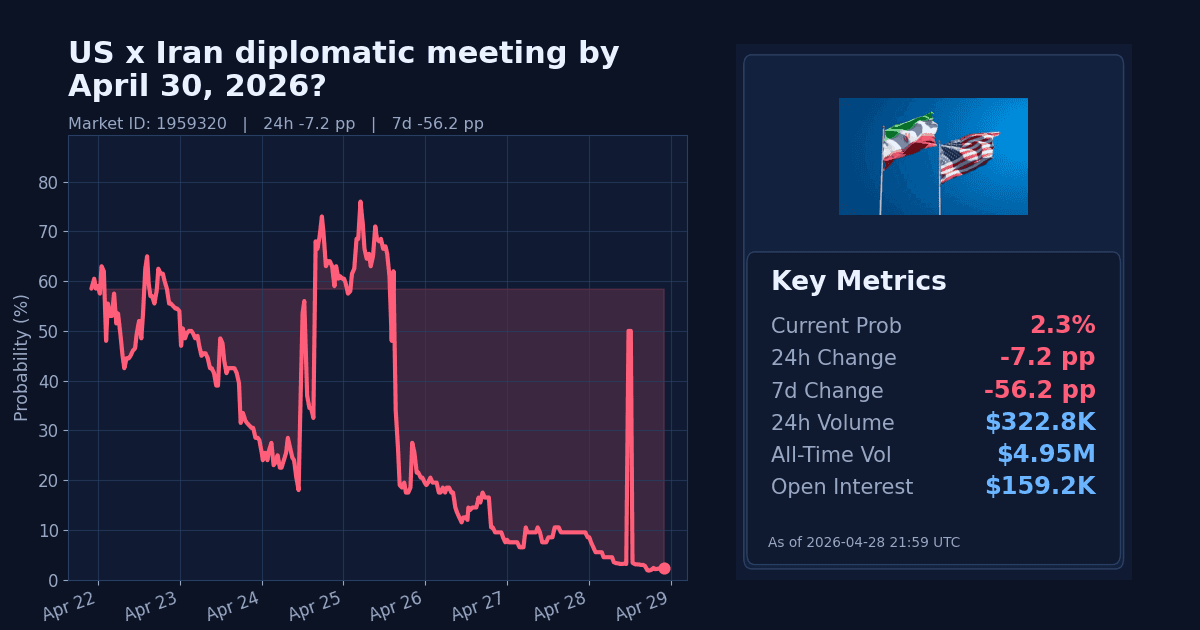
This Polymarket contract asks whether the United States and Iran will hold a qualifying in‑person diplomatic meeting by April 30, 2026 (11:59 PM ET). As of April 28, the market price fell sharply.
Over the past 24 hours, the implied probability dropped 7.2 percentage points to 2.3%. Over seven days, it is down 56.2 percentage points, marking a pronounced repricing toward “No” as the end of the contract window approaches.
Why It Likely Moved
- Repricing appears driven by official US signals that direct engagement remains limited. On April 27, the US State Department published an interview in which Secretary of State Marco Rubio said he has “never spoken to the foreign minister of Iran,” that talks are “mostly indirect,” and that direct communications are “very rare and very discreet,” dampening the odds of a publicly acknowledged, in‑person meeting before April 30 (US State Department, 2026‑04‑27).
- Markets reacted to Rubio confirming that President Trump canceled planned talks in Islamabad, keeping US envoys at home—signaling a missed near‑term opportunity for a qualifying meeting within the market’s narrow time frame (same State Department source, 2026‑04‑27).
- The repricing follows heightened diplomatic friction from close US partners: the UK government summoned Iran’s ambassador on April 28 and, a day earlier, urged stepped‑up efforts at the UN Security Council to safeguard international waterways—both pointing to ongoing tensions rather than imminent face‑to‑face diplomacy (UK government, 2026‑04‑28; UK government, 2026‑04‑27).
- Markets likely noted that public messaging remains ambiguous: President Trump asserted on April 28 that Iran wants the Strait of Hormuz reopened “ASAP,” but Tehran has not confirmed this, and it does not constitute an in‑person meeting (Axios, 2026‑04‑28).
- With the April 30 resolution deadline days away and no public acknowledgment by either government of a qualifying in‑person session, traders appear to have repriced toward time‑decay risk.
How Strong the Move Is
The move is extreme. The 24‑hour decline of 7.2pp comes with a 24h z‑score of 28.6, and the 7‑day drop of 56.2pp has a 7d z‑score of 4.14. Both indicate outsized, statistically unusual selling pressure relative to recent trading history.
Given the contract expires on April 30, this resembles a late‑window capitulation toward “No,” rather than ordinary noise. The path of least resistance is down absent clear, official confirmation of an imminent, qualifying in‑person meeting.
Cross-Market Confirmation
- US×Iran permanent peace deal by June 30, 2026: up 1.0pp in 24h but down 22.0pp over 7d, a partial divergence near‑term but confirming broader weekly skepticism (delta_24h +1.0, delta_7d −22.0).
- US×Iran permanent peace deal by May 31, 2026: up 2.0pp in 24h yet down 24.5pp in 7d, echoing the same pattern—minor daily bounce amid a weekly downdraft (delta_24h +2.0, delta_7d −24.5).
- “Trump announces end of military operations against Iran by April 30”: up 0.3pp in 24h but down 17.65pp over 7d, broadly aligned weekly with reduced prospects for a near‑term breakthrough (delta_24h +0.3, delta_7d −17.65).
Overall, related markets show weekly declines consistent with diminished expectations, while the sharp drop in this near‑expiry meeting contract is notably more severe.
News & Real-World Context
- The US State Department on April 27 published an interview in which Secretary Rubio underscored that most US–Iran contacts are indirect, direct communications are rare, and the President canceled planned Islamabad talks—details that directly bear on the feasibility of a qualifying, publicly acknowledged, in‑person meeting before April 30 (US State Department, 2026‑04‑27).
- The UK government on April 28 summoned Iran’s ambassador, and on April 27 told the UN Security Council that states must step up efforts to protect international waterways—both official signals of ongoing maritime and diplomatic contention rather than near‑term rapprochement (UK government, 2026‑04‑28; UK government, 2026‑04‑27).
- On April 28, Axios reported President Trump’s claim that Iran wants the Strait of Hormuz reopened “ASAP,” without Iranian confirmation, underscoring the gap between statements and the public evidence required for this contract’s resolution (Axios, 2026‑04‑28).
- AP News on April 28 detailed the severe strain on Iran’s economy amid sanctions and trade disruptions, outlining pressures that shape Tehran’s posture but not indicating a scheduled in‑person meeting in the contract window (AP News, 2026‑04‑28).
- Energy markets reflect persistent disruption risk: WTI crude is $99.62/bbl, up 8.1% over the past week, consistent with concerns around maritime flows and the Strait of Hormuz backdrop (Yahoo Finance).
Bottom Line
Pricing collapsed as official US statements highlighted canceled Islamabad talks and the rarity of direct, publicly acknowledged contacts, with no sign of a qualifying in‑person meeting before April 30. The move looks like late‑window capitulation rather than a structural trend shift. Absent immediate official confirmation of an in‑person diplomatic engagement, the path to “Yes” appears very narrow.
Market Conditions at Time of Writing
- Current Probability: 2.3%
- 24h Change: −7.2pp
- 7d Change: −56.2pp
- Volume (24h, $): 322,755.52
- Open Interest ($): 159,245.31
- Spread (pp): 0.1
- Z-score (24h): 28.6