What Moved the Market
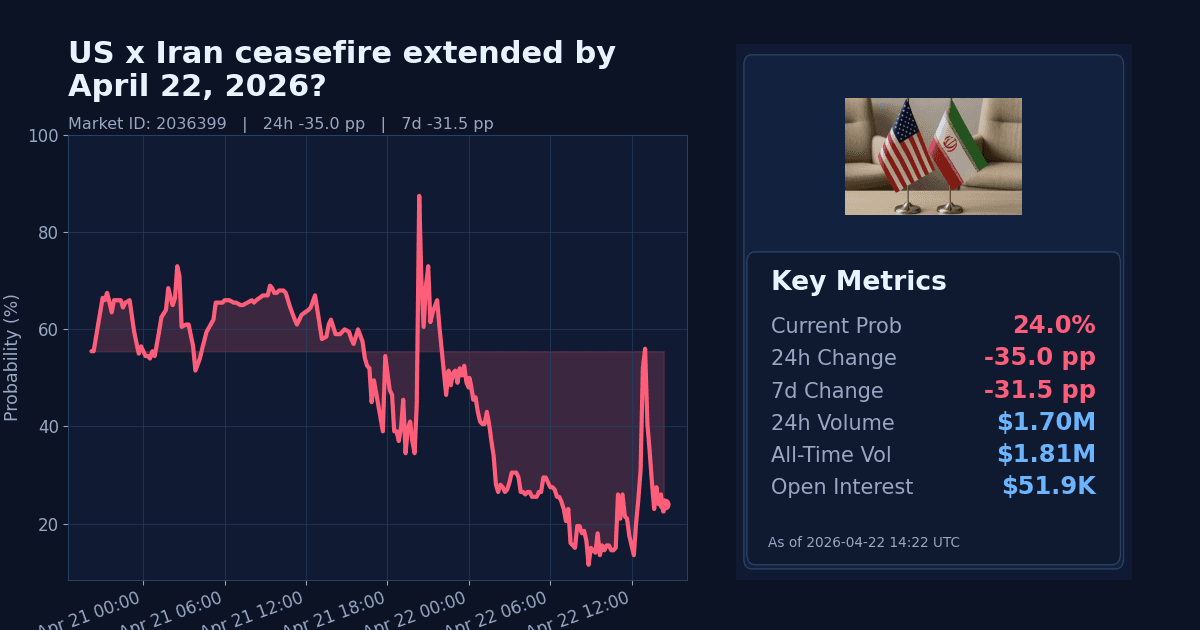
The Polymarket contract “US x Iran ceasefire extended by April 22, 2026?” sold off sharply, with the implied probability dropping 35 percentage points to 24% over the past 24 hours. The move occurred into the contract’s deadline window.
The market opened on April 20, 2026, and resolves by April 22, 2026. It requires a publicly announced, mutually agreed US–Iran extension of the April 7 two‑week ceasefire (or a new agreement that explicitly extends it) by 11:59 PM ET on the resolution date.
Why It Likely Moved
- The repricing appears driven by the lack of clear, public confirmation from both Washington and Tehran that they have agreed to extend the ceasefire, a requirement for a “Yes” resolution under the market’s rules.
- Markets reacted to reporting that two ships were attacked in the Strait of Hormuz and that planned US–Iran talks in Pakistan did not occur, signaling fragile conditions despite headlines that President Trump “indefinitely extended” the ceasefire—without parallel Iranian confirmation cited (NPR, Apr 22).
- Repricing follows an official signal that maritime risks remain elevated: the UK government (Apr 21) announced a two‑day, UK‑hosted multinational conference (over 30 nations) to advance planning to reopen the Strait of Hormuz.
- Policy focus on energy security persists in Europe, with an EU Parliament written question on fuel prices, supply routes, and refinery margins published on Apr 21—highlighting continued concern over supply disruptions (European Parliament).
How Strong the Move Is
This is an extreme one-day repricing. The 24-hour swing of -35pp comes with a 24h z-score of 140.0, indicating an outsized move versus the market’s short-term history.
Over seven days, the contract is down 31.5pp, which the model classifies as normal for its recent volatility profile. Taken together, the tape shows a sharp, deadline-proximate adjustment rather than a long build-up.
Cross-Market Confirmation
- US x Iran permanent peace deal by April 30, 2026: down 14pp (24h) and 17pp (7d), aligning with a broader markdown in near-term diplomatic optimism (market: 21%).
- US x Iran permanent peace deal by May 31, 2026: down 12pp (24h) and 7pp (7d), also confirming directionally weaker confidence (market: 48%).
- US x Iran permanent peace deal by April 24, 2026: trading at 2.8% with no recorded 24h/7d deltas, consistent with low expectations before that nearer-term date.
News & Real-World Context
Two vessels were attacked in the Strait of Hormuz on Apr 22, hours after US and Iranian officials reportedly failed to meet in Pakistan for talks. The identity of the attackers was not immediately clear. The same report noted that President Trump “indefinitely extended” the ceasefire, but did not cite an Iranian counterpart confirmation—relevant because the market requires a mutually agreed extension (NPR, Apr 22).
Official government signaling underscores persistent maritime risk. The UK government (Apr 21, 2026) said the UK and France are leading a two‑day conference with military planners from 30+ nations to advance plans to reopen the Strait of Hormuz. European policymakers are also scrutinizing fuel-price drivers, including oil supply routes and refinery margins, per a European Parliament written question (Apr 21). Separately, European actors are preparing for potential energy shocks tied to the conflict (Ground News, Apr 22).
Macro indicators are consistent with ongoing risk premia: Brent crude trades near $95.13/bbl (up ~0.21% over 7d), while the VIX is at 19.11 (up ~5.17% over 7d), pointing to firmer energy prices and slightly elevated equity volatility.
Bottom Line
Pricing now reflects skepticism that a mutually confirmed US–Iran ceasefire extension will be publicly announced by April 22. Unilateral US signaling, absent Iranian confirmation, appears insufficient under the market’s criteria, especially amid fresh Hormuz incidents and allied planning to secure the waterway. The move looks deadline-driven and event-specific rather than structural.
Market Conditions at Time of Writing
- Current Probability (%): 24.0
- 24h Change (pp): -35.0
- 7d Change (pp): -31.5
- Volume (24h, $): 1,704,802.05
- Open Interest ($): 51,855.75
- Spread (pp): 1.0
- Z-score (24h): 140.0