What Moved the Market
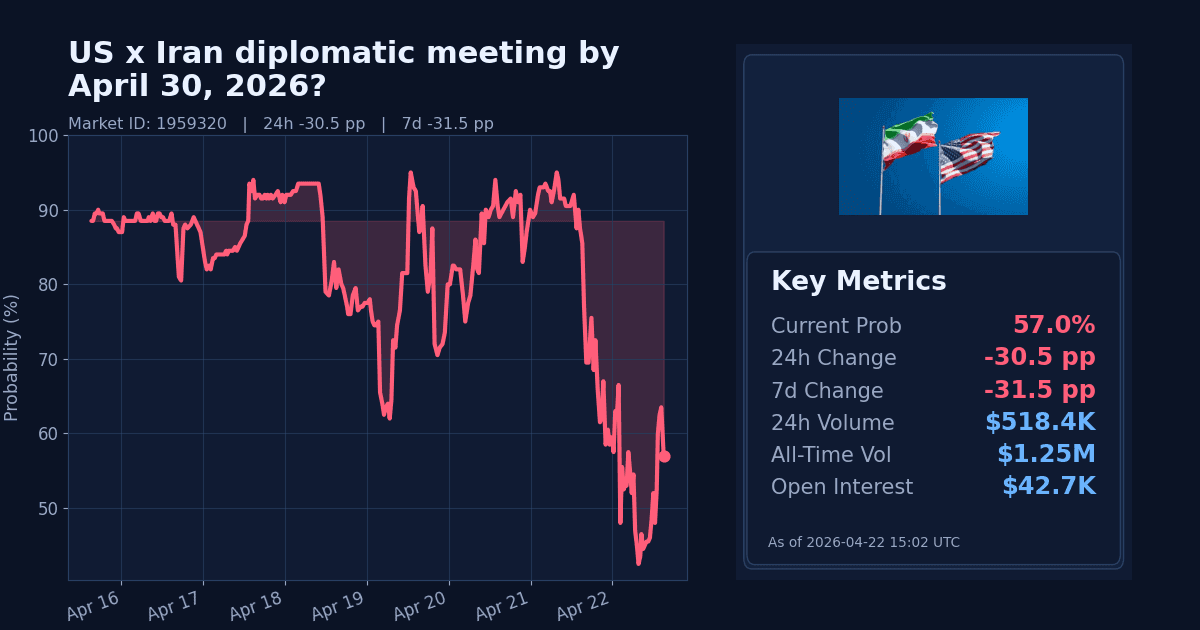
The Polymarket contract on whether the United States and Iran will hold an in‑person, officially acknowledged diplomatic meeting by April 30, 2026 dropped sharply. As of April 22, the market priced the outcome at 57%, down 30.5 percentage points over 24 hours and 31.5 points over seven days.
This repricing occurred within the final stretch of the contract window (market runs through April 30, 2026), marking an extreme single‑day drawdown as traders reassessed the likelihood of a publicly confirmed, in‑person engagement meeting the market’s resolution criteria.
Why It Likely Moved
- Markets reacted to April 22 reporting that U.S. and Iranian officials “failed to meet in Pakistan for talks aimed at ending the war,” with maritime attacks in the Strait of Hormuz occurring hours later, according to NPR. This appears to have reduced confidence in a near‑term, publicly acknowledged in‑person meeting.
- The repricing follows a UK government announcement on April 21 that the UK and France are leading a two‑day conference of military planners from 30+ nations to “reopen the Strait of Hormuz,” signaling coordinated operational focus on maritime security rather than imminent diplomacy (UK government).
- Additional pressure came from a U.S. government announcement on April 20 that U.S. forces disabled a vessel attempting to enter an Iranian port in violation of a blockade, underscoring ongoing enforcement actions (U.S. government). Such developments appear to weigh on expectations for an in‑person meeting under the market’s definition.
- Broader energy‑risk context remains elevated: Brent crude is around $95.9/bbl, up 1.0% over 7 days and 53% over six months, indicating a persistent risk premium tied to Middle East disruptions. This backdrop, alongside Europe’s preparations for potential energy strain linked to the Iran war (Ground News), aligns with reduced near‑term de‑escalation expectations.
How Strong the Move Is
By the market’s own historical volatility, the move is extreme. The 24‑hour z‑score is 106.0 (extreme, down), and the seven‑day z‑score is 112.0 (extreme, down), indicating the decline is well outside typical trading ranges.
With only days left before the April 30 end date, the combination of a ~30.5pp 24‑hour slide and extreme z‑scores classifies this as a sharp, event‑driven selloff rather than routine noise or gradual trend continuation.
Cross-Market Confirmation
- US x Iran diplomatic meeting by April 23, 2026: Down 68.5pp in 24h to 2.4% — a steeper near‑term collapse that confirms broader skepticism about an imminent meeting in adjacent timeframes.
- US x Iran permanent peace deal by April 30, 2026: Down 7.0pp (24h) and 20.0pp (7d) to 21.0% — directionally aligned, suggesting diminished confidence in larger diplomatic outcomes alongside meeting odds.
- US x Iran permanent peace deal by April 24, 2026: At 2.0% with no recorded 24h/7d change — already priced near zero; does not contradict the main move.
News & Real-World Context
On April 22, NPR reported that U.S. and Iranian officials failed to meet in Pakistan for talks aimed at ending the war, and that two ships were attacked in the Strait of Hormuz hours later; identities of attackers and damage details were unclear. The report also noted President Trump had indefinitely extended a ceasefire the same day.
On April 21, the UK government announced a London conference led by the UK and France, bringing together military planners from over 30 nations to advance detailed plans to reopen the Strait of Hormuz. Separately, on April 20, the U.S. government stated that U.S. forces disabled a vessel attempting to enter an Iranian port in violation of a blockade (U.S. government).
In parallel, European officials and firms are preparing for possible energy disruptions tied to the conflict involving Iran, according to an April 22 report (Ground News). This situational backdrop aligns with Brent crude at $95.9/bbl (+1.0% over 7d; +53% over 6m), reflecting an elevated macro risk environment.
Bottom Line
The market’s sharp downward repricing appears driven by the reported failure of planned US–Iran talks and concurrent signals of intensified maritime security planning and enforcement. With the contract ending April 30, traders are marking down the probability of a public, in‑person encounter that meets resolution criteria.
Given the extreme z‑scores and tight time window, this looks like a short‑term, event‑driven shift rather than a structural revaluation beyond the contract horizon.
Market Conditions at Time of Writing
- Current Probability (%): 57.0
- 24h Change (pp): -30.5
- 7d Change (pp): -31.5
- Volume (24h, $): 518,428.71
- Open Interest ($): 42,698.99
- Spread (pp): 1.0
- Z-score (24h): 106.0