What Moved the Market
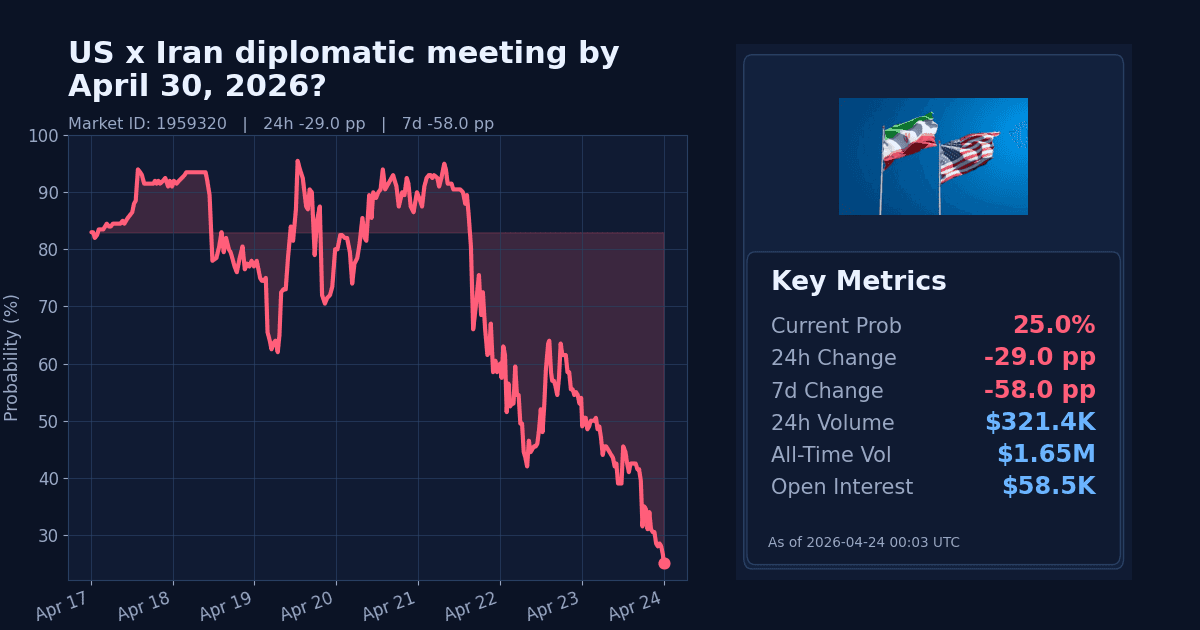
The Polymarket contract on whether the United States and Iran will hold a qualifying in‑person diplomatic meeting by 11:59 PM ET on April 30, 2026 fell sharply. As of April 24, the market priced the outcome at 25%, down 29 percentage points over 24 hours and 58 points over seven days.
The decline registered as an extreme move by the market’s own history: both the 24-hour and 7-day z-scores are flagged “extreme” to the downside.
Why It Likely Moved
- The repricing appears driven by reporting that “U.S.-Iran peace talks [are] still in limbo” following Iran’s seizure of ships in the Strait of Hormuz, with no near-term breakthrough signaled (NPR, Apr 23, 2026).
- Markets reacted to the extension of a U.S.–Iran ceasefire with “no time pressure,” alongside a still-closed Strait of Hormuz and no agreement on Iran’s nuclear program—signals that do not point to an imminent, public in‑person meeting before the April 30 window closes (NPR, Apr 23, 2026).
- The European Parliament’s official activity underscores ongoing maritime tension: on April 22 it published a written question regarding the EU response to “Trump’s threats to shipping through the Strait of Hormuz,” reinforcing a backdrop of strained conditions rather than active de‑escalatory diplomacy (European Parliament, Apr 22, 2026).
- There was no concurrent U.S. government announcement of Iran-focused diplomacy in the cited materials; on April 23 the U.S. State Department spotlighted sanctions targeting transnational fentanyl networks, a separate policy track that offered no offsetting signal of an imminent U.S.–Iran diplomatic meeting (U.S. State Department, Apr 23, 2026).
- Elevated energy prices may have reinforced risk perceptions: WTI crude stands at $96.73/bbl, up 2.15% over 7 days and 56.5% over six months, consistent with sustained shipping and regional risk, even as the latest daily change is flat.
How Strong the Move Is
The 24-hour drop of 29 percentage points is flagged as an extreme downside move (24h z-score: 104.0), pointing to a sharp repricing rather than routine volatility. Over seven days, the cumulative 58-point decline is also categorized as extreme (7d z-score: 6.8731).
Given the imminent April 30, 2026 end date, the move looks like an extreme downside spike into expiry rather than a gradual trend continuation.
Cross-Market Confirmation
- “US x Iran permanent peace deal by April 30, 2026?” fell 9pp over 24h and 34pp over 7d to 8%, confirming broader pessimism on near-term breakthroughs.
- “US x Iran permanent peace deal by May 31, 2026?” declined 12pp over 24h and 26pp over 7d to 31%, aligning directionally with the main move.
- “US x Iran permanent peace deal by June 30, 2026?” dropped 12pp over 24h and 22pp over 7d to 47%, indicating the bearish repricing extends beyond the April window.
News & Real-World Context
NPR reported on April 23 that U.S.–Iran peace talks are “still in limbo” after Iran seized ships in the Strait of Hormuz, and that President Trump said there was “no time pressure” on a ceasefire he has extended indefinitely; the Strait remains closed and there is no agreement on Iran’s nuclear program (NPR, Apr 23, 2026; NPR, Apr 23, 2026).
On the government side, the European Parliament put maritime security on the agenda with a written question on April 22 about the EU response to “Trump’s threats to shipping through the Strait of Hormuz” (European Parliament, Apr 22, 2026) and issued a press kit for the April 23–24 informal EU summit covering foreign affairs and defense priorities (European Parliament, Apr 23, 2026). Separately, on April 23 the U.S. State Department announced sanctions targeting a transnational fentanyl network, an action unrelated to Iran diplomacy in the cited release (U.S. State Department, Apr 23, 2026).
Bottom Line
With days left before the April 30 deadline and reporting that talks are “in limbo” amid a closed Strait of Hormuz and an extended ceasefire with “no time pressure,” traders marked down the chance of a qualifying in‑person U.S.–Iran diplomatic meeting. The move is extreme and appears timing-driven into expiry, with related markets confirming a broader near-term de‑risking of diplomatic outcomes.
Market Conditions at Time of Writing
- Current Probability: 25%
- 24h Change: -29pp
- 7d Change: -58pp
- Volume (24h, $): 321,371.42
- Open Interest ($): 58,515.65
- Spread (pp): 1.0
- Z-score (24h): 104.0