What Moved the Market
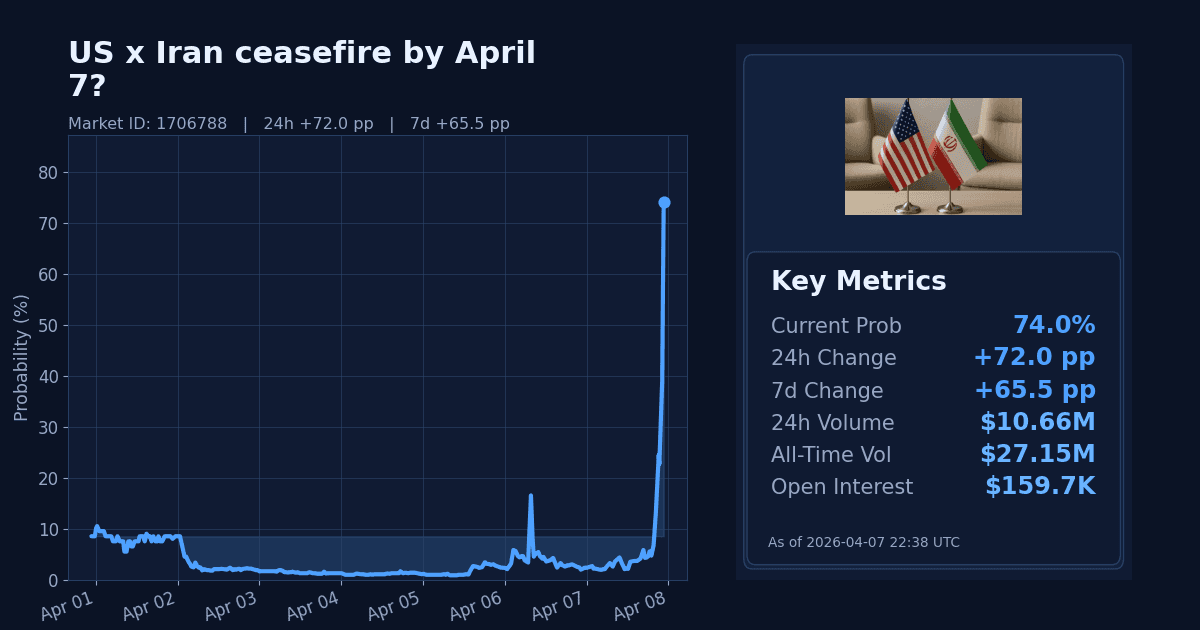
The Polymarket contract “US x Iran ceasefire by April 7?” jumped to a 74% implied probability as of April 7, 22:38 UTC. That is a 72.05 percentage point gain over 24 hours and a 54.05 point surge in the last hour.
Trading activity was intense: 24-hour volume reached $10.66 million, with a tight 1.0 pp spread and open interest at $159.7k. The contract resolves on April 7 at 11:59 PM ET, based on official, public confirmation by both the U.S. and Iran of a mutually agreed halt in hostilities.
Why It Likely Moved
- The repricing appears driven by the explicit time-bound focal point: Trump’s 8 p.m. ET ultimatum to Iran to reopen an oil route, highlighted by NPR and NPR. Markets often cluster around such deadlines for potential announcements.
- Elevated, same-day official signals likely concentrated attention on de-escalation scenarios: the UK government on April 7 expressed regret that a Middle East Security Council resolution “did not pass” in its Explanation of Vote, and the White House held an April 6 press conference lauding a rescue of downed airmen in Iran, per a U.S. government release (war.gov).
- Cross-contract flows reinforced the move: later-dated ceasefire markets also rose sharply (see Cross-Market Confirmation), indicating a broad repricing toward higher ceasefire odds rather than an isolated swing.
- Macro context around energy risk stayed prominent as traders watched Hormuz-related headlines: WTI crude is elevated at $107.78/bbl, up 6.3% over 7 days and 18.6% over 30 days, underscoring sensitivity to shipping disruptions.
How Strong the Move Is
The 24-hour change (+72.05 pp) and 7-day change (+65.5 pp) both register as extreme relative to recent trading history. The 24-hour z-score is 294.2 (extreme), and the 7-day z-score is 4.415 (extreme).
Given the contract’s imminent resolution window (market_end_date: April 7, 11:59 PM ET), this reads as an extreme, deadline-proximate spike rather than a slow-building trend. Price discovery concentrated in the final hours.
Cross-Market Confirmation
- US x Iran ceasefire by April 15: 83% (Δ24h: +64.5 pp; Δ7d: +61.5 pp) — confirms broad upward repricing.
- US x Iran ceasefire by April 30: 77% (Δ24h: +50.0 pp; Δ7d: +44.0 pp) — aligns directionally with strong magnitude.
- US x Iran ceasefire by June 30: 77% (Δ24h: +19.0 pp; Δ7d: +11.0 pp) — smaller, but still supportive of the main move.
News & Real-World Context
- NPR reported an 8 p.m. ET ultimatum from Trump for Iran to reopen the Strait of Hormuz, with continued attacks and “no agreement in sight” earlier on April 7 (NPR; NPR).
- The UK government stated on April 7 that it was “deeply regrettable” a Middle East UNSC resolution failed (UK government). Related reporting noted China and Russia vetoed a French proposal to protect shipping and reopen the Strait of Hormuz (Ground News).
- A U.S. government release on April 6 described a White House press conference praising the rescue of downed airmen in Iran, reflecting active operations and the salience of the theater (war.gov).
- AP highlighted domestic Iranian fear of infrastructure strikes as the deadline nears (AP News) and reviewed legal questions raised by Trump’s Iran-related statements (AP News). AP also noted markets watching for oil-route risks (AP News).
No official U.S.–Iran ceasefire announcement is cited in these sources as of the timestamps provided.
Bottom Line
This is an extreme, deadline-driven repricing concentrated in the final hours of the contract window. Cross-markets corroborate the shift, but official statements and reporting referenced here do not confirm a ceasefire.
Absent formal, bilateral announcements before 11:59 PM ET, resolution risk remains high. The move looks tactical and time-bound rather than structural.
Market Conditions at Time of Writing
- Current Probability: 74%
- 24h Change: +72.05 pp
- 7d Change: +65.5 pp
- Volume (24h): $10,659,441.90
- Open Interest: $159,655.31
- Spread: 1.0 pp
- Z-score (24h): 294.2