What Moved the Market
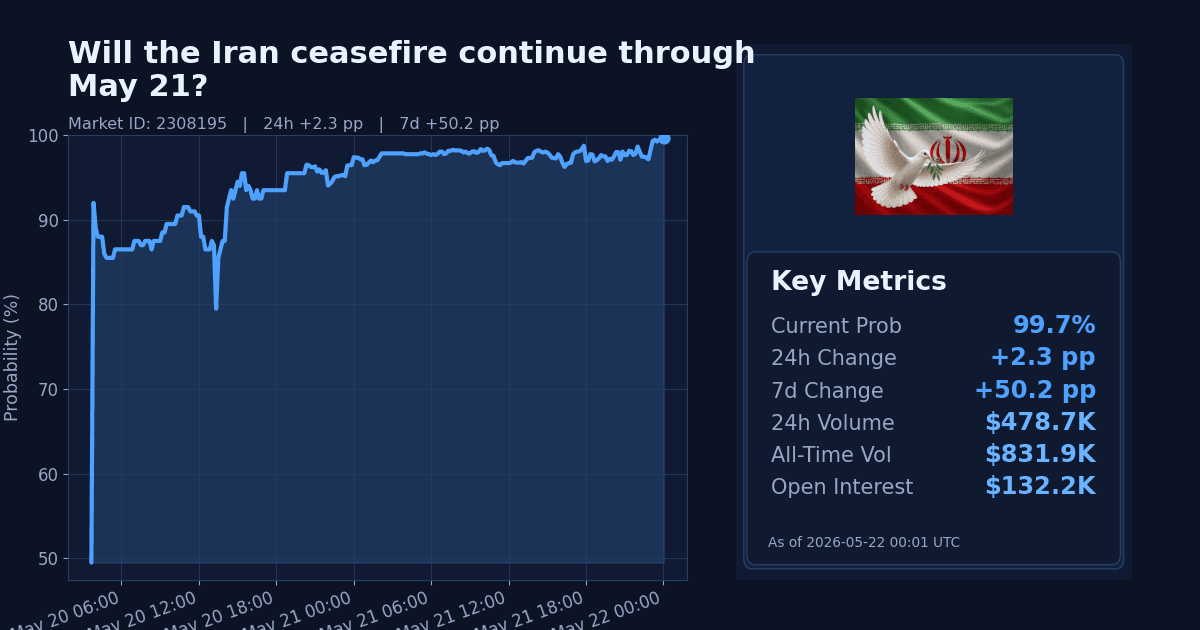
The Polymarket contract on whether the U.S.–Iran ceasefire would hold through May 21 (ET) surged to 99.7% by 00:01 UTC on May 22. That is a 2.3 percentage-point rise over 24 hours and a 50.2pp increase over the past week.
This market resolves “No” only if the U.S. is confirmed to have conducted an aerial bomb, drone, or missile strike impacting Iranian territory before the cutoff, with confirmation allowed up to one calendar day later. As the contract’s window (covering through May 21 ET, with a one-day confirmation buffer) approached completion, pricing shifted decisively toward “Yes.”
Why It Likely Moved
- Repricing appears driven by the lack of mainstream reporting of any qualifying U.S. kinetic action on Iranian soil within the market’s timeframe, reducing perceived headline risk into the confirmation buffer.
- Markets reacted to U.S. congressional focus on oversight and limits regarding potential actions involving Iran, as the House took up another vote on May 21; debate centered on constraining authorities rather than green-lighting operations, according to AP News (May 21).
- The repricing follows official communications emphasizing diplomatic and policy issues over military escalation: the European Parliament adopted resolutions on human rights in Iran on May 21, and the European Commission discussed economic impacts from the regional conflict the same day.
- Macro signals were not flashing acute stress: Brent crude stood at $104.49/bbl (flat on the day, down 1.16% over 7d), and the VIX was 16.76 (down 2.9% over 7d), consistent with markets not pricing a fresh escalation shock.
How Strong the Move Is
The 24-hour move is classified as an extreme spike (z-score 11.8), indicating a sharp, late-window repricing as traders marked down the probability of a qualifying U.S. strike being reported in time.
Over seven days, the probability increase is large (+50.2pp), but the 7d z-metric is “normal,” suggesting the most pronounced shift concentrated in the final 24 hours rather than a steady week-long climb.
Cross-Market Confirmation
- Adjacent contract (ceasefire through May 22) rose to 94.0%, up 4.0pp in 24h, aligning with the main market’s direction and implying continuity risk is seen as low into the next day.
- Longer-horizon outcomes diverged: “US x Iran permanent peace deal by May 31, 2026?” fell 3.0pp to 18.0% over 24h, and “US x Iran permanent peace deal by May 22, 2026?” fell 2.4pp to 3.9% over 24h. This supports the interpretation that traders view the current calm as short-term, not structural.
News & Real-World Context
- On May 21, the U.S. House took up another vote tied to potential U.S. military action involving Iran, with Democrats seeking a breakthrough on congressional oversight and limits, per AP News (May 21).
- The European Parliament adopted resolutions addressing human rights in Iran on May 21, an official signal focused on rights and diplomacy rather than immediate military measures.
- The European Commission on May 21 linked weaker EU growth to an energy shock from the Middle East conflict; separately, it published an overview (May 20) of national emergency measures to cushion consumers and industry during the conflict (Commission).
- Energy markets show adaptation rather than acute stress: reporting noted rerouted flows and inventories helping temper price spikes despite disruptions, per NPR (May 21).
Bottom Line
Pricing has effectively locked in a “Yes” outcome as the May 21 (ET) cutoff passes without credible reports of a qualifying U.S. strike on Iranian territory. Cross-market moves and macro signals point to a short-term stabilization rather than a durable détente.
Market Conditions at Time of Writing
- Current Probability (%): 99.7
- 24h Change (pp): 2.3
- 7d Change (pp): 50.2
- Volume (24h, $): 478,693.9
- Open Interest ($): 132,190.79
- Spread (pp): 0.4
- Z-score (24h): 11.8