What Moved the Market
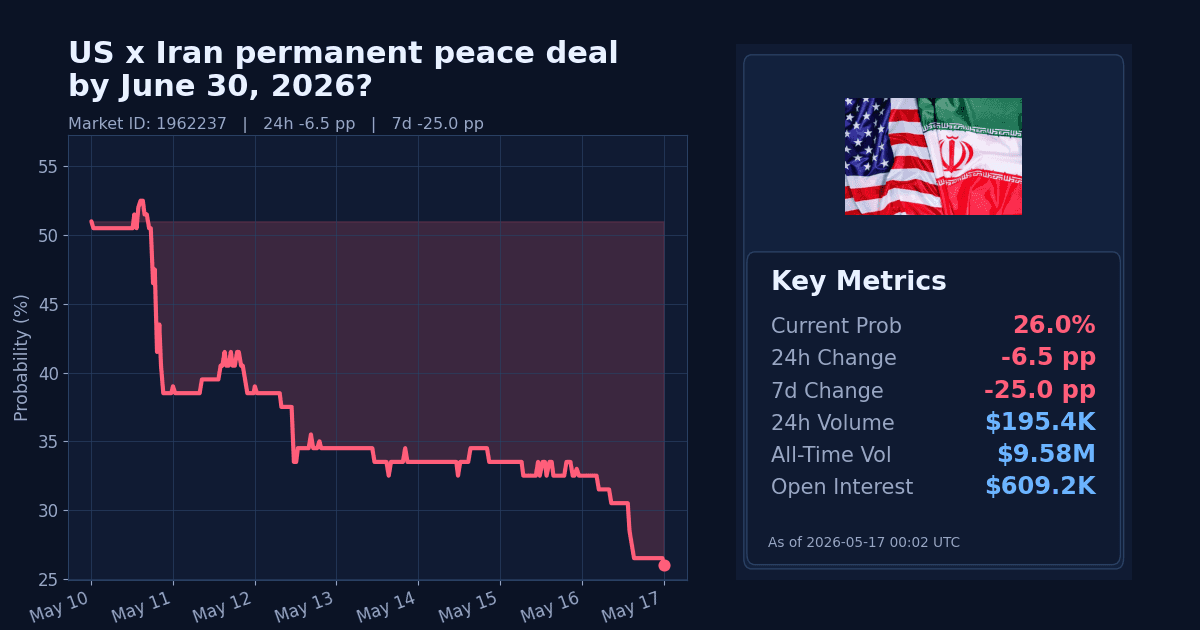
The Polymarket contract “US x Iran permanent peace deal by June 30, 2026?” fell to 26%, down 6.5 percentage points over the past 24 hours and 25 points over the past week. The move marks a sharp repricing lower in the probability of a qualifying agreement by the deadline.
Per the market rules, resolution to “Yes” requires both governments to sign or clearly confirm a permanent end to military hostilities by 11:59 PM ET on June 30, 2026. The trading window began on April 12, 2026 and runs until the June 30, 2026 market close.
Why It Likely Moved
- Repricing follows a May 14 statement from the U.S. military: the CENTCOM commander said Operation Epic Fury “crippled Iran’s military and its ability to project power,” signaling an ongoing conflict posture rather than de‑escalation, according to the U.S. War Department’s release (War.gov, May 14).
- Markets reacted to diplomatic headwinds highlighted by Iran’s top diplomat, who said on May 15 that a lack of trust is impeding talks to end the war with the United States (AP News, May 15).
- Additional defense signaling came via a multinational statement backing a military mission in the Strait of Hormuz, indicating sustained coalition security operations in the area (UK government, May 12 statement published May 14).
- Macro context appears risk‑aware: Brent crude is at $109.26/bbl, up 7.9% over the past week, while the VIX is up 7.2% over the same period — conditions often associated with elevated geopolitical risk premia.
How Strong the Move Is
The 24-hour decline registers an extreme z‑score of 24.0, and the 7‑day slide also screens as extreme. By these measures, the selloff is well outside the market’s recent trading range.
Given the concurrent weeklong drawdown (−25pp), this looks like a sharp, trend‑continuation move rather than routine noise. The tightening 1.0pp spread alongside elevated 24h volume supports the view that this repricing was actively traded.
Cross-Market Confirmation
- US x Iran permanent peace by May 31, 2026: 9% (−2pp 24h, −19pp 7d) — confirms broader bearish repricing of near‑term peace probabilities.
- Iran closes its airspace by May 24: 23% (−4.5pp 24h) — a decline in immediate escalation risk diverges from the drop in peace‑deal odds, suggesting mixed near‑term security signals.
- Iran presidential election by June 30: 2.5% (+0.15pp 24h, +0.1pp 7d) — essentially neutral to this thesis and not confirming the peace‑deal move.
News & Real-World Context
On May 14, the U.S. War Department published remarks by the CENTCOM commander stating that Operation Epic Fury had “crippled” Iran’s military and its power‑projection capabilities, framing a continued U.S. operational posture in the region (War.gov, May 14). On the same day, the UK government released a joint statement from a broad coalition supporting a multinational military mission for the Strait of Hormuz, underscoring ongoing maritime security coordination (UK government, May 14).
Diplomatic prospects were described as constrained on May 15, when Iran’s top diplomat said that lack of trust is hindering talks to end the war with the United States (AP News, May 15). On May 16, the USS Ford’s return from an 11‑month deployment that supported U.S. operations connected to the conflict involving Iran was reported, marking a transition in U.S. naval deployments rather than a formal de‑escalation step (AP News, May 16).
Bottom Line
Markets sharply marked down the probability of a permanent US–Iran peace agreement before June 30, 2026, amid official signals of continued hostilities and statements highlighting barriers to talks. The move appears structural over the past week and is corroborated by related markets pricing lower near‑term peace odds. Absent clear, coordinated announcements from both governments, traders are discounting a qualifying deal within the contract window.
Market Conditions at Time of Writing
- Current Probability: 26.0%
- 24h Change: −6.5pp
- 7d Change: −25.0pp
- Volume (24h, $): 195,382.95
- Open Interest ($): 609,165.94
- Spread (pp): 1.0
- Z-score (24h): 24.0