What Moved the Market
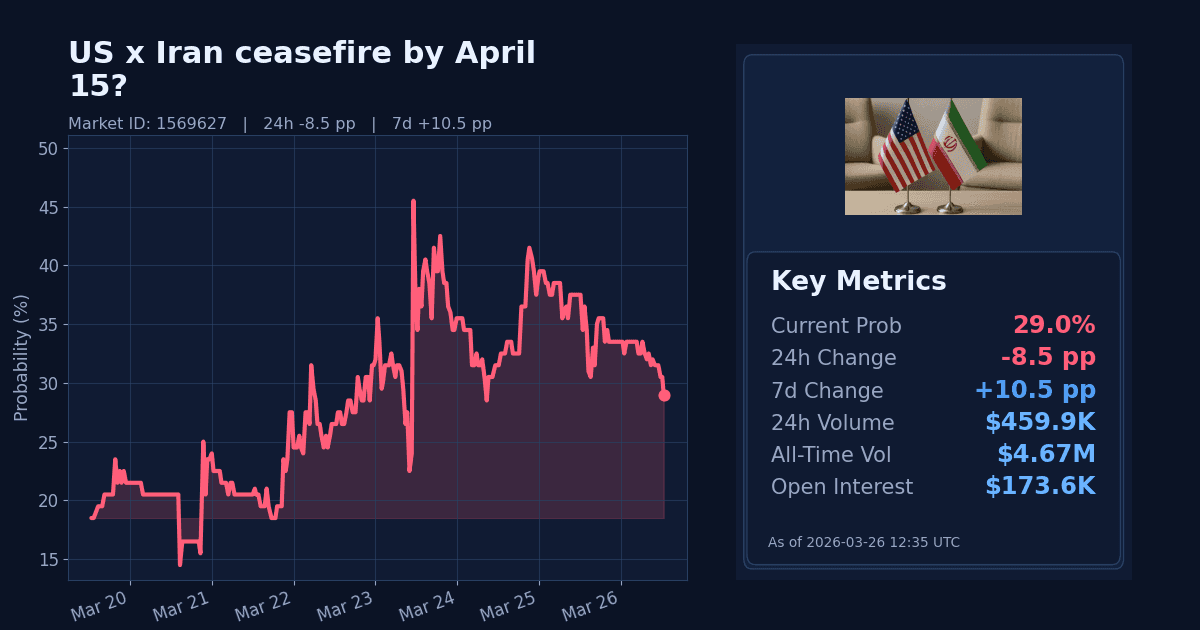
The Polymarket contract asking whether the United States and Iran will reach an official, mutually announced ceasefire by 11:59 PM ET on April 15, 2026, declined to 29%.
Over the last 24 hours, price fell 8.5 percentage points to 29%. Despite the day-over-day slide, the contract remains 10.5 percentage points higher than a week ago.
Why It Likely Moved
- Repricing appears driven by reporting that Iran and the United States have hardened their positions while Tehran maintains control over the Strait of Hormuz, signaling limited near‑term de‑escalation prospects (AP News, March 26) (AP News).
- Markets reacted to indications that Iran rejected a U.S. peace proposal and tabled a counter‑proposal, suggesting continued negotiation gaps ahead of the April 15 window (NPR, March 26) (NPR).
- The move also aligns with reports of Iranian steps affecting maritime transit — including a draft law to formalize tolls on the Strait of Hormuz — which reinforce a posture not consistent with imminent bilateral de‑escalation (Ground News, March 26) (Ground News).
- Official statements at the UN Human Rights Council by the UK government on March 25 condemned recent Iranian aggression against Gulf states, providing an authoritative signal of ongoing tensions rather than de‑escalation (UK government, March 25; UK government, March 25).
- Repricing follows broader risk cues: Brent crude is at $101.38/bbl (−6.7% over 7d but +43.3% over 30d), and the VIX is 27.25 (+13.3% over 7d), consistent with elevated geopolitical risk premia affecting near‑term ceasefire odds.
How Strong the Move Is
The 24‑hour decline of 8.5pp is a notable day-over-day dip but, by z‑score, the move is classified as normal relative to recent volatility. That points to a repricing within the market’s usual trading range rather than a shock.
On a 7‑day basis, the contract is still up 10.5pp, indicating the latest decline is a pullback rather than a full reversal of last week’s gains. With both 24h and 7d z‑scores reading “normal,” the current move looks like a standard fluctuation rather than an extreme spike.
Cross-Market Confirmation
- US × Iran ceasefire by April 30: trading around 45%. No 24h/7d deltas available; the higher level for the later deadline suggests time‑value optimism but offers no fresh confirmation of today’s Apr 15 pullback.
- US × Iran ceasefire by March 31: trading near 12%. Deltas unavailable; the low level aligns with skepticism for very near‑term agreement but does not confirm the latest 24h change.
- US forces enter Iran by March 31: at ~24% with −0.5pp (24h) and −1.0pp (7d). Slightly lower near‑term escalation risk diverges from today’s ceasefire‑probability drop, offering mixed cross‑signals.
News & Real-World Context
Reporting on March 26 highlighted uncertainty around de‑escalation, with Asian equities mostly lower and oil prices firmer amid Iran‑related risk concerns (AP News). Coverage the same day described hardening U.S. and Iranian positions and Tehran’s grip on the Strait of Hormuz (AP News). Additional reports noted Iran’s draft law to formalize transit tolls in the strait (Ground News) and allegations of Russian drone supplies to Iran (Reuters via Ground News, March 26). NPR on March 26 reported Iran’s rejection of a U.S. plan and a counter‑proposal, alongside intensified regional exchanges (NPR; NPR). The OECD on March 26 flagged that the global outlook has weakened amid an energy shock and rising geopolitical risks, underlining the broader macro backdrop (OECD).
Government signals remain a primary reference point: on March 25, the UK government delivered formal statements at UN Human Rights Council 61 condemning recent Iranian military aggression in the Gulf, emphasizing a deteriorated security context (UK government; UK government).
Bottom Line
Traders appear to be discounting the likelihood of a formally announced, mutual US–Iran ceasefire within the April 15 window amid reports of hardened positions and official censure signals. The 24h move looks like a normal pullback rather than an extreme shift, but the news flow tilts against near‑term agreement odds.
Market Conditions at Time of Writing
- Current Probability (%): 29.0
- 24h Change (pp): -8.5
- 7d Change (pp): +10.5
- Volume (24h, $): 459,898.59
- Open Interest ($): 173,553.35
- Spread (pp): 1.0
- Z-score (24h): 0.0 (normal)