What Moved the Market
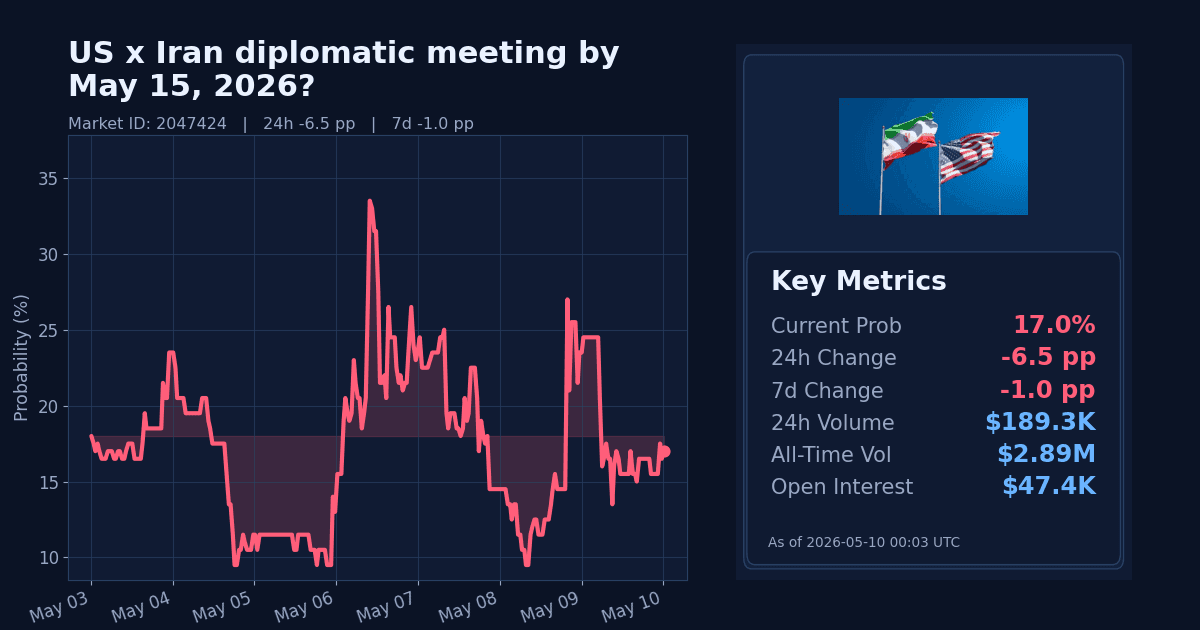
The Polymarket contract on whether the United States and Iran will hold a qualifying in‑person diplomatic meeting by 11:59 PM ET on May 15, 2026 fell 6.5 percentage points over the past 24 hours to 17%. The bid-ask spread remains tight at 1 pp, with $189k in 24h volume and $47k open interest.
The decline comes within a narrow window to expiry (contract window: Apr 21–May 15, 2026) and follows an extreme 24h z-score move to the downside.
Why It Likely Moved
- The US government emphasized military enforcement and sanctions, not near-term face-to-face engagement. In May 6 remarks, the US State Department outlined the conclusion of “Operation Epic Fury,” the launch of “Project Freedom” to secure shipping, stepped-up sanctions enforcement, and only a conditional “diplomatic path” with no announced meeting dates or venues US State Department (May 6, 2026).
- Markets reacted to indications that Washington is still awaiting a reply from Tehran amid a fragile ceasefire, suggesting talks have not yet progressed to a publicly acknowledged, in-person format required by this market AP News (May 9, 2026).
- Repricing follows signals of ongoing mediation and allied coordination—but not a US–Iran meeting. A report of a meeting between US figures and a Qatari mediator underscores indirect channels, yet does not constitute a qualifying in-person US–Iran encounter Axios (May 9, 2026).
- The European Parliament’s written question on EU engagement in US–Iran ceasefire efforts highlights process-level involvement without confirming a scheduled in-person meeting before the May 15 deadline European Parliament (May 7, 2026).
How Strong the Move Is
The 24-hour drop of 6.5 percentage points is classified as extreme by the market’s 24h z-score (28.0), signaling an outsized one-day repricing relative to recent trading history. The 7-day change is modest at -1.0 pp, but the platform still flags the weekly move as extreme versus typical variance.
Taken together, this looks like a sharp, event-driven markdown rather than a steady trend. With the contract expiring on May 15, the timing element likely amplified sensitivity to the lack of any publicly acknowledged in-person meeting.
Cross-Market Confirmation
- Related “US x Iran permanent peace deal” markets also declined over 24h: -2.2 pp to 16.3% and -7.0 pp to 28.0%, aligning with lower near-term diplomacy odds (24h confirmation).
- On a 7d basis, those same markets are higher (+11.85 pp and +11.0 pp), which diverges from the weekly drift here and suggests broader optimism on eventual outcomes that has not translated into a pre–May 15 meeting.
- A near-term “permanent peace deal by May 11, 2026” market is down 1.95 pp to 3.5% over 24h, reinforcing skepticism about immediate breakthroughs.
News & Real-World Context
- The US stated on May 6 that major operations against Iran’s conventional capabilities have concluded and that “Project Freedom” aims to secure shipping lanes, alongside intensified sanctions enforcement. Officials referenced a potential “diplomatic path,” but provided no dates for direct, in-person talks US State Department (May 6, 2026).
- On May 9, AP reported a fragile ceasefire holding while US officials await Iran’s response—an indication that any negotiation milestone has not yet advanced to a publicly acknowledged, in-person meeting AP News (May 9, 2026).
- Axios on May 9 reported a meeting in Miami between US figures and a Qatari mediator regarding a potential Iran deal, underscoring active mediation but not a direct US–Iran in-person meeting Axios (May 9, 2026).
- The European Parliament on May 7 queried the Commission about EU engagement in US–Iran ceasefire negotiations, signaling institutional attention rather than a confirmed bilateral meeting European Parliament (May 7, 2026). Separately, the European Commission convened its Oil Coordination Group on May 7 to address jet fuel supply amid the ongoing Middle East conflict, reflecting continued disruption risks European Commission (May 7, 2026).
Macro backdrop: Brent crude is $101.29/bbl, down 6.36% over 7 days, suggesting some easing in energy risk premium even as policy statements and timelines weigh specifically on this meeting contract.
Bottom Line
With days left until the May 15 deadline and no publicly acknowledged in-person meeting, traders marked down odds sharply. Government statements prioritize enforcement and sanctions while referencing a possible diplomatic track without concrete scheduling.
This appears to be a short-term, timing-driven repricing rather than a structural shift in longer-run diplomacy expectations.
Market Conditions at Time of Writing
- Current Probability (%): 17.0
- 24h Change (pp): -6.5
- 7d Change (pp): -1.0
- Volume (24h, $): 189,261.31
- Open Interest ($): 47,448.43
- Spread (pp): 1.0
- Z-score (24h): 28.0