What Moved the Market
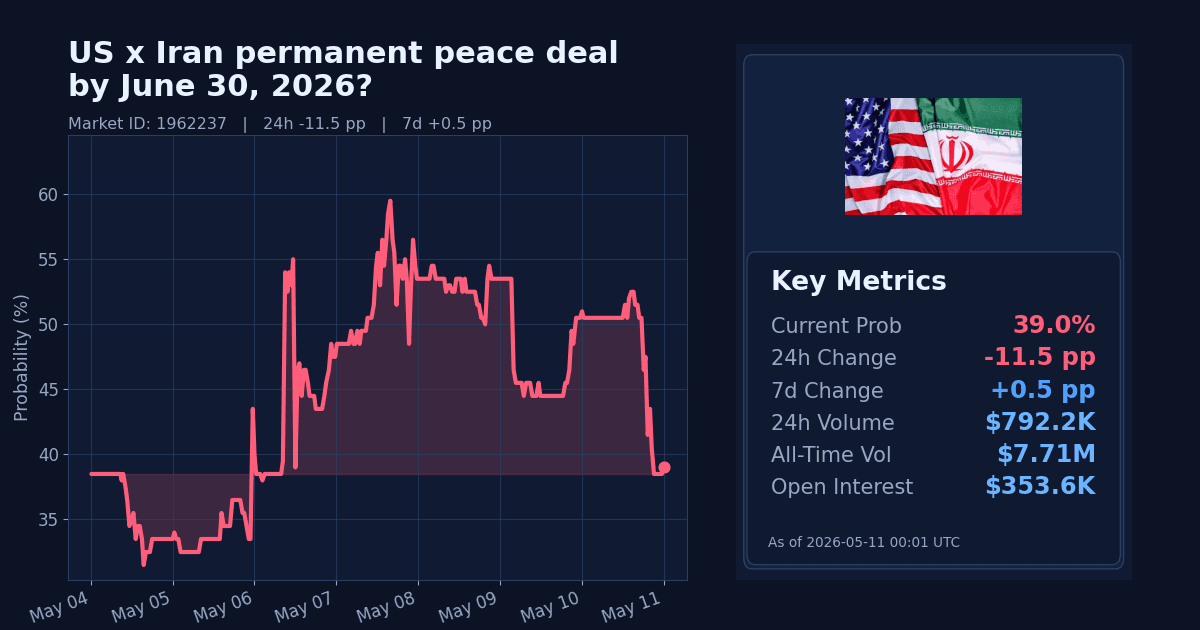
The Polymarket contract asking whether the United States and Iran will agree to a “permanent peace deal” by 11:59 PM ET on June 30, 2026 fell 11.5 percentage points over the past 24 hours, to 39% as of May 11, 2026. The market launched on April 12, 2026 and closes on June 30, 2026.
This is an extreme one-day downside move by the market’s own trading-history standard, with heavy 24h volume.
Why It Likely Moved
- The repricing appears driven by reporting on May 10 that President Trump rejected Iran’s latest reply to a U.S. ceasefire proposal, signaling stalled diplomacy rather than convergence toward a lasting accord, according to NPR.
- Markets likely reacted to an incident the same day in which a cargo ship caught fire after being hit off Qatar’s coast, testing the durability of an Iran-related ceasefire and highlighting persistent risk, per NPR.
- The U.S. posture outlined by the State Department on May 6—ending “Operation Epic Fury,” initiating “Project Freedom” to escort shipping, and intensifying sanctions enforcement—signals ongoing coercive pressure rather than imminent peace terms, as stated by Secretary of State Marco Rubio (U.S. State Department, May 6, 2026).
- The European Parliament’s May 7 written question on EU engagement in U.S.–Iran ceasefire talks indicates interest but provides no sign of a concluded agreement, reinforcing uncertainty around a comprehensive peace deal within the contract window (European Parliament, May 7, 2026).
- Broader signaling that the “Iran war” remains a live factor shaping top-level diplomacy—such as coverage ahead of President Trump’s China trip—frames the environment as unsettled rather than post-conflict, per AP News on May 10.
How Strong the Move Is
The 24-hour drop of 11.5 percentage points carries an extreme 24h z-score (48.0), pointing to an outsized, event-driven repricing. By contrast, the 7-day change is nearly flat (+0.5pp) and judged “normal,” suggesting the decline is a sharp, single-session adjustment rather than a weeklong trend.
Overall, this looks like a significant, news-triggered spike lower rather than a sustained reversal—at least so far.
Cross-Market Confirmation
- “US x Iran permanent peace deal by May 31, 2026” fell 9.0pp in 24h to 20.0% and is down 3.0pp over 7d, confirming broader near-term skepticism.
- “US x Iran permanent peace deal by May 13, 2026” dropped 7.65pp in 24h to 1.9% (7d N/A), aligning with the same bearish impulse in ultra-near maturities.
- “US x Iran permanent peace deal by May 15, 2026” declined 11.5pp in 24h to 5.0%, while up 0.35pp over 7d—again showing a synchronized 24h downturn across expiries.
Taken together, related markets moved down in tandem over 24h, reinforcing the signal of a cross-curve repricing lower.
News & Real-World Context
On May 10, NPR reported that President Trump rejected Iran’s latest response to a U.S. ceasefire proposal relayed via Pakistani mediators, underscoring friction in efforts to halt hostilities. The same day, NPR reported a cargo ship fire after being struck off Qatar’s coast, raising concerns about the ceasefire’s resilience.
In a May 6 press briefing, the U.S. State Department outlined that “Operation Epic Fury” had concluded while “Project Freedom” would provide a defensive umbrella for commercial shipping through the Strait of Hormuz and that sanctions enforcement on Iran is being stepped up. Secretary Rubio also linked any diplomatic path to clear topics and concessions, including nuclear-related issues.
Separately, the European Parliament on May 7 published a written question on EU engagement in U.S.–Iran ceasefire negotiations, signaling institutional attention but no definitive outcome.
Macro context shows WTI crude oil at $98.38 per barrel, down 3.5% over the past week as of May 10, 2026, while roughly flat on the day (source: Yahoo Finance). This energy-price backdrop offers limited confirmation of the contract-specific repricing but indicates no concurrent weeklong surge in oil despite the shipping-risk headlines.
Bottom Line
The market sharply marked down the likelihood of a permanent US–Iran peace deal by June 30, 2026 after reports of a rejected Iranian reply and fresh signs of fragile conditions at sea, alongside firm U.S. policy signals. With fewer than two months left in the contract window, the path to a qualifying agreement remains uncertain and appears event-dependent rather than structural at this stage.
Market Conditions at Time of Writing
- Current Probability: 39.0%
- 24h Change: -11.5pp
- 7d Change: +0.5pp
- Volume (24h): $792,188.59
- Open Interest: $353,604.75
- Spread: 1.0pp
- Z-score (24h): 48.0