What Moved the Market
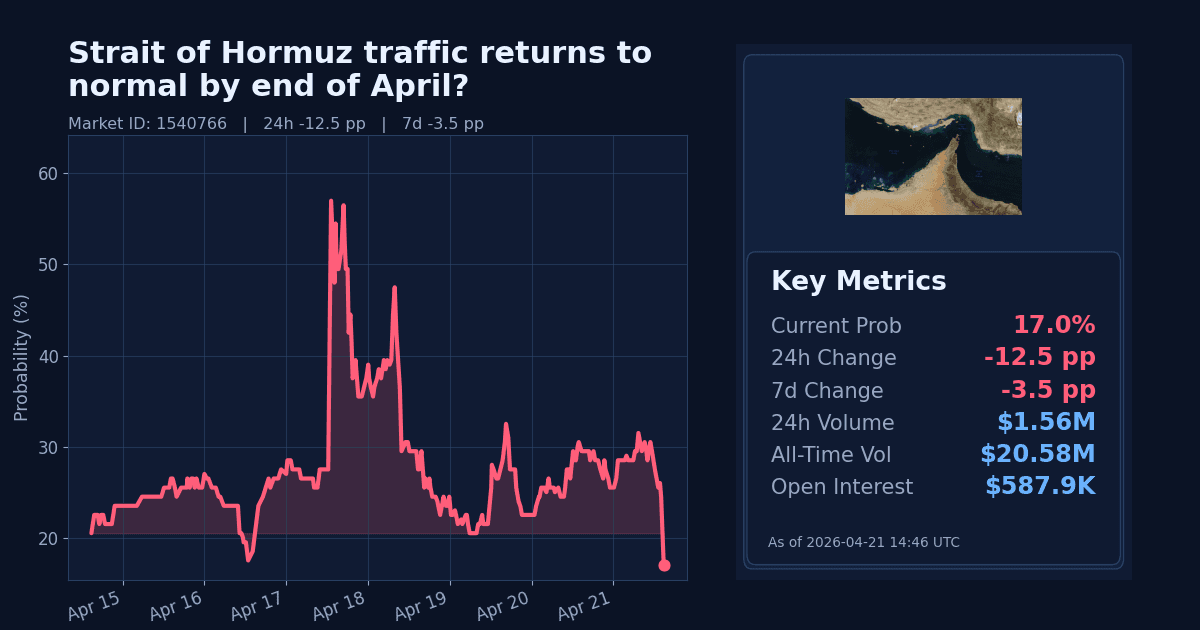
The market "Strait of Hormuz traffic returns to normal by end of April?" fell sharply over the past 24 hours. Implied probability declined 12.5 percentage points to 17.0% as of April 21, with a 9.0pp drop in the last hour.
This contract resolves Yes if IMF Portwatch reports a 7‑day moving average of Strait of Hormuz transit calls at or above 60 on any date from market creation (March 9, 2026) through April 30, 2026. The repricing comes late in that window.
Why It Likely Moved
- Repricing appears driven by a US government announcement on April 20 that US forces disabled a vessel attempting to enter an Iranian port in violation of a blockade, signaling continued maritime enforcement that could impede a near‑term return to normal traffic levels (the U.S. government announced).
- Markets reacted to reporting that extending the US–Iran ceasefire remains unresolved, with maritime transit rules and the Strait of Hormuz cited among key sticking points ahead of the deadline (NPR, April 21).
- The move also appears consistent with analysis that shipping risks around the Strait of Hormuz are keeping fuel prices elevated, implying no quick normalization in flows even if broader hostilities abate (Axios, April 21).
- Additional high‑level diplomacy, such as the Chinese Foreign Ministry’s April 20 readout of President Xi’s call with Saudi Arabia’s Crown Prince, has not produced concrete operational changes for transit conditions in the Strait (China MFA).
How Strong the Move Is
By the platform’s measure, the 24‑hour move is extreme relative to recent trading (24h z‑score: 48.0), indicating a sharp, outsized one‑day repricing. The 7‑day shift is modest (down 3.5pp) and labeled normal, suggesting the drop is a sudden adjustment rather than the continuation of a week‑long trend.
With only days remaining in the contract window, this looks like a decisive, late‑stage markdown rather than incremental drift.
Cross-Market Confirmation
- US × Iran ceasefire extended by April 21, 2026? fell 49.0pp in 24h (to 16.0) and 53.5pp in 7d, aligning with reduced expectations of near‑term de‑escalation that would facilitate traffic normalization.
- US × Iran permanent peace deal by April 30, 2026? down 11.5pp in 24h and 1.5pp in 7d, also directionally consistent with lower odds of a rapid maritime reset.
- Kharg Island no longer under Iranian control by April 30? up 2.25pp in 24h (to 8.1) and slightly down 0.35pp over 7d; the 24h uptick points to lingering conflict risk, reinforcing the main market’s downturn.
News & Real-World Context
- On April 20, the United States reported that its forces “disabled” an Iranian‑flagged vessel attempting to enter an Iranian port in violation of a blockade, underscoring active enforcement operations in adjacent waters (the U.S. government stated, Apr 20, 2026).
- On April 21, NPR reported that a ceasefire deadline involving the United States and Iran is approaching with unresolved issues, including inspections and maritime transit rules tied to the Strait of Hormuz, leaving the extension uncertain (NPR; NPR).
- Axios on April 21 highlighted expectations for sustained higher gasoline prices in 2026 due to crude flow disruptions and shipping risks around the Strait of Hormuz, indicating that market participants do not foresee rapid normalization of maritime conditions (Axios).
- In parallel policy and diplomatic context, the Chinese Foreign Ministry noted an April 20 call between President Xi and Saudi Arabia’s Crown Prince (China MFA), while EU bodies flagged fuel‑price pressures in separate communications (European Parliament, Apr 20; European Commission, Apr 21).
Macro backdrop: Brent crude is $91.18/bbl, down 3.8% over 7 days and 18.7% over 30 days, indicating a recent easing in benchmark prices even as shipping‑specific risks persist. Broader risk sentiment is steady to slightly higher volatility, with the VIX at 19.05, up 3.8% over 7 days.
Bottom Line
The market sharply marked down the probability that Strait of Hormuz traffic will meet the “normal” threshold before April 30, reflecting official signals of continued maritime enforcement and unresolved ceasefire terms. The move looks like an extreme one‑day repricing rather than an extended trend.
Absent clear operational de‑escalation, traders appear to view the remaining time in the resolution window as insufficient for a 7‑day average transit rebound to the qualifying level.
Market Conditions at Time of Writing
- Current Probability: 17.0%
- 24h Change: -12.5pp
- 7d Change: -3.5pp
- Volume (24h, $): 1,560,880.25
- Open Interest ($): 587,853.85
- Spread (pp): 1.0
- Z-score (24h): 48.0 (extreme)